New here? Just sign up with Google — your account includes Matilda, our gift book, forever.
The Trumpet of the Swan · Garden Heights
Part 7
for The Trumpet of the Swan · Part 7 · Chapters 18–19
8 Parts40 min
What Happens in Part 7
Sam Beaver answers the telegram — older now, but the same boy who kept still by a Canadian pond — and walks into the Philadelphia Zoo to negotiate. The zoo’s claim is real: storm-blown birds on Bird Lake are traditionally kept. So Sam brokers a bargain worthy of the book: Serena flies free with Louis, and in exchange Louis pledges that if he and Serena ever have more cygnets than they need, the zoo may have one to raise. Freedom, purchased with a promise — the family trade, again. Then comes the quiet chapter that gives the book its conscience: a talk about money. Louis’s moneybag now holds more than the debt; he and Sam reckon the accounts — what the storekeeper is owed for the trumpet and the smashed storefront, what the journey home will take — and the plan is set: the cob himself must fly to Billings and repay, beak held high, the debt he took on two years of chapters ago. The ledger’s last page is finally open.
Freedom bought with promises, and the quiet money chapter
Cross-Curricular
What a debt really is
Chapter Summary
Ch.
What happens
18–19
Freedom, and a Talk About Money — Sam negotiates Serena’s release: she flies free, and Louis pledges a spare cygnet to the zoo someday; then Sam and Louis reckon the moneybag against the old debt, and the cob is chosen to fly the repayment to Billings.
Part 1
Vocabulary
Study 10 key words from Chapters 18–19, then answer each question.
🧠Knowledge Bank · Why Swans Choose One Mate
Lexicology · Why Swans Choose One Mate
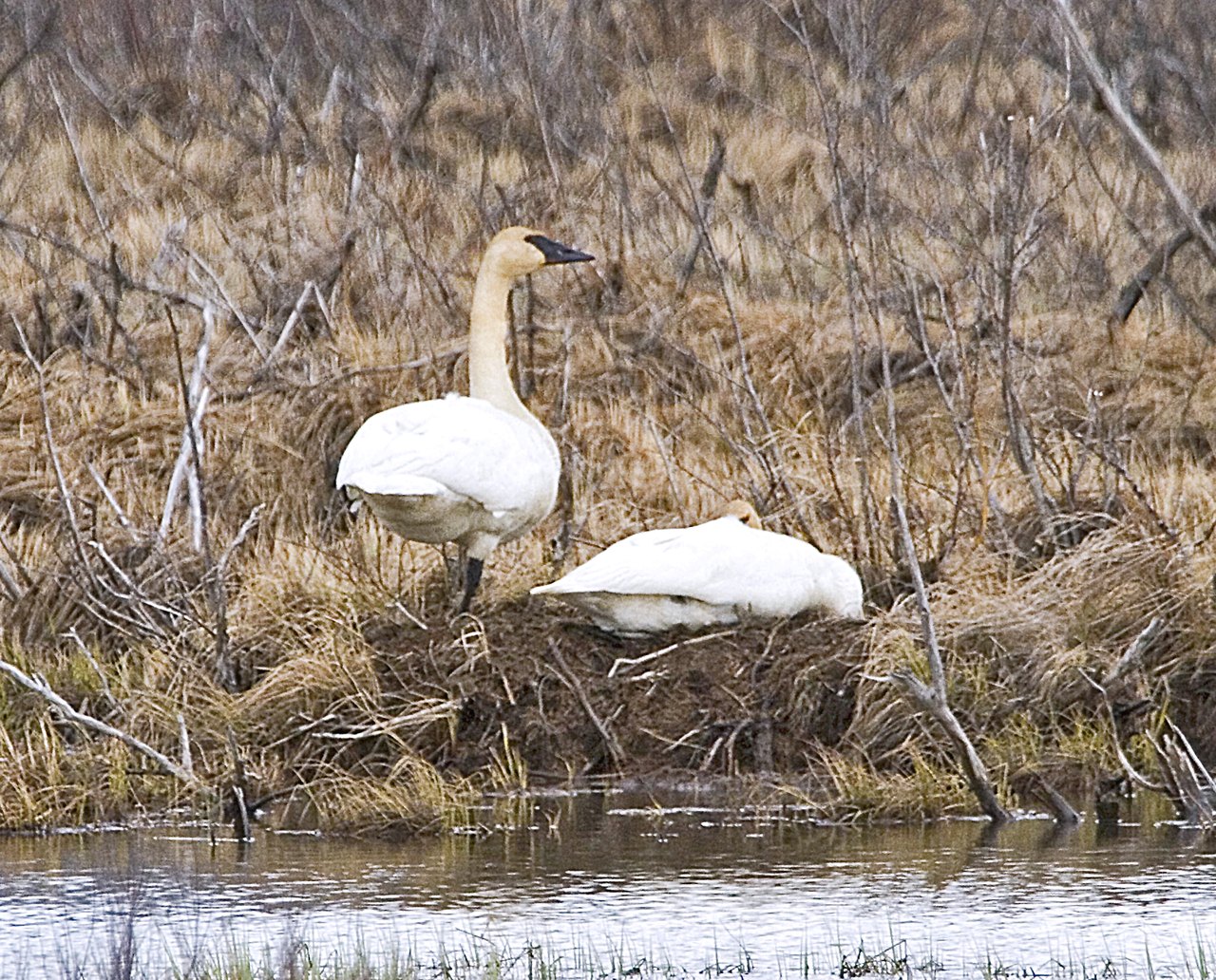
The urgency of these bargaining chapters rests on a real and beautiful fact of swan biology: trumpeter swans mate for life. Once two swans form a bond, they usually stay together year after year, raising cygnets, migrating, and defending their nest as a devoted pair. Scientists call this lasting partnership a pair bond, and in swans it is unusually strong — so strong that swans have become a human symbol of faithful love the world over. For a swan, choosing a mate is not a passing fancy but a decision meant to last a lifetime, which is exactly why he is willing to work, earn, and bargain so hard to be with her. Understanding this deep, lifelong loyalty helps you feel the true weight behind every deal Louis is so desperate to strike.
Visual AidA pair that stays a pair
Photograph of a pair of trumpeter swans at their nest. The Knowledge Bank explains that trumpeter swans mate for life, that once two swans form a bond they usually stay together year after year raising cygnets and defending the nest as a devoted pair, and that scientists call this lasting partnership a pair bond. Notice that one bird is up and one is down. That division of the watch is what the bond looks like on an ordinary morning.
Pair of trumpeter swans at a nest; U.S. Fish and Wildlife Service. Source: Wikimedia Commons, public domain.
bargainn.Ch.18–19
An agreement where each side gives something
“Sam’s bargain traded a promise for freedom.”
pledgev.Ch.18–19
To promise formally and seriously
“Louis pledged a future cygnet to the zoo.”
releasen.Ch.18–19
The act of setting someone free
“Serena’s release was written into the deal.”
reckonv.Ch.18–19
To count and calculate carefully
“Sam and Louis reckoned the moneybag’s worth.”
accountn.Ch.18–19
A record of money owed and paid
“The old account would finally be settled.”
obligationn.Ch.18–19
Something a person must do; a duty
“Each promise added a new obligation.”
repaymentn.Ch.18–19
Money given back to settle a debt
“The cob would carry the repayment himself.”
propertyn.Ch.18–19
Something that belongs to someone
“The zoo saw a storm-blown bird as its property.”
consciencen.Ch.18–19
The inner sense of right and wrong
“The money chapter is the book’s conscience.”
settlev.Ch.18–19
To bring a matter to a final end
“One flight to Billings would settle everything.”
ⓘ The vocabulary words in this list are selected to help you understand and complete this workbook. Some may not appear verbatim in the original novel.
🧠Knowledge Bank question
1According to the Knowledge Bank, scientists call a lasting swan partnership ___.Ch.18–19
2To ‘pledge’ is to promise formally and seriously.Ch.18–19
3To count and calculate carefully is to ___.Ch.18–19
4An ‘obligation’ is something a person is free to ignore.Ch.18–19
5Fill in each blank with the correct word.Ch.18–19
Word choices:releaseaccountsettleproperty- some words will not be used
Serena’s was written into the deal.
The old would finally be settled.
6Money given back to settle a debt is a ___.Ch.18–19
7A ‘conscience’ is the inner sense of right and wrong.Ch.18–19
8Something that belongs to someone is their ___.Ch.18–19
9Fill in the blanks with the correct words.Ch.18–19
Word choices:pledgereckonobligationbargain- some words will not be used
Each promise added a new .
Sam’s traded a promise for freedom.
10To bring a matter to a final end is to ___ it.Ch.18–19
Part 2
Comprehension
Show you understood what happens in Chapters 18–19.
🧠Knowledge Bank · Boiling a Chapter Down
Narrative Logic · Boiling a Chapter Down
When a chapter is full of back-and-forth talk, like the bargaining over Serena, a strong reader knows how to summarize — to boil many sentences down to the few that truly matter. Summarizing is not simply shrinking a story; it is choosing the main idea and the key events while letting the smaller details fall away. Ask yourself: if I had only one or two sentences to tell a friend what happened here, what would I keep. In these chapters you would keep the heart of it — Louis and the zookeeper reach an agreement about Serena — and set aside the lesser back-and-forth. Practice it after every chapter, folding a whole crowd of sentences into one clear thought, and you will find that you remember and understand far more of what you read.
🧠Knowledge Bank question
1The Knowledge Bank says summarizing is not simply shrinking a story but ___.Ch.18–19
2What is the zoo’s side of the bargain?Ch.18–19
3Louis pledges a future spare cygnet to the zoo.Ch.18–19
4Why does the zoo believe it may keep Serena at all?Ch.18–19
5Write the numbers 1–5 in the boxes to show the correct order of events in Chapters 18–19. Number 1 = what happens first.Ch.18–19
The cob is chosen to fly the repayment to Billings.
Sam arrives in Philadelphia to negotiate.
Louis pledges a spare cygnet someday.
Sam and Louis reckon the moneybag against the debt.
The zoo agrees: Serena flies free.
6The moneybag holds less than the debt requires.Ch.18–19
7What must the repayment cover?Ch.18–19
8Who will carry the money to Billings?Ch.18–19
9The money talk is played as a fast, comic scene.Ch.18–19
10By the end of Part 7, what stands between the family and a clear ledger?Ch.18–19
Part 3
Literary Elements
Understanding HOW and WHY E.B. White tells the story across Chapters 18–19.
🧠Knowledge Bank · The Story Comes Full Circle
Literary Technique · The Story Comes Full Circle
As the book nears its close, notice how neatly the pieces begin to answer one another, a shape writers call structure — the underlying design of a story. Sam Beaver, the quiet boy who watched the swans in the very first chapters, returns to help settle Louis’s future, so that the watcher from the opening becomes part of the resolution. A well-built story is like a bridge: the shape on one side echoes the shape on the other, and the whole thing holds together because of that answering design. Whenever you sense a story circling back to an earlier place, person, or image, pause and admire the craft, for the author is closing a loop he opened long ago and giving the whole book a pleasing sense of wholeness.
Visual AidThe watcher returns
Diagram for the Knowledge Bank on structure. Card 1 is where Sam Beaver stands in the opening chapters, card 2 is where he stands at the close, and the two arrows show the shape answering itself. The Knowledge Bank says a well-built story is like a bridge, where the shape on one side echoes the shape on the other. Notice that Sam does not change roles; he simply moves from watching to helping.
A story that comes full circle, as described in the Knowledge Bank. Drawn for Garden Heights Academy.
Symmetry
Taking opens the book, repaying closes it — and the zoo deal repeats the give-and-pledge shape.
The quiet chapter
Plot halts to count money — arithmetic felt as drama, because every dollar has a story.
The returning frame
Sam, the Chapter-1 watcher, comes back to speak for the wild he once only observed.
🧠Knowledge Bank question
1According to the Knowledge Bank, the watcher from the opening becomes ___.Ch.18–19
2Fill in the blank with the correct literary term.Ch.18–19
Word choices:symmetryframecliffhangerflashback- some words will not be used
Taking answered by repaying gives the book its .
Sam’s return closes the begun in Chapter 1.
3White’s gamble in the money chapter is that ___.Ch.18–19
4The zoo bargain repeats the book’s give-and-pledge shape in miniature.Ch.18–19
5Giving the negotiation to Sam — not Louis — matters because ___.Ch.18–19
6Choosing the COB to fly the repayment completes ___.Ch.18–19
7The bargain leaves one side tricked and empty-handed.Ch.18–19
8Fill in the blank with the correct literary term.Ch.18–19
Word choices:quietloudcomicfinal- some words will not be used
The money talk is the book’s chapter.
9After Part 7, the story’s remaining tension is ___.Ch.18–19
10Part 7 turns the book’s adventure arithmetic into ___.Ch.18–19
Part 4
Think Deeper
Four deeper challenges — no single-word recall. Read, weigh the evidence, and reason it out.
🧠Knowledge Bank · Making a Wrong Right
Ethical Reasoning · Making a Wrong Right
Beneath the bargaining runs a deeper current: Louis’s determination to act with honor. He never forgets that his father took the trumpet without paying, and he carries that debt like a stone he means to set down properly. Rather than shrug off a wrong that was not even his own doing, Louis takes responsibility for it, working and earning so the music store can finally be paid. Notice that Louis’s honor is not about looking good to others; it is a private promise he keeps to himself and to his family’s name. Being responsible often means cleaning up a mess you did not make, simply because it is right. In a world quick to make excuses, Louis shows young readers that a debt honestly repaid and a promise faithfully kept are among the surest measures of a person’s true character.
Think back over these chapters. In a zoo office smelling of paper and birdseed, a young man from Montana talks quietly, and a director listens — and somewhere in the middle of the talking, a wild swan’s future changes hands. Later, on the shore of Bird Lake, a moneybag is opened and counted twice: so much for a trumpet, so much for a storefront, so much for the journey. And an old cob in Montana straightens his neck, feeling the weight he will carry — lighter than the weight he has carried for two years.
Original passage written for Garden Heights — not a quotation from the novel.
1Claim: “Part 7 argues that true freedom is bought with promises, not taken.” — choose the two details that best prove it.Claim & Evidence
2What is given, or What is gained? Tap each detail to sort it — tap again to switch sides. You can keep tapping to change your answer.Sort into two
◄ What is givenWhat is gained ►
3Match each cause to its result. For each cause, pick its result.Cause & Effect
A telegram reaches Montana→
The zoo claims its storm-blown prize→
The moneybag outweighs the debt→
A father’s old theft comes due→
🧠Knowledge Bank question
4Fill both blanks to complete the reasoning.Build the Argument
The Knowledge Bank says Louis takes responsibility for a wrong that was , and it stresses that his honor is .
Part 5
Standardized Test
Reading passage · What Is a Debt? · SAT & TOEFL-style practice
Read the passage — the highlighted words are tested — then answer. Tap an answer, then tap it again to confirm.
SATCentral Ideas — the passage's main point
SATWords in Context — a word's meaning in this passage
SATInference — a conclusion the passage implies
SATDetail — a fact stated in the passage
SATText Connections — how two parts of the text relate
TOEFLFactual Information — a fact stated in the passage
TOEFLVocabulary — a tested word's meaning here
TOEFLInsert Text — where a sentence best fits
Debt Trust and Reputation
A debt begins the moment something of value changes hands with a promise attached. Borrow a dollar, a book, or a bicycle, and you have made an unwritten contract: the thing, or its worth, will come back. Economists call the two sides of this arrangement credit and debt, since the lender extends trust while the borrower takes on an obligation, and entire economies float on the reliability of that loop. When repaying is delayed, lenders often charge interest, a small extra amount that grows with time; it is the price of waiting, and a reason debts are lighter the sooner they are settled.
But debt has always been more than mathematics. Across cultures, owing and paying back are matters of reputation, and a person or a family that reliably keeps its promises finds doors open that stay shut for promise-breakers. This is why restitution appears in law codes from ancient times to today: repayment repairs the damage, but it also repairs something less visible, the trust between the two parties. The novel runs precisely on this doubled meaning. The cob’s debt to the storekeeper is a sum of dollars, but what the moneybag really carries toward Montana is the family’s name.
Original passage written for Garden Heights — not a quotation from the novel.
1What is the main idea of the passage?SAT · Central Ideas
2In the passage, an obligation is ___.SAT · Words in Context
3The two sides of the arrangement are called ___.TOEFL · Factual Information
4In the passage, interest is ___.TOEFL · Vocabulary
5Why are debts ‘lighter the sooner they are settled’?SAT · Inference
6In the passage, repayment is ___.SAT · Words in Context
7What is restitution?SAT · Detail
8According to the passage, repayment repairs the damage AND ___.TOEFL · Factual Information
9The cob’s moneybag ‘really carries’ ___.SAT · Text Connections
10Insert Text (TOEFL). Look at the four squares [1]–[4] in the excerpt below. They show where this sentence could be added: “A borrower who repays late may still settle the sum, but the extra cost — and the strain on trust — has already begun.”
When repayment is delayed, lenders often charge interest, a small extra amount that grows with time — the price of waiting. [1] Reputation is the second ledger, and it is kept just as carefully. [2] A borrower whose promises hold is called creditworthy, and doors open for such people that stay shut for promise-breakers. [3] That is why law codes from ancient times to today have required restitution, which repairs the trust as well as the money. [4]
Where would the sentence fit best?TOEFL · Insert Text
Part 6 · Optional
Creative Writing
A bonus challenge to practice your English. Take your time and have fun with it.
About This Section
This writing task is optional and is not part of your auto-graded score. The feedback below checks only the basics — length, spelling, and grammar — not whether your ideas are right or wrong. It is meant for classroom discussion and creative practice, so feel free to use your imagination!
Writing Task — Part 7 “The Fair Deal”
Sam’s bargain gave both sides something real. Write about a deal or trade you have made — with a sibling, a friend, a parent, a teammate — that felt truly FAIR. What did each side give? What did each side gain? 6–10 sentences. End by telling whether the deal was kept, and how you both knew it would be.
You can start with: “The trade sounded simple when we shook on it, but each of us was giving up something that mattered...”
0 / 40 words minimum
🗣 Teach It · Just for Fun (optional)
No right or wrong — tell someone nearby what happened in this part. Can’t find anyone? Tell yourself out loud. The moment you teach it, you truly understand it.
Part 7 Complete!
You finished Chapters 18–19 of The Trumpet of the Swan.
Here are your auto-graded results:
-
points out of 100
Teach it to someone
The best last step is to teach it. In your own words, explain what happened — retell a favorite scene, teach a character’s big choice, or sum up the main idea for a parent, friend, or classmate. When you can teach it clearly, you truly own it.
Independent study guide by Garden Heights. Not affiliated with or endorsed by E.B. White. Contains original analysis only; no text from the novel is reproduced. Reference text: This workbook follows E.B. White’s classic text (the standard Puffin edition sold worldwide). Revised 2023 UK editions change some wording and may not match the vocabulary studied here.
SAT® is a registered trademark of College Board, which is not affiliated with, and does not endorse, these materials. TOEFL® is a registered trademark of ETS. These materials are not endorsed or approved by ETS. Garden Heights is an independent provider of test-style reading practice.