New here? Just sign up with Google — your account includes Matilda, our gift book, forever.
Tuck Everlasting · Garden Heights
Part 2
for Tuck Everlasting · Part 2 · Chapters 4–6
8 Parts40 min
What Happens in Part 2
Winnie finds Jesse Tuck drinking at a hidden spring — and his alarmed family carries her off.
Questions at the gateAt sunset the stranger in the yellow suit stands at the Fosters' gate with smooth manners and probing questions: how long has the family lived here? Do they know everyone nearby? Winnie's grandmother answers in curt, unfriendly bursts — until faint, tinkling music drifts from the wood. Elf music, she declares — she heard it long ago. The stranger's eyes gleam.
Boy at the springNext morning Winnie dares to venture into the wood — exploring, not running away — and at its center finds a giant ash tree, a tiny spring bubbling among its roots, and a beautiful boy of about seventeen drinking from it: Jesse Tuck. They talk — until Winnie asks for a drink, and Jesse's easy charm snaps into alarm.
A gentle kidnappingHe is blocking her way when Mae and Miles arrive and do the unthinkable: they lift Winnie onto the old horse and carry her off. The kidnapping is clumsy and gentle at once — and when the terrified girl cries, Mae winds her music box, the very tune the grandmother called elf music, and its melody soothes her.
What We Will Learn
Section
What you will practice
Vocabulary
Words of caution and comfort: curt, inquisitive, faint, venture, reluctant, soothe, captive…
Literary Elements
Suspense & tension, imagery, and revealing character through dialogue
Cross-Curricular
How springs and groundwater work, and who wandered the roads of the 1880s
Chapter Summary
Ch.
What happens
4
The Man at the Gate — the yellow-suited stranger asks smooth questions; tinkling ‘elf music’ drifts from the wood, and he listens hard.
5
The Boy at the Spring — Winnie ventures into the wood and finds Jesse Tuck drinking from a hidden spring beneath the giant ash.
6
Carried Away — Mae and Miles arrive, see what Winnie has found, and carry her off; Mae’s music box calms the frightened girl.
Part 1
Vocabulary
Study 10 key words from Chapters 4–6, then answer each question.
🧠Knowledge Bank · What an Old Tree Records
Forestry · Reading a Wood
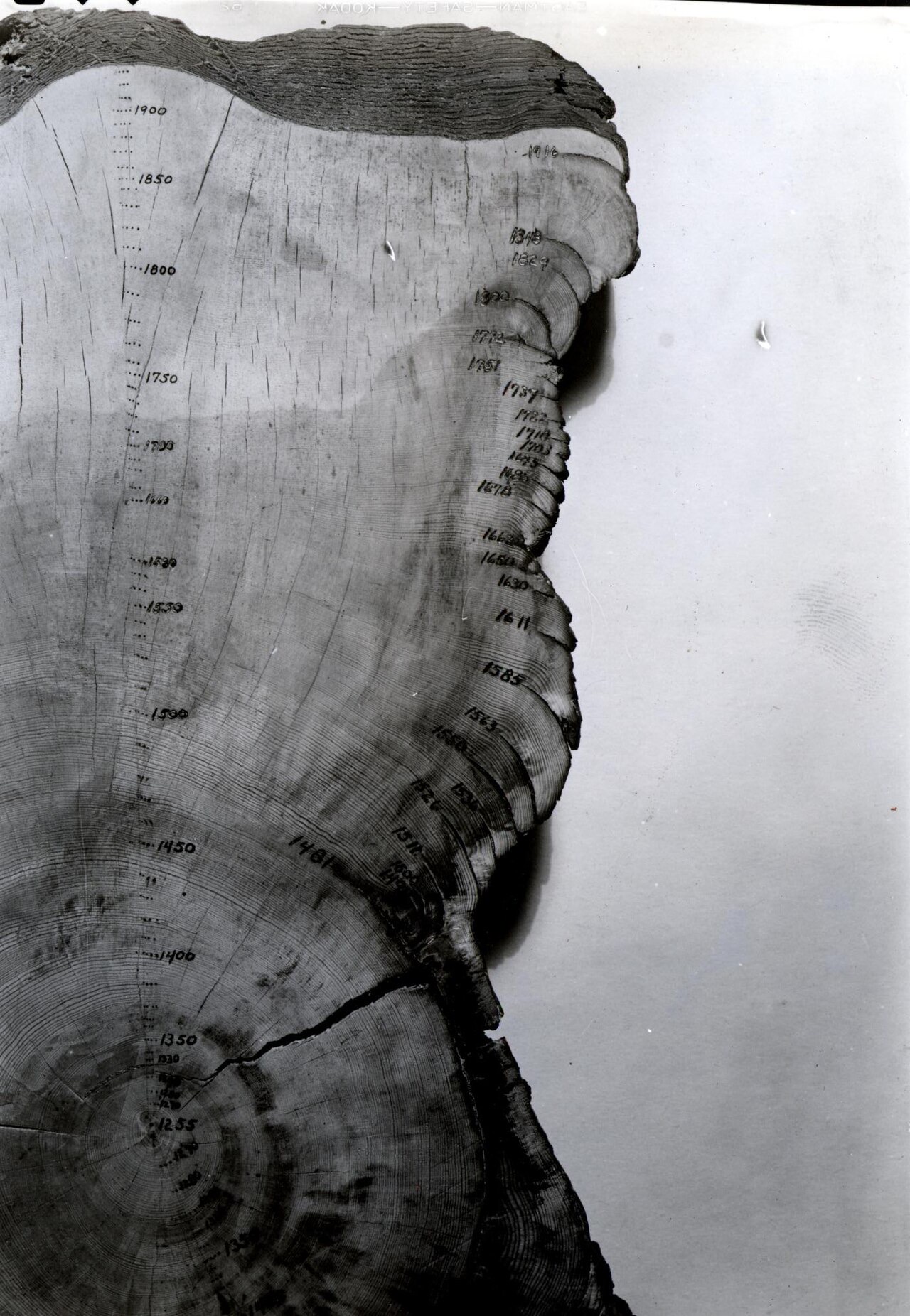
Trees keep records. Each year most temperate species add a ring of new wood, wide in a wet season and narrow in a dry one, and the science of reading those patterns is dendrochronology. Because the sequence of good and poor years is shared across a region, researchers can match a pattern from a beam in an old house to a pattern from living trees and date the timber to within a year. The technique has fixed the dates of archaeological sites and calibrated radiocarbon dating itself. Rings also record fires as scars and record injury as distorted grain. Foresters use a second clue: a wood full of even-aged trees was probably cleared at one moment, while a wood with seedlings, mature trunks and standing deadwood together has been left alone for a long time. Read carefully, a patch of forest reports its own history.
Visual AidA stump that kept a 700-year diary
Photograph, taken by foresters in 1937, of a ponderosa pine stump near Bly, Oregon. The handwritten years — 1255 at the center out to the 1900s at the bark — were inked onto the wood by the researchers, one date per counted ring, exactly the reading the Knowledge Bank calls dendrochronology; the dark curling layers up the right side are healed-over fire scars, a burn recorded and then grown past again and again. The photograph shows a real dated stump, not the great ash in the novel, and the dates mark rings, not events in any story.
Ponderosa pine stump section with dated growth rings and fire scars, Deming Creek, Bly, Oregon, 1937; USDA Forest Service. Source: Wikimedia Commons, File:1937. Ponderosa pine stump section showing tree growth rings and fire scars from 1255-1930. Deming Creek. Bly, Oregon. (34049124174).jpg, public domain.
curtadj.Ch.4
Rudely short in speech
“The grandmother’s curt answers told the stranger nothing.”
inquisitiveadj.Ch.4
Asking many questions; overly curious
“The inquisitive stranger wanted to know all about the family.”
faintadj.Ch.4
Very weak; barely able to be heard or seen
“A faint tinkling drifted from the darkening wood.”
venturev.Ch.5
To dare to go somewhere uncertain or risky
“Winnie decided to venture into the wood at last.”
startledadj.Ch.5
Suddenly surprised or alarmed
“Jesse looked up, startled to find he was being watched.”
reluctantadj.Ch.5
Unwilling; hesitating to do something
“Jesse was strangely reluctant to let her drink.”
sturdyadj.Ch.6
Strongly built; solid
“Miles was a sturdy young man with quiet, careful hands.”
urgentadj.Ch.6
Needing action right away
“The Tucks spoke in low, urgent voices.”
captiven.Ch.6
A person who has been taken and held
“Winnie, an accidental captive, rode wedged between them.”
soothev.Ch.6
To calm or comfort someone
“The music box began to soothe the crying girl.”
ⓘ The vocabulary words in this list are selected to help you understand and complete this workbook. Some may not appear verbatim in the original novel.
🧠Knowledge Bank question
1The Knowledge Bank explains that an inquisitive researcher can date the timber in an old house by ___.Ch.4
2An ‘inquisitive’ person shows no interest in other people’s business.Ch.4
3A sound you can barely hear is ___.Ch.4
4To ‘venture’ somewhere means to go there boldly even though it feels risky.Ch.5
5Fill in each blank with the correct word.Ch.5
Word choices:startledreluctantcaptivecurt- some words will not be used
Jesse was to look up and find Winnie watching him.
He seemed oddly to share the spring’s water.
6A ___ young man is strongly and solidly built.Ch.6
7If a matter is ‘urgent,’ it can safely wait until next week.Ch.6
8A person who has been taken and held is a ___.Ch.6
9Fill in the blanks with the correct words.Ch.6
Word choices:sootheventureurgentinquisitive- some words will not be used
Mae hoped the little tune would the frightened girl.
The brothers traded low, words as the horse hurried on.
10To calm and comfort someone is to ___ them.Ch.6
Part 2
Comprehension
Show you understood what happens in Chapters 4–6.
🧠Knowledge Bank · What It Means to Own a Wood
Human Geography · Land and Ownership
Owning land does not mean owning everything about it. Lawyers describe property as a bundle of separable rights: the right to occupy, to exclude others, to take timber or water, to sell, and to pass it on. Any of these can be held by different people at once, which is why a farmer may own a field while a neighbor holds a right of way across it and a company holds the minerals beneath. English common law once let owners claim everything from the depths to the sky, a rule aviation quietly ended. Rural landholding also carries duties, since a landowner can be liable for what happens to a visitor. This matters for anyone who inherits ground they did not choose. To own a wood is not simply to possess trees; it is to hold a set of powers over other people’s access, and powers can be refused.
Visual AidOwning a wood: the bundle of rights
Structure diagram of the lawyers’ picture the Knowledge Bank describes: one wood, one deed — but ownership splits into separable rights, and different people can hold different sticks at once. The five sticks shown are the Knowledge Bank’s own list, simplified; real property law counts more, and the drawing does not claim the Fosters have sold or shared any of theirs. Notice the last line: every stick is a power that can also be refused.
The bundle-of-rights model of property, as presented in standard introductions to property law. Drawn for Garden Heights Academy.
🧠Knowledge Bank question
1According to the Knowledge Bank, lawyers describe owning property as holding ___.Ch.4
2How does Winnie’s grandmother explain the faint tinkling music?Ch.4
3Winnie goes into the wood planning never to return home again.Ch.5
4What does Winnie find at the center of the wood?Ch.5
5Write the numbers 1–5 in the boxes to show the correct order of events. Number 1 = what happens first.Ch.4–6
Faint tinkling music drifts from the wood at sunset.
Mae and Miles carry Winnie away on the old horse.
Jesse refuses to let Winnie taste the water.
Winnie ventures into the wood and watches a boy drink from the spring.
The stranger begins asking the family his polite questions.
6Jesse cheerfully offers Winnie a cup of the spring water.Ch.5
7About how old does Jesse Tuck appear to be?Ch.5
8Why do Mae and Miles carry Winnie off?Ch.6
9The tune Mae’s music box plays is the same music the grandmother called elf music.Ch.6
10How do the Tucks treat their accidental captive on the ride?Ch.6
Part 3
Literary Elements
Understanding HOW and WHY Natalie Babbitt (author) tells the story across Chapters 4–6.
🧠Knowledge Bank · Moving the Camera Between Characters
Literary Craft · Point of View Shifts
Most novels commit to one vantage point, but a third-person narrator can move. Critics call the roaming version omniscient, able to enter any mind, and the disciplined version limited third person, staying inside one character per scene. Shifting between characters is powerful and dangerous: it lets a reader hold information that no single character has, generating suspense from the gap, but a shift made mid-scene without warning produces confusion readers experience as clumsiness. Writers therefore mark transitions with chapter or section breaks, and they usually give each viewpoint a distinct diction so the change is audible. Watch what a novel chooses to show you from outside a character’s head. Anything reported at that distance is being placed beyond that character’s understanding on purpose, and the reader is being invited to know more than the person they are asked to follow.
Suspense & Tension
The reader’s worry about what comes next — built from stacked wrongnesses like music with no source and a boy’s sudden panic.
Imagery
Language for the senses — the green, cool, secret light of the wood against the hot, dusty road outside.
Dialogue
Speech that reveals character — silky questions from the stranger, curt answers from the grandmother.
🧠Knowledge Bank question
1The Knowledge Bank explains that when a novel reports something from outside a character’s head, the reader is being ___.Ch.5
2Fill in the blank with the correct literary term.Ch.4
Word choices:dialogueimageryflashbackrhyme- some words will not be used
The stranger’s silky questions and the grandmother’s clipped replies reveal character through .
The green, cool light of the wood against the dusty road is .
3The tinkling music that drifts to the gate is a suspense device because it ___.Ch.4
4‘Imagery’ is language that appeals to the reader’s five senses.Ch.5
5By showing the stranger listening hard to the elf music, Babbitt hints that he ___.Ch.4
6The wood’s cool green interior against the hot fenced yard is an example of ___.Ch.5
7Dialogue can reveal a character’s nature by how they speak, not just what they say.Ch.4
8Fill in the blank with the correct literary term.Ch.5
Word choices:suspenseimagerymoralsetting- some words will not be used
The stacked wrongnesses that make readers worry about the spring build .
9Making the kidnapping gentle and apologetic instead of violent mainly shows that ___.Ch.6
10Ending Chapter 6 with the music box tune answers the elf-music mystery and also ___.Ch.6
Part 4
Think Deeper
Four deeper challenges — no single-word recall. Read, weigh the evidence, and reason it out.
🧠Knowledge Bank · Why Childhood Has Stages
Developmental Psychology · Growing Up
Psychologists have long argued that development is not simply accumulation. Jean Piaget proposed that children reorganize their thinking in stages, moving around adolescence into what he called formal operations, the ability to reason about possibilities rather than only about things present. Erik Erikson framed the same span as a sequence of conflicts, with adolescence dominated by the search for identity against role confusion. Later researchers criticized both for treating stages as universal and tidy when real development is uneven, culture-dependent and sometimes reversible. What survives is the core observation: a young person newly able to imagine alternative lives will start comparing the one they have to the ones they can picture, and that comparison is the engine of adolescence. It explains why the same house can feel safe at ten and unbearably small at eleven without anything in the house having moved.
Hold the three meetings side by side. At the gate, a stranger asks velvet questions and files away every answer, smiling at music only he seems to place. At the spring, a friendly boy turns pale the moment a thirsty girl reaches for the water. And on the road, two kidnappers keep saying sorry, wedging their captive safely between them and winding a music box to dry her tears. Someone in these chapters is dangerous — and it is not the family stealing the child.
Original passage written for Garden Heights — not a quotation from the novel.
1Claim: “The Tucks take Winnie because they are protecting the spring’s secret, not because they mean her harm.” — choose the two details that best prove it.Claim & Evidence
2The stranger’s manner, or The Tucks’ manner? Tap each detail to sort it — tap again to switch sides. You can keep tapping to change your answer.Sort into two
◄ The stranger’s mannerThe Tucks’ manner ►
3Match each cause to its result. For each cause, pick its result.Cause & Effect
The music box tune drifts from the wood to the gate→
Winnie finally ventures past her fence into the wood→
Winnie asks Jesse for a drink of the water→
Winnie sobs in fear on the galloping horse→
🧠Knowledge Bank question
4Fill both blanks to complete the reasoning.Build the Argument
The Knowledge Bank argues that a house can feel safe at ten and too small at eleven because , which shows that .
Part 5
Standardized Test
The Secret Life of a Spring · SAT & TOEFL-style practice
Read the passage — the highlighted words are tested — then answer. Tap an answer, then tap it again to confirm.
SATCentral Ideas — the passage's main point
SATWords in Context — a word's meaning in this passage
SATDetail — a fact stated in the passage
SATText Structure & Purpose — how the passage is built, and why
SATInference — a conclusion the passage implies
TOEFLFactual Information — a fact stated in the passage
TOEFLVocabulary — a tested word's meaning here
TOEFLProse Summary — the three sentences that sum it up
The Long Journey of Spring Water
A spring looks like magic — clear, cold water rising out of dry ground — but it is really the end of a long underground journey. Rain soaks into the soil and sinks until it reaches rock too tight to pass, and there it gathers, creeping slowly sideways through beds of sand and gravel that strain out dirt with every meter traveled. That journey can take months or even years, so the water reaching the surface today may have fallen as rain long before anyone living could remember. A quiet hillside, in other words, may be delivering water that began its trip generations ago.
Where a hillside dips low enough, the hidden water is squeezed back to the surface, arriving so cold and clean that a faint trickle of it could serve a whole household. In the 1880s, families would venture miles off the road to find such a source, for a good spring ran steady in drought and frost alike. When a shallow well went dry in a burning August, the search for water turned urgent — a farm could not wait even a day for it. Wells had to be dug and pumps could break, but a living spring asked for no labor and rarely failed even in a hot summer.
Cool spring water could soothe a fever, keep milk sweet in a springhouse, and decide exactly where a cabin should be built. The best springhouses were sturdy buildings of stone and heavy timber, solid enough to outlast storms that flattened flimsier sheds. Villages grew up around dependable springs the way ships gather at a harbor. A spring that nobody knew, hidden deep in a private wood, was therefore something close to treasure — and treasure, as every story knows, attracts hunters.
Original passage written for Garden Heights — not a quotation from the novel.
1What is the passage mainly about?SAT · Central Ideas
2According to the passage, what cleans the water on its underground journey?TOEFL · Factual Information
3In the passage, urgent most nearly means ___.SAT · Words in Context
4In the passage, families “venture” miles off the road. Here venture means to ___.TOEFL · Vocabulary
5Why did a good spring matter in drought, according to the passage?SAT · Detail
6In the passage, sturdy most nearly means ___.SAT · Words in Context
7What does the passage compare to ships gathering at a harbor?SAT · Detail
8The passage saves the hidden spring for its final sentences in order to ___.SAT · Text Structure & Purpose
9Which statement would the author most likely agree with?SAT · Inference
10Prose Summary (TOEFL).The passage explains how springs form and why they mattered. This TOEFL task lists six sentences; choose the THREE that best capture the passage’s main ideas. The other three do not belong — they state minor details or ideas the passage does not present.TOEFL · Prose Summary
Part 6 · Optional
Creative Writing
A bonus challenge to practice your English. Take your time and have fun with it.
About This Section
This writing task is optional and is not part of your auto-graded score. The feedback below checks only the basics — length, spelling, and grammar — not whether your ideas are right or wrong. It is meant for classroom discussion and creative practice, so feel free to use your imagination!
Writing Task — Part 2 “The Politest Danger”
The stranger at the gate is perfectly polite — and somehow the most frightening person in these chapters. Write about how someone’s manner (their voice, questions, or smile) can feel more important than their words. Describe the stranger from Winnie’s point of view, or invent a polite stranger of your own. Use at least two vocabulary words from this part.
You can start with: “The stranger spoke so politely, and yet...”
0 / 40 words minimum
🗣 Teach It · Just for Fun (optional)
No right or wrong — close the screen and tell someone nearby what happened in this part. Can’t find anyone? Tell yourself out loud. The moment you teach it, you truly understand it.
Part 2 Complete!
You finished Chapters 4–6 of Tuck Everlasting.
Here are your auto-graded results:
-
points out of 100
Teach it to someone
The best last step is to teach it. In your own words, explain what happened — retell a favorite scene, teach a character’s big choice, or sum up the main idea for a parent, friend, or classmate. When you can teach it clearly, you truly own it.
Independent study guide by Garden Heights. Not affiliated with or endorsed by Natalie Babbitt. Contains original analysis only; no text from the novel is reproduced. Reference text: This workbook follows Natalie Babbitt’s classic text (the standard Puffin edition sold worldwide). Revised 2023 UK editions change some wording and may not match the vocabulary studied here.
SAT® is a registered trademark of College Board, which is not affiliated with, and does not endorse, these materials. TOEFL® is a registered trademark of ETS. These materials are not endorsed or approved by ETS. Garden Heights is an independent provider of test-style reading practice.