New here? Just sign up with Google — your account includes Matilda, our gift book, forever.
Tuck Everlasting · Garden Heights
Part 3
for Tuck Everlasting · Part 3 · Chapters 7–9
8 Parts40 min
What Happens in Part 3
The Tucks reveal their secret: the spring made them immortal — and the stranger overhears everything.
The impossible storyBeside a quiet stream, the Tucks confide their story. Eighty-seven years ago the family came through these hills, camped in the wood, and drank from the spring at the ash tree — all except the cat. Slowly the truth forced itself on them: Jesse fell headfirst from a tree and stood up unhurt; hunters' shot left the horse unmarked; Tuck even fired a gun at himself, and the wound closed before their eyes.
The price of foreverThe cat, the one creature that never drank, grew old and died as every living thing should. Nothing about the Tucks changes: Jesse has been seventeen for over eighty years, and Miles's wife, bewildered and frightened, left him and took their two children. Friends whispered of witchcraft, so the family slipped away, learned to live quietly, and have guarded the secret ever since.
A hidden listenerAs the story ends, the narrator shows what the family cannot see: the man in the yellow suit, crouched close enough to hear every word. The Tucks then carry the bewildered Winnie over the hills to their cluttered, welcoming house beside a small pond, where Angus Tuck greets a living child as the finest sight he has seen in eighty years.
What We Will Learn
Section
What you will practice
Vocabulary
Words of secrets and proof: confide, reveal, experiment, eternal, eavesdrop, ordeal…
Literary Elements
Flashback, dramatic irony, and simile
Cross-Curricular
How a fair test proves what changes — and what the Tucks’ cat proved
Chapter Summary
Ch.
What happens
7
The Secret Told — by the stream, the Tucks recount drinking from the spring 87 years ago and the slow proof that they no longer change.
8
Ears in the Bushes — Winnie struggles to believe; unseen by all of them, the man in the yellow suit has crept close and heard everything.
9
The House by the Pond — the Tucks bring Winnie home to their cluttered cottage, where Tuck welcomes her with astonished joy.
Part 1
Vocabulary
Study 10 key words from Chapters 7–9, then answer each question.
🧠Knowledge Bank · Why Bodies Wear Out
Biology · Cell Division and Ageing
Ageing is not one process but many running together. A central one involves telomeres, protective caps of repeated DNA at the ends of chromosomes that shorten a little each time a cell divides. When they grow too short the cell stops dividing and becomes senescent, neither working properly nor dying. An enzyme called telomerase can rebuild them, and it is active in embryos — living things at their earliest stage — and in some stem cells, but switching it on everywhere is dangerous: unlimited division is close to a definition of cancer. Other mechanisms add up alongside it, including accumulated damage to proteins and declining repair. Biologists studying species that barely age, such as certain jellyfish and the naked mole-rat, find no single trick but several defences layered together. The picture that emerges is that ageing is the price of a body built from cells that must keep dividing.
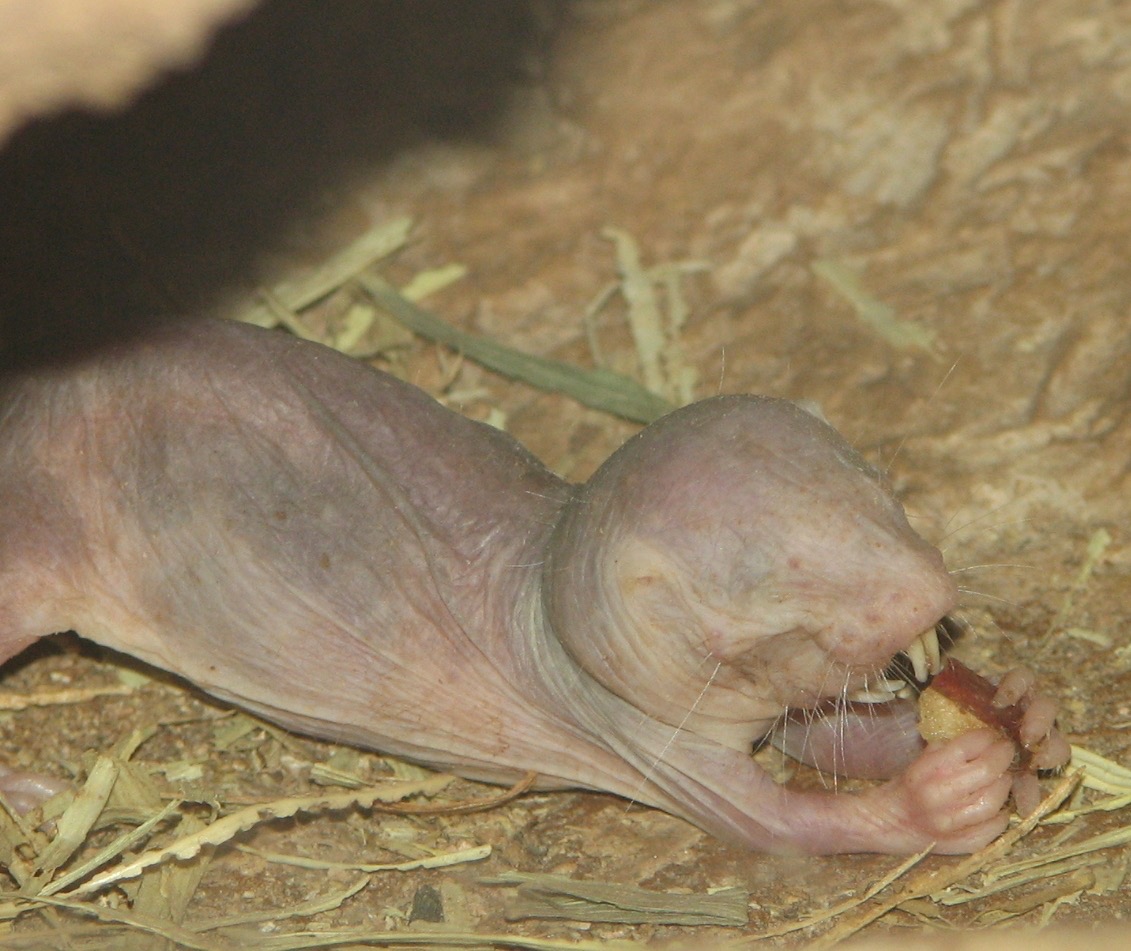
Visual AidAn animal that hardly ages
Photograph of a naked mole-rat eating, taken at a zoo in 2007 — the wrinkled, nearly hairless burrower the Knowledge Bank names among the species that barely age. Biologists find in it no single trick but several layered defenses, including unusually careful cell repair. What the picture cannot show is the animal’s strangest fact: its risk of dying does not climb with age the way ours does. It is not immortal — only the Tucks are, and they are invented.
Naked mole-rat (Heterocephalus glaber) eating; photograph by Trisha M. Shears, 2007. Source: Wikimedia Commons, File:Naked Mole Rat Eating.jpg, public domain.
confidev.Ch.7
To tell a secret to someone you trust
“At last the Tucks confide their story to Winnie.”
revealv.Ch.7
To make something hidden known
“Each accident helped reveal what the spring had done.”
experimentn.Ch.7
A careful test made to learn something
“Tuck’s gunshot was a desperate experiment.”
eternaladj.Ch.7
Lasting forever; never ending
“The spring had trapped them in an eternal present.”
seldomadv.Ch.8
Not often; rarely
“The Tucks seldom stayed long in any one town.”
eavesdropv.Ch.8
To listen secretly to others’ talk
“The stranger crept close to eavesdrop on the story.”
bewilderedadj.Ch.8
Completely confused
“Winnie sat bewildered by all she had heard.”
ordealn.Ch.8
A long, difficult, exhausting experience
“The strange day had become a real ordeal for Winnie.”
clutteredadj.Ch.9
Messily full of things
“The Tucks’ cluttered rooms had not been tidied in years.”
heartyadj.Ch.9
Warm, loud, and full of feeling
“Tuck gave Winnie a hearty, astonished welcome.”
ⓘ The vocabulary words in this list are selected to help you understand and complete this workbook. Some may not appear verbatim in the original novel.
🧠Knowledge Bank question
1The Knowledge Bank explains that switching on telomerase everywhere, in hopes of making cells eternal, would be dangerous because ___.Ch.7
2An ‘experiment’ is a careless accident that teaches nothing.Ch.7
3Something that lasts forever is ___.Ch.7
4To ‘eavesdrop’ is to listen secretly to a conversation not meant for you.Ch.8
5Fill in each blank with the correct word.Ch.7–8
Word choices:revealbewilderedheartyeternal- some words will not be used
Each unhurt accident helped the spring’s power.
Winnie felt utterly by the impossible story.
6If something happens ___, it happens only rarely.Ch.8
7A ‘cluttered’ room is perfectly neat and empty.Ch.9
8A long, difficult, exhausting experience is an ___.Ch.8
9Fill in the blanks with the correct words.Ch.9
Word choices:clutteredheartyseldomconfide- some words will not be used
The Tucks’ house had not been dusted in years.
Tuck greeted the child with a welcome.
10A ___ welcome is warm, loud, and full of feeling.Ch.9
Part 2
Comprehension
Show you understood what happens in Chapters 7–9.
🧠Knowledge Bank · A Story Told in Many Countries
Folklore · The Fountain of Youth
The idea of water that restores youth appears across unconnected cultures. Herodotus recorded a report of a spring in Ethiopia said to give long life; Alexander romances sent the conqueror searching for a water of life; medieval Europe placed such a fountain in the imagined kingdom of Prester John. The version most familiar in English attaches to the Spanish explorer Ponce de León and Florida, and historians are confident it is a later invention: no contemporary account of his expedition mentions it, and the story appears in print decades after his death. Folklorists treat this as a classic migratory legend, a portable tale that attaches itself to whichever traveler a culture finds convenient. The persistence tells us less about geography than about desire. Every version places the water somewhere just beyond the known world, which is exactly where a wish has to live to remain believable.
Visual AidOne legend, many addresses
Sequence diagram of the journey the Knowledge Bank traces: the same wish-story surfacing in Herodotus, riding the Alexander romances, settling in Prester John’s imagined kingdom, and finally being pinned on Ponce de León and Florida. Dates are approximate and stops in other cultures are left out. The arrows mean the legend traveled, not that any spring did — and the last note is the Knowledge Bank’s point: the water always lives just beyond the known world.
Legend history as summarized in the Knowledge Bank; the earliest printed attributions to Ponce de León postdate his death in 1521. Drawn for Garden Heights Academy.
🧠Knowledge Bank question
1According to the Knowledge Bank, why are historians confident that the Ponce de León fountain story is a later invention?Ch.7
2Which member of the household never drank the spring water?Ch.7
3When Tuck shot himself as a test, the wound healed before their eyes.Ch.7
4What happened to Miles’s wife?Ch.7
5Write the numbers 1–5 in the boxes to show the correct order of events. Number 1 = what happens first.Ch.7–9
The Tucks bring Winnie to their house beside the pond.
Tuck fires a gun at himself as a final test.
Neighbors’ witch talk drives the family to scatter and hide.
Jesse falls headfirst from a tree and stands up unhurt.
The Tucks camp in the wood and drink from the spring.
6The Tucks’ friends grew suspicious because the family never seemed to age.Ch.7
7Who secretly hears the Tucks tell Winnie their whole story?Ch.8
8How does Tuck react when he first sees Winnie?Ch.9
9The Tucks’ house is as neat and polished as the Fosters’ cottage.Ch.9
10Where do the Tucks live?Ch.9
Part 3
Literary Elements
Understanding HOW and WHY Natalie Babbitt (author) tells the story across Chapters 7–9.
🧠Knowledge Bank · Objects That Carry an Idea
Literary Craft · Symbol
A symbol is a concrete thing that stands for something abstract while remaining fully itself. That double life is the whole craft. A wheel in a story is a real wheel and can also mean the turning of time; if the author insists too hard on the second meaning, the wheel stops being a wheel and the writing turns into a lecture. Critics distinguish inherited symbols, which arrive with meanings a culture already agrees on, from private ones a book builds through repetition. Water is a strong example of the first kind, connected to birth, cleansing and death across many literatures. Novelists usually let a symbol accumulate quietly and then place it in one scene where a character interacts with it physically, so the idea is felt through an action rather than explained. That physical contact is the test of a working symbol: if a character can pick the object up, refuse it, break it or give it away, the abstraction has been converted into something a story can actually dramatize.
Flashback
A scene from the past set inside the present story — the Tucks’ 87-year-old memory told beside the stream.
Dramatic Irony
The reader knows what characters do not — we see the listener in the bushes; the Tucks never do.
Simile
A comparison using like or as — a healed wound like water closing over a stone.
🧠Knowledge Bank question
1The Knowledge Bank explains that the real test of a working symbol is whether ___.Ch.7
2Fill in the blank with the correct literary term.Ch.8
Word choices:dramatic ironysimileflashbackalliteration- some words will not be used
Readers seeing the eavesdropper the Tucks cannot see creates .
Comparing a healing wound to water closing over a stone is a .
3The cat’s ordinary death matters to the story’s logic because it ___.Ch.7
4Dramatic irony happens when characters know far more than the reader does.Ch.8
5Because we see the man in the yellow suit listening, every comforting word the Tucks speak feels ___.Ch.8
6Babbitt makes the Tucks doubt their own agelessness at first mainly to ___.Ch.7
7A simile compares two unlike things using the words ‘like’ or ‘as.’Ch.7
8Fill in the blank with the correct literary term.Ch.7
Word choices:flashbackdialoguemoodsimile- some words will not be used
A past scene set inside the present story is a .
9The contrast between the Fosters’ spotless cottage and the Tucks’ cluttered house suggests that ___.Ch.9
10Ending Part 3 at the warm, cluttered house right after the eavesdropping scene makes readers feel ___.Ch.9
Part 4
Think Deeper
Four deeper challenges — no single-word recall. Read, weigh the evidence, and reason it out.
🧠Knowledge Bank · Length Is Not the Only Measure
Philosophy · What Makes a Life Good
Philosophers ask what makes a life go well, and answers fall into three families. Hedonism says a good life contains the most pleasure and least pain. Desire theories say it consists of getting what you actually want, whether or not it feels good. Objective-list theories name goods that count regardless of preference — friendship, knowledge, achievement, health. The debate matters here because the three disagree sharply about duration. Bernard Williams argued in a famous essay that an endless life would eventually exhaust every project that gives a person reasons to act, leaving boredom no amount of time could cure. Others reply that new interests keep arriving indefinitely, and that boredom is a failure of imagination rather than of arithmetic. What both sides accept is that a life is assessed by its shape as well as its length, and that a story with no possible ending is also a story with nothing at stake.
Picture the trial the Tucks have lived. Exhibit one: a boy who fell from the top of a tree and walked away. Exhibit two: gunshot that left the old horse unmarked. Exhibit three: a father’s desperate experiment with his own shotgun, and a wound that closed like water. And the quiet witness against them all: one cat, who never drank, and who grew old and died exactly as every living thing should. The verdict is impossible and unavoidable — and in the bushes, a man in a yellow suit is taking notes.
Original passage written for Garden Heights — not a quotation from the novel.
1Claim: “By the time the story is told, the Tucks have real proof — not just belief — that the spring changed them.” — choose the two details that best prove it.Claim & Evidence
2Before the spring, or After the spring? Tap each detail to sort it — tap again to switch sides. You can keep tapping to change your answer.Sort into two
◄ Before the springAfter the spring ►
3Match each cause to its result. For each cause, pick its result.Cause & Effect
The cat never drank from the spring→
Miles stopped aging while his wife grew older→
Neighbors began whispering about witchcraft→
The man in the yellow suit trails the family quietly→
🧠Knowledge Bank question
4Fill both blanks to complete the reasoning.Build the Argument
In the Knowledge Bank's account, Bernard Williams argued that an endless life would fail because , which shows that .
Part 5
Standardized Test
The Fair Test · SAT & TOEFL-style practice
Read the passage — the highlighted words are tested — then answer. Tap an answer, then tap it again to confirm.
SATCentral Ideas — the passage's main point
SATDetail — a fact stated in the passage
SATWords in Context — a word's meaning in this passage
SATInference — a conclusion the passage implies
SATText Connections — how two parts of the text relate
TOEFLFactual Information — a fact stated in the passage
The Logic of a Fair Test
How can anyone prove what caused a change — or prove that no change happened at all? Science answers with a method called the fair test. A careful experiment compares two subjects that are alike in every way except one, so that any difference in the outcome must come from that single difference in treatment. If two subjects differ in several ways at once, no one can say which difference did the work. A test cluttered with extra differences — new soil, new seed, and new watering all tried together — is as hard to read as a desk buried under loose papers.
The untouched subject is called the control, and without it, results seldom mean much: a plant that thrives might simply have had a lucky pot, and a patient who recovers might have healed on his own. The control does nothing new; its whole task is to show what would have happened anyway. Doctors testing a new medicine therefore give it to one group and not to another, and farmers trying a new fertilizer leave one strip of field unfed. Whatever the treated group does, its result gains meaning only beside that quiet, untouched partner.
Repeating the test matters just as much, since one surprising result may be chance, while the same result over and over begins to reveal a rule. A single trial can be fooled by weather, a mistake, or plain luck, but chance rarely lines up the same way many times in a row by accident. A researcher bewildered by one strange outcome, unsure whether to credit luck or law, simply runs the trial again until the confusion clears. Compare, control, repeat: three plain habits that turn a lucky guess into knowledge you can trust.
Original passage written for Garden Heights — not a quotation from the novel.
1What is the passage mainly about?SAT · Central Ideas
2In a fair test, the two subjects must be ___.SAT · Detail
3In the passage, the untouched subject is called ___.TOEFL · Factual Information
4In the passage, cluttered most nearly means ___.SAT · Words in Context
5Why does the passage say results “seldom” mean much without a control?SAT · Inference
6The farmer’s unfed strip of field serves the same purpose as ___.SAT · Text Connections
7According to the passage, why does repeating a test matter?TOEFL · Factual Information
8In the passage, bewildered most nearly means ___.SAT · Words in Context
9A family drinks from a spring and stops aging; their cat does not drink and ages normally. In the passage’s terms, the cat is ___.SAT · Inference
10Which title best fits the passage?SAT · Central Ideas
Part 6 · Optional
Creative Writing
A bonus challenge to practice your English. Take your time and have fun with it.
About This Section
This writing task is optional and is not part of your auto-graded score. The feedback below checks only the basics — length, spelling, and grammar — not whether your ideas are right or wrong. It is meant for classroom discussion and creative practice, so feel free to use your imagination!
Writing Task — Part 3 “The Listener in the Bushes”
The Tucks tell their most dangerous secret beside the stream — and the man in the yellow suit hears every word. Rewrite the moment the story ends from HIS point of view, crouched in the bushes. What is he thinking? What is his plan? Do not make him explain everything — let his thoughts give him away. Use at least two vocabulary words from this part.
You can start with: “From where I crouched, I could hear everything, and...”
0 / 40 words minimum
🗣 Teach It · Just for Fun (optional)
No right or wrong — close the screen and tell someone nearby what happened in this part. Can’t find anyone? Tell yourself out loud. The moment you teach it, you truly understand it.
Part 3 Complete!
You finished Chapters 7–9 of Tuck Everlasting.
Here are your auto-graded results:
-
points out of 100
Teach it to someone
The best last step is to teach it. In your own words, explain what happened — retell a favorite scene, teach a character’s big choice, or sum up the main idea for a parent, friend, or classmate. When you can teach it clearly, you truly own it.
Independent study guide by Garden Heights. Not affiliated with or endorsed by Natalie Babbitt. Contains original analysis only; no text from the novel is reproduced. Reference text: This workbook follows Natalie Babbitt’s classic text (the standard Puffin edition sold worldwide). Revised 2023 UK editions change some wording and may not match the vocabulary studied here.
SAT® is a registered trademark of College Board, which is not affiliated with, and does not endorse, these materials. TOEFL® is a registered trademark of ETS. These materials are not endorsed or approved by ETS. Garden Heights is an independent provider of test-style reading practice.