New here? Just sign up with Google — your account includes Matilda, our gift book, forever.
Tuck Everlasting · Garden Heights
Part 6
for Tuck Everlasting · Part 6 · Chapters 17–19
8 Parts40 min
What Happens in Part 6
Miles models a purposeful forever — then the stranger seizes Winnie, and Mae strikes him down before the constable's eyes.
Fishing with MilesAt dawn, Miles takes Winnie fishing and shows her another way of carrying forever. Where Jesse spends eternity playing, Miles wants a purpose: people, he says, ought to be useful. He speaks quietly of the wife and children who left him — his little daughter would be an old woman now.
The troutThen the rod bends: a trout comes up flapping in the bottom of the boat. Winnie, watching one small creature fight for its place on the wheel, begs Miles to let it go. He slips it back into the water, and breakfast is flapjacks again.
The stranger's claimThen the man in the yellow suit lets himself in and smilingly announces that the wood is now his. His plan pours out: he will bottle and sell the spring water to those he judges deserving — and since the Tucks refuse to help, he will demonstrate its power on Winnie herself.
Mae's shotgunHe seizes Winnie's arm and drags her toward the door — and gentle, motherly Mae Tuck swings the long shotgun by the barrel and brings the stock down on his skull. He crumples in the yard just as the constable rides up — in time to witness the blow and nothing before it.
What We Will Learn
Section
What you will practice
Vocabulary
Words of the climax: gasp, purpose, release, intrude, announce, demonstrate, seize, witness…
Literary Elements
Climax, foil characters, and motif
Cross-Curricular
What the law can see — evidence, witnesses, and defending someone in danger
Chapter Summary
Ch.
What happens
17
Fishing with Miles — usefulness against fun, a father’s lost children, and a gasping trout that Winnie sends back to the wheel.
18
Flapjacks Again — at breakfast Winnie counts the Tucks as friends — until an uninvited knock changes everything.
19
The Blow — the stranger claims the wood, unveils his plan to sell the water, and seizes Winnie; Mae fells him with the shotgun stock as the constable rides up.
Part 1
Vocabulary
Study 10 key words from Chapters 17–19, then answer each question.
🧠Knowledge Bank · A Small Water World
Ecology · Ponds and Their Life
A pond is a complete ecosystem compressed into a few meters. Sunlight powers algae and pondweed, which feed grazing invertebrates, which feed beetles, newts and fish, and everything eventually feeds the decomposers in the sediment. Ecologists describe this as a food web rather than a chain, because most species eat several things and are eaten by several more. Ponds also age. Silt and dead plants accumulate, the water shallows, reeds advance from the edges, and over decades open water becomes marsh and then dry land — a process called succession. Left completely undisturbed, a pond therefore disappears. That is a useful thing to know about anything alive. A pond that stays exactly the same year after year is not a healthy pond in balance; it is a pond in which the ordinary processes of growth and decay have somehow stopped, which in an ecosystem is not stability but death.
Visual AidA pond, left alone, disappears
Sequence diagram of the slow change ecologists call succession, exactly as the Knowledge Bank runs it: open water shallows under silt, reeds close in, and marsh hardens at last into dry land. Real ponds take detours — floods, droughts and grazing can push the arrows backward — and the decades between panels are compressed to nothing. The point to notice is the Knowledge Bank’s: a pond held perfectly unchanged is not healthy balance but stopped life, which is the Tucks’ own condition drawn in water and reeds.
Pond succession as described in introductory ecology texts. Drawn for Garden Heights Academy.
gaspv.Ch.17
To struggle for breath with open mouth
“The trout lay gasping in the bottom of the boat.”
purposen.Ch.17
A reason for doing or being; useful aim
“Miles believes a person needs a purpose, not just fun.”
releasev.Ch.17
To set something free
“Winnie begged him to release the struggling fish.”
intrudev.Ch.19
To enter where you are not wanted
“The stranger did not knock so much as intrude.”
announcev.Ch.19
To declare something publicly
“He paused to announce that the wood was now his.”
demonstratev.Ch.19
To show how something works by example
“He meant to demonstrate the water’s power using Winnie.”
seizev.Ch.19
To grab suddenly and firmly
“He seized the child’s arm and pulled her toward the door.”
thresholdn.Ch.19
The strip of floor at a doorway; an entrance
“A long shadow fell across the threshold.”
crumplev.Ch.19
To collapse suddenly in a heap
“The man swayed once and crumpled in the yard.”
witnessv.Ch.19
To see an event happen with your own eyes
“The constable arrived just in time to witness the blow.”
ⓘ The vocabulary words in this list are selected to help you understand and complete this workbook. Some may not appear verbatim in the original novel.
🧠Knowledge Bank question
1The Knowledge Bank explains that reeds advancing from a pond's edges announce that ___.Ch.17
2To ‘release’ a caught fish means to keep it for breakfast.Ch.17
3Miles believes every person needs a ___ — a useful reason for being.Ch.17
4To ‘intrude’ is to enter politely after being invited.Ch.19
5Fill in each blank with the correct word.Ch.19
Word choices:announcethresholdgasprelease- some words will not be used
A shadow fell across the of the kitchen door.
He paused, smiling, to that the wood belonged to him.
6To grab something suddenly and firmly is to ___ it.Ch.19
7If a man ‘crumples,’ he collapses suddenly in a heap.Ch.19
8To show how something works by example is to ___ it.Ch.19
9Fill in the blanks with the correct words.Ch.17–19
Word choices:purposewitnessseizeintrude- some words will not be used
Miles wants his endless years to serve some real .
The constable rode up just in time to the blow.
10The strip of floor at a doorway is called the ___.Ch.19
Part 2
Comprehension
Show you understood what happens in Chapters 17–19.
🧠Knowledge Bank · The Cost of Keeping a Secret
Psychology · Living Outside the Ordinary
Research on secrecy has produced a consistent and slightly surprising result. The burden of a secret comes less from actively concealing it in conversation than from how often the keeper’s mind returns to it when alone. Psychologist Michael Slepian’s studies find that this rumination predicts lowered wellbeing, while moments of active hiding barely register. Secrets that concern identity — who someone really is, rather than something they did — are the heaviest, because they cannot be resolved and set down. Long-term concealment also narrows a life in measurable ways: it limits which friendships can deepen and where a person can settle. Researchers find the strongest relief comes not from confessing widely but from telling one trusted person, which converts a solitary weight into a shared one. What isolates is not the secret itself. It is being the only witness to your own life, and knowing that nobody else holds the account that would let you check it.
🧠Knowledge Bank question
1According to the Knowledge Bank, the burden of keeping a secret comes mostly from ___.Ch.17
2What happens to the trout Miles catches?Ch.17
3Miles’s wife and children stayed with him after the family’s secret came out.Ch.17
4What does the man in the yellow suit announce at the pond house?Ch.19
5Write the numbers 1–5 in the boxes to show the correct order of events. Number 1 = what happens first.Ch.17–19
The stranger intrudes and announces his ownership of the wood.
He seizes Winnie to use her as his demonstration.
Winnie begs for the gasping trout to be released.
Mae strikes him down as the constable rides into the yard.
Miles and Winnie fish at dawn and talk about being useful.
6The stranger plans to give the spring water away freely to everyone.Ch.19
7Why does the stranger seize Winnie?Ch.19
8What does Mae strike the stranger with?Ch.19
9The constable arrives early enough to hear the stranger’s entire plan.Ch.19
10Why is the timing of the constable’s arrival so disastrous for Mae?Ch.19
Part 3
Literary Elements
Understanding HOW and WHY Natalie Babbitt (author) tells the story across Chapters 17–19.
🧠Knowledge Bank · One Comparison Carried Through a Book
Literary Craft · Extended Metaphor
A metaphor states that one thing is another; an extended metaphor keeps the comparison running long enough to be developed. When it is carried through a whole work, critics may call it a conceit, a term from Renaissance poetry for an elaborate comparison sustained past the point of surprise. The technique earns its length by yielding new correspondences: if life is a wheel, then the metaphor must be able to say something about the spokes, the turning and the point that comes back around. A weak extended metaphor repeats one likeness; a strong one keeps discovering. Writers usually introduce the comparison plainly, once, near the start, then rely on the images alone. Watch for the moment a book returns to its opening comparison at the end, because the return asks you to measure how far the story has come by how differently the same picture now reads.
Climax
The story’s highest point of tension, where the central conflict breaks — the seizure, the blow, and the witness in one minute.
Foil
Characters who highlight each other by contrast — Miles’s duty against Jesse’s delight, one gift carried two ways.
Motif
An image repeating with meaning — the wheel returns in the pond, the seasons, and one gasping trout sent home.
🧠Knowledge Bank question
1The Knowledge Bank explains that a strong extended metaphor earns its length by ___.Ch.19
2Fill in the blank with the correct literary term.Ch.17
Word choices:foilmotifclimaxsimile- some words will not be used
Miles and Jesse, contrasting ways of carrying one gift, are characters.
The wheel image returning in the trout scene is a .
3The released trout carries the wheel motif because it ___.Ch.17
4A foil character highlights another character through contrast.Ch.17
5Winnie begging for the trout’s release foreshadows that she will ___.Ch.17
6Mae’s character arc makes the blow shocking because she has been, until now, ___.Ch.19
7The climax of a story is the calm explanation that follows the main conflict.Ch.19
8Fill in the blank with the correct literary term.Ch.19
Word choices:climaxfoilthemeflashback- some words will not be used
The single scene where the novel’s tension finally breaks is its .
9The stranger revealing his selling plan just before seizing Winnie serves to ___.Ch.19
10Ending the chapter on the constable’s arrival — a witness to the blow alone — converts the climax into ___.Ch.19
Part 4
Think Deeper
Four deeper challenges — no single-word recall. Read, weigh the evidence, and reason it out.
🧠Knowledge Bank · Deciding What Stays Wild
Environmental Science · Protecting a Place
Conservation is a series of hard choices about what to protect and from whom. Ecologists distinguish preservation, keeping a place free from human use, from conservation, managing use so the resource endures. National parks began as the first, and quickly ran into the second: fire suppression in protected forests allowed fuel to build up and produced worse fires later, so managers now light controlled burns in places once left strictly alone. Small isolated reserves lose species over time because populations too small to withstand a bad year cannot be replenished, which is why planners connect reserves with corridors. Underneath every decision is a question about people. Protection almost always restricts somebody’s access, so the durable schemes are those that give the local community a genuine stake in the outcome rather than a rule they had no part in writing. Protection imposed from outside is obeyed only while somebody is watching.
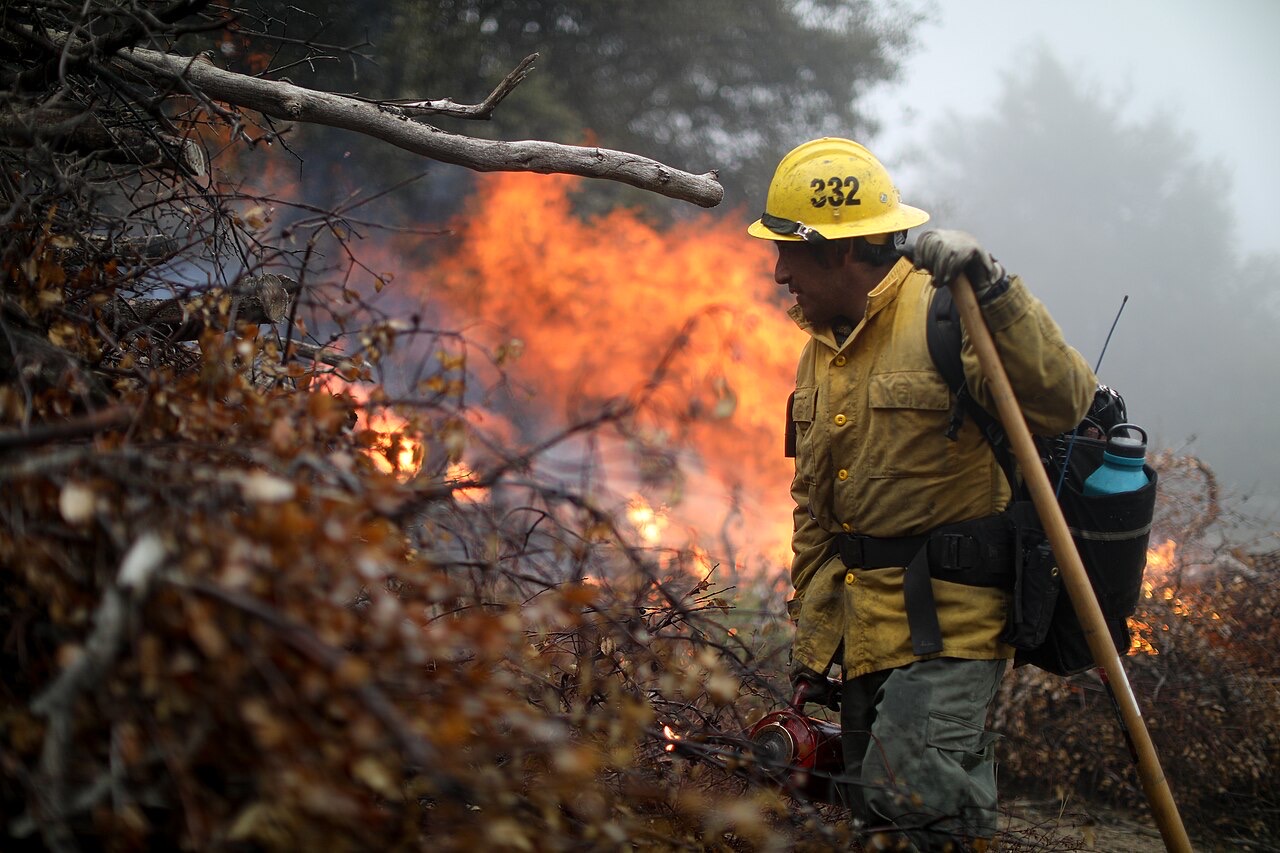
Visual AidFire lit on purpose to protect a forest
Photograph of a prescribed burn in the Cleveland National Forest, California, in January 2023: a trained crew member tends flames that were set on purpose. This is the practice the Knowledge Bank describes — managers learned that keeping every fire out let fuel pile up for worse ones, so they now burn small and early, on their own terms. The fire in the picture is controlled and planned; nothing here is a wildfire, and no forest in the novel burns.
Prescribed pile burn, Cleveland National Forest, California, January 29, 2023; USDA Forest Service photograph by Andrew Avitt. Source: Wikimedia Commons, File:Cleveland National Forest- Prescribed Burn (20230129-Cleveland-PileBurn-27).jpg, public domain.
Run the minute back in slow motion. A man who now owns the wood stands in a borrowed doorway, explaining how he will bottle eternity and sell it to the deserving. Refused, he closes his hand around a child’s arm and pulls. A mother who has not hurt anything in eighty-seven years reaches for the shotgun — not the trigger, the barrel — and swings once. He folds into the sunlight. And up the lane, at precisely the wrong moment, rides the one man in the county whose job is to believe his own eyes.
Original passage written for Garden Heights — not a quotation from the novel.
1Claim: “Mae strikes to protect Winnie, not to murder the stranger.” — choose the two details that best prove it.Claim & Evidence
2Miles’s way of bearing forever, or Jesse’s way of bearing forever? Tap each detail to sort it — tap again to switch sides. You can keep tapping to change your answer.Sort into two
◄ Miles’s way of bearing foreverJesse’s way of bearing forever ►
3Match each cause to its result. For each cause, pick its result.Cause & Effect
The trout lies gasping in the bottom of the boat→
The signed deed makes the wood the stranger’s property→
The Tucks refuse to help sell the water→
The constable rides up at the very last moment→
🧠Knowledge Bank question
4Fill both blanks to complete the reasoning.Build the Argument
Durable conservation schemes give local people a genuine stake because , which shows that .
Part 5
Standardized Test
What the Law Can See · SAT & TOEFL-style practice
Read the passage — the highlighted words are tested — then answer. Tap an answer, then tap it again to confirm.
SATCentral Ideas — the passage's main point
SATDetail — a fact stated in the passage
SATWords in Context — a word's meaning in this passage
SATInference — a conclusion the passage implies
SATText Connections — how two parts of the text relate
TOEFLFactual Information — a fact stated in the passage
TOEFLProse Summary — the three sentences that sum it up
When Rescue Looks Like Assault
The law has always allowed a person to use reasonable force to protect someone in immediate danger — a parent shielding a child, a neighbor rushing to seize an attacker's arm and hold it fast. Yet the right to step in has always carried a risk, for a rescuer and an attacker can look surprisingly alike to a stranger's eye. One figure grips another; who is saving, and who is striking? The law runs on evidence, and evidence is mostly what witnesses see and swear to. A rescue that looks like an assault will be judged, at least at first, by how it looked.
In the small towns of the 1880s this problem was sharpest of all, because there were no photographs of the scene and no detectives to reconstruct it — only testimony. A witness who arrived in the middle of events would honestly testify to the half he saw. His half could send an innocent rescuer to trial. One confident speaker, sure of the little he had seen, could sway a jury more than the quiet word of the person who had actually been wronged. Certainty, in a courtroom, has a volume all its own.
Judges and juries knew such testimony could mislead, and they weighed the speaker's character, the parties' reputations, and any story the injuries themselves could tell. A bruise or a torn sleeve might demonstrate — show plainly, beyond talk — what had truly happened before anyone arrived. Even so, the hard truth remained: in a courtroom, what happened matters less than what can be shown. Timing, in justice as in comedy, is very nearly everything.
Original passage written for Garden Heights — not a quotation from the novel.
1What is the passage mainly about?SAT · Central Ideas
2According to the passage, the law has always allowed ___.TOEFL · Factual Information
3In the passage, “evidence” is described as mostly ___.SAT · Detail
4Why was the problem “sharpest” in 1880s small towns?TOEFL · Factual Information
5In the passage, seize most nearly means ___.SAT · Words in Context
6A witness arriving mid-scene is dangerous to justice because he ___.SAT · Inference
7In the passage, demonstrate most nearly means ___.SAT · Words in Context
8What did judges and juries weigh alongside testimony, according to the passage?SAT · Detail
9A woman strikes a man just as a lawman rides into view; the lawman saw nothing before the blow. By the passage’s logic, she is in danger because ___.SAT · Text Connections
10Prose Summary (TOEFL).The passage explains how evidence shapes justice. This TOEFL task lists six sentences; choose the THREE that best capture the passage’s main ideas. The other three do not belong — they state minor details or ideas the passage does not present.TOEFL · Prose Summary
Part 6 · Optional
Creative Writing
A bonus challenge to practice your English. Take your time and have fun with it.
About This Section
This writing task is optional and is not part of your auto-graded score. The feedback below checks only the basics — length, spelling, and grammar — not whether your ideas are right or wrong. It is meant for classroom discussion and creative practice, so feel free to use your imagination!
Writing Task — Part 6 “One Second Earlier”
The constable rides up one second too late to see WHY Mae swung. Rewrite the scene as the constable’s official report — first as he actually saw it, then add the paragraph he WOULD have written if he had arrived one minute earlier. How different are the two reports? Use at least two vocabulary words from this part.
You can start with: “REPORT OF THE TREEGAP CONSTABLE. Upon arriving at the dwelling by the pond, I witnessed...”
0 / 40 words minimum
🗣 Teach It · Just for Fun (optional)
No right or wrong — close the screen and tell someone nearby what happened in this part. Can’t find anyone? Tell yourself out loud. The moment you teach it, you truly understand it.
Part 6 Complete!
You finished Chapters 17–19 of Tuck Everlasting.
Here are your auto-graded results:
-
points out of 100
Teach it to someone
The best last step is to teach it. In your own words, explain what happened — retell a favorite scene, teach a character’s big choice, or sum up the main idea for a parent, friend, or classmate. When you can teach it clearly, you truly own it.
Independent study guide by Garden Heights. Not affiliated with or endorsed by Natalie Babbitt. Contains original analysis only; no text from the novel is reproduced. Reference text: This workbook follows Natalie Babbitt’s classic text (the standard Puffin edition sold worldwide). Revised 2023 UK editions change some wording and may not match the vocabulary studied here.
SAT® is a registered trademark of College Board, which is not affiliated with, and does not endorse, these materials. TOEFL® is a registered trademark of ETS. These materials are not endorsed or approved by ETS. Garden Heights is an independent provider of test-style reading practice.