New here? Just sign up with Google — your account includes Matilda, our gift book, forever.
Tuck Everlasting · Garden Heights
Part 7
for Tuck Everlasting · Part 7 · Chapters 20–22
8 Parts40 min
What Happens in Part 7
Mae is jailed facing the gallows; Winnie joins the midnight plan to take her place.
The gallows threatThe constable leads his procession back to Treegap: Winnie delivered home, Mae under arrest for the blow everyone saw and no one understood. On the road he chats about the county's new jailhouse — and its gallows. If the yellow-suited man dies, Mae will hang.
Winnie's realizationWinnie goes cold: she alone understands that Mae cannot hang — the rope simply will not work — and when it fails before a watching crowd, the secret of the spring is loose in the world forever. At home she is hugged, scolded, questioned, and watched more closely than ever, thinking only of the pond house.
Jesse's bottleThen the news arrives: the stranger is dead. The trial will come; the verdict is certain. And at the fence where a toad once listened, Jesse appears with a tiny bottle of spring water — to drink when she turns seventeen — bringing the family's rescue plan.
Taking Mae's placeAt midnight, Miles will pull the bars from the jail window and Mae will slip away. But the constable peeks into the cell all night — so Winnie, no longer the girl who only dreamed at fences, vows to climb through the window and take Mae's place in the cot until morning.
What We Will Learn
Section
What you will practice
Vocabulary
Words of law and risk: arrest, gallows, cell, verdict, commotion, accomplice, daring, vow…
Literary Elements
Internal conflict, pacing, and the dynamic character
Cross-Curricular
County jails and public hangings — and why Mae’s secret makes the gallows a catastrophe
Chapter Summary
Ch.
What happens
20
The Ride Back — the constable talks cheerfully of the new jail and its gallows; Winnie grasps the true catastrophe: Mae cannot hang.
21
Watched Again — home amid the commotion, Winnie frets for the Tucks; word comes that the man in the yellow suit has died.
22
The Bottle and the Plan — Jesse brings Winnie a bottle of spring water and the midnight plan; Winnie vows to take Mae’s place in the cell.
Part 1
Vocabulary
Study 10 key words from Chapters 20–22, then answer each question.
🧠Knowledge Bank · The Universal Solvent
Chemistry · What Water Carries
Water dissolves more substances than any other common liquid, which is why chemists call it the universal solvent. The reason is its shape: the molecule is bent, with a slight negative charge near the oxygen and slight positive charges at the hydrogens, making it polar. Polar water pulls charged particles out of a solid’s crystal structure and surrounds them, which is how salt disappears into a glass. It also explains what water will not dissolve — oils and fats, whose molecules carry no such charges, stay stubbornly separate. Groundwater exploits this on a geological timescale, dissolving limestone as it moves and depositing it elsewhere as stalactites or the crust inside a kettle. Anyone testing a mysterious spring would start here, because whatever a water has passed through, it carries some of it in solution. Dissolved minerals, temperature and the age of the water all leave a signature, and a laboratory can read that signature to say roughly where a spring’s water has been.
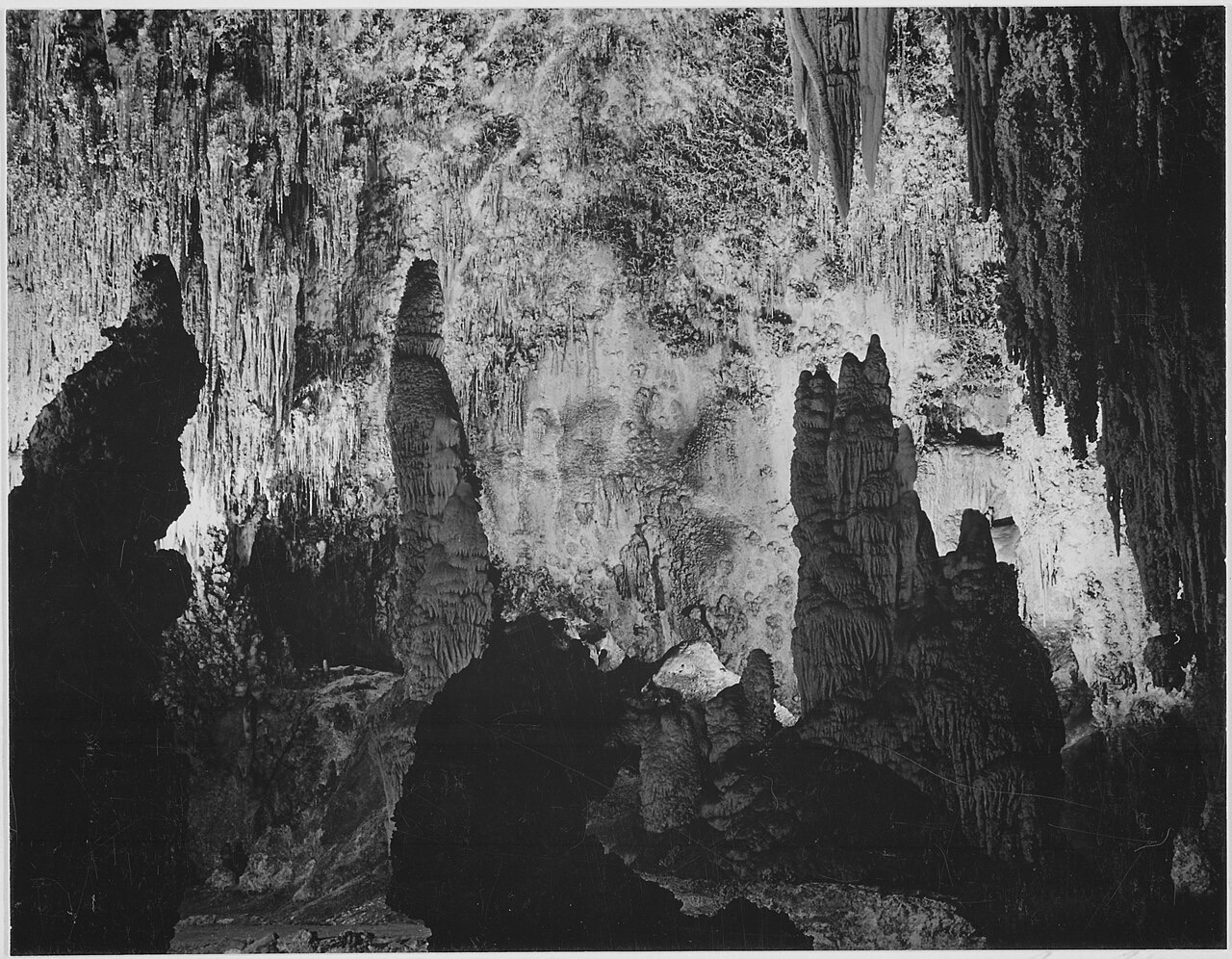
Visual AidWhat water carried, stone by stone
Photograph by Ansel Adams of the Queen’s Chamber in Carlsbad Caverns, New Mexico, made for the National Park Service between 1933 and 1942. Every spike and column is limestone that polar water dissolved somewhere else and set down here, drip by drip — the Knowledge Bank’s universal solvent working on a geological timescale. The black-and-white film adds no color the cave lacks; the chamber is lit for the camera, not naturally. Nothing here is magic water: this is what ordinary water does, given rock and time.
Stalagmites and stalactites in the Queen’s Chamber, Carlsbad Caverns National Park, New Mexico; photograph by Ansel Adams, 1933–1942, U.S. National Archives (NARA 520034). Source: Wikimedia Commons, File:"Stalagmites and stalactites, 'In the Queen's Chamber,' Carlsbad Caverns National Park," New Mexico., 1933 - 1942 - NARA - 520034.jpg, public domain.
arrestv.Ch.20
To take someone into custody by law
“The constable had no choice but to arrest Mae.”
gallowsn.Ch.20
A wooden frame used for hanging criminals
“The new jailhouse had a gallows in its yard.”
celln.Ch.20
A small locked room for a prisoner
“Mae sat alone in the narrow cell.”
commotionn.Ch.21
Noisy excitement and confusion
“Winnie’s return threw the cottage into commotion.”
scarcelyadv.Ch.21
Barely; almost not at all
“She could scarcely think of anything but the Tucks.”
fretv.Ch.21
To worry constantly
“All day Winnie could only fret about the trial to come.”
verdictn.Ch.21
A court’s official decision
“With the stranger dead, the verdict seemed certain.”
accomplicen.Ch.22
A person who helps carry out a plan, often a forbidden one
“By agreeing, Winnie became an accomplice in the escape.”
daringadj.Ch.22
Boldly risky; adventurous
“Taking Mae’s place was the most daring act she could imagine.”
vown.Ch.22
A solemn promise
“Winnie made a quiet vow to be at the fence at midnight.”
ⓘ The vocabulary words in this list are selected to help you understand and complete this workbook. Some may not appear verbatim in the original novel.
🧠Knowledge Bank question
1The Knowledge Bank explains that oils and fats scarcely dissolve in water because ___.Ch.20
2A ‘gallows’ is a wooden frame used for hanging criminals.Ch.20
3A small locked room that holds a prisoner is a ___.Ch.20
4‘Commotion’ means perfect stillness and quiet.Ch.21
5Fill in each blank with the correct word.Ch.21
Word choices:scarcelyfretgallowsvow- some words will not be used
Winnie could eat for worrying.
She did nothing all afternoon but about Mae.
6A court’s official decision is called the ___.Ch.21
7An ‘accomplice’ refuses to take any part in a plan.Ch.22
8A plan that is boldly risky is ___.Ch.22
9Fill in the blanks with the correct words.Ch.22
Word choices:vowaccomplicecellcommotion- some words will not be used
Winnie made a solemn to be there at midnight.
Helping the escape would make her an .
10If you can ___ believe the news, you can barely believe it at all.Ch.21
Part 2
Comprehension
Show you understood what happens in Chapters 20–22.
🧠Knowledge Bank · What It Takes to Prove Something
Law · Evidence and Proof
Courts sort evidence carefully. Direct evidence reports the fact itself, such as an eyewitness account; circumstantial evidence supports an inference, such as a fingerprint on a window. Contrary to popular belief, circumstantial evidence is not weaker — many convictions rest on it — because a chain of independent circumstances can be far harder to fake than one confident witness. What courts do insist on is a standard of proof. Criminal cases require proof beyond reasonable doubt, while civil cases ask only which account is more probable, and the difference reflects how much a mistake would cost. A separate question is admissibility: evidence may be excluded because it was obtained improperly or because a jury would weigh it emotionally rather than logically. Anyone arguing about what really happened is doing the same work informally, and the useful discipline is stating in advance what would change your mind.
Visual AidDirect and circumstantial evidence
Structure diagram of the two routes the Knowledge Bank lays out: direct evidence reports the fact itself, while circumstantial evidence is a chain of independent clues that only fit together one way. The three clues are invented examples, not items from any case — and from this novel least of all, where what the constable saw is the problem. The diagram ranks nothing; its point is the Knowledge Bank’s: the chain is not the weaker road, and every argument should state what would change its mind.
Direct and circumstantial evidence, and standards of proof, as described in standard introductions to the law of evidence. Drawn for Garden Heights Academy.
🧠Knowledge Bank question
1According to the Knowledge Bank, circumstantial evidence can be as strong as direct evidence because ___.Ch.20
2Why would Mae’s hanging be a catastrophe beyond her family?Ch.20
3Winnie tells the constable that the Tucks treated her as a friend, not a prisoner.Ch.20
4What news reaches Winnie at home?Ch.21
5Write the numbers 1–5 in the boxes to show the correct order of events. Number 1 = what happens first.Ch.20–22
News comes that the man in the yellow suit is dead.
Jesse appears at the fence with a little bottle of water.
Winnie makes the Tucks a bold promise about midnight.
Winnie is swept home into hugging, scolding commotion.
The constable chats about the new jail and its gallows.
6After her return, Winnie’s family finally stops watching her.Ch.21
7What gift does Jesse bring to the fence?Ch.22
8What is Miles’s part in the escape plan?Ch.22
9The plan works only if the constable believes Mae is still in her cot until morning.Ch.22
10What does Winnie offer to do?Ch.22
Part 3
Literary Elements
Understanding HOW and WHY Natalie Babbitt (author) tells the story across Chapters 20–22.
🧠Knowledge Bank · The Scene That Forces a Decision
Literary Craft · Climax and Moral Choice
The strongest climaxes are not the most violent; they are the ones in which a character must choose between two things they genuinely value. Dramatists call this an obligatory scene — the confrontation a story has been promising, which the author cannot skip without cheating the reader. Its power comes from cost. If one option is obviously right and free, the choice reveals nothing, so writers construct climaxes in which both paths take something away. The technique also demands preparation: a reader must know exactly what each option means to this character before the moment arrives, which is what the middle of a novel is quietly for. Notice how little explanation surrounds a well-built climax. The author has spent the whole book making the decision legible, and can now afford to report the action and stop talking. Watch how short the sentences become in the decisive paragraph of a well-built book, because a writer who has prepared properly no longer needs to explain.
Internal Conflict
A struggle inside one mind — Winnie torn between obeying her family and saving her friends.
Pacing
The speed a story feels — chapters shortening and stakes stacking as midnight approaches.
Dynamic Character
One who is changed by the story — the fence-dreamer of Chapter 3 becomes the volunteer of Chapter 22.
🧠Knowledge Bank question
1The Knowledge Bank explains that the strongest climaxes force a character to choose between ___.Ch.22
2Fill in the blank with the correct literary term.Ch.22
Word choices:dynamicpacingstaticfoil- some words will not be used
A character changed by the story’s events is called a character.
The quickening speed of these short chapters is a matter of .
3Babbitt returns to the fence for Jesse’s visit because the setting ___.Ch.22
4A dynamic character ends a story exactly as they began it.Ch.22
5The constable’s cheerful gallows talk is chilling mainly because of ___.Ch.20
6Killing the stranger offstage — reported, not shown — keeps the story’s focus on ___.Ch.21
7Pacing describes how fast or slow a story feels to the reader.Ch.20–22
8Fill in the blank with the correct literary term.Ch.22
Word choices:internal conflictpacingmotifflashback- some words will not be used
Obedience wrestling loyalty inside Winnie’s mind is an .
9The little bottle of spring water works as a symbol of ___.Ch.22
10Ending the part on Winnie’s vow — before the escape itself — is a pacing choice that ___.Ch.22
Part 4
Think Deeper
Four deeper challenges — no single-word recall. Read, weigh the evidence, and reason it out.
🧠Knowledge Bank · The Argument for Disobedience
Civics · Breaking a Law on Principle
Political philosophers have a name for deliberately breaking a law to protest its injustice: civil disobedience. Henry David Thoreau argued for it after refusing a tax, and later movements refined the idea into a set of conditions most theorists still accept. The act should be public rather than secret, non-violent, aimed at a specific injustice, undertaken only after lawful means have been tried, and accompanied by a willingness to accept the penalty — because accepting punishment is what distinguishes protest from simply escaping a rule you dislike. Critics answer that widespread rule-breaking corrodes the legal order everyone depends on, including those it protects. The disagreement is old and unresolved, but it sharpens a question worth asking of any act of defiance: whether it is an appeal to the community’s conscience or merely a private exemption. The willingness to be caught is usually what separates the two.
Do the arithmetic Winnie does at the fence. If Mae hangs, the rope fails; if the rope fails, the crowd sees; if the crowd sees, the secret is loose, and every greedy man on earth becomes the man in the yellow suit. So Mae must not stand trial — which means she must escape; which means someone small enough to pass for a sleeping woman must be lying in her cot when the constable’s lantern peeks in. The girl who once told a toad she wanted to do something that mattered has finally found the something. It is a crime, it is for her friends, and it is entirely her own idea.
Original passage written for Garden Heights — not a quotation from the novel.
1Claim: “By Chapter 22, Winnie is no longer the sheltered girl from the fence.” — choose the two details that best prove it.Claim & Evidence
2What the law believes, or What Winnie knows? Tap each detail to sort it — tap again to switch sides. You can keep tapping to change your answer.Sort into two
◄ What the law believesWhat Winnie knows ►
3Match each cause to its result. For each cause, pick its result.Cause & Effect
The man in the yellow suit dies of the blow→
Mae’s body cannot die on the rope→
The constable peeks into the cell through the night→
Miles has a carpenter’s strength and skill→
🧠Knowledge Bank question
4Fill both blanks to complete the reasoning.Build the Argument
According to the Knowledge Bank, accepting the penalty matters because it , which shows the act is .
Part 5
Standardized Test
Justice in a Small County · SAT & TOEFL-style practice
Read the passage — the highlighted words are tested — then answer. Tap an answer, then tap it again to confirm.
SATCentral Ideas — the passage's main point
SATWords in Context — a word's meaning in this passage
SATDetail — a fact stated in the passage
SATInference — a conclusion the passage implies
SATText Connections — how two parts of the text relate
TOEFLFactual Information — a fact stated in the passage
TOEFLRhetorical Purpose — why the author included a detail
Justice in a Small Frontier Town
Justice in a small 1880s county was a compact affair. The county seat kept a small jailhouse — often a single brick room with one iron-barred cell, a stove, and the constable’s desk by the door — and serious prisoners simply waited there until the traveling judge arrived to hold court. A county that size could not afford a courthouse full of clerks, so one elected constable often served as jailer, guard, and messenger all at once. The same officer who made an arrest, taking a suspect into custody, might then guard that prisoner alone for weeks.
Trials moved quickly once he came: local juries knew the parties, testimony was short, and the verdict often arrived the same week as the crime. For murder, the sentence was hanging, carried out on a wooden gallows built in the jail yard, and such executions were public events that drew crowds from every farm in the district. Newspapers sent reporters; families packed picnics; the whole county watched the law keep its word.
Escapes, meanwhile, were surprisingly common — iron bars set in timber frames could be worked loose by a determined friend outside — and a prisoner missing at dawn was often long gone before any pursuit began. A single loyal accomplice, helping with a plan the law forbade, could achieve at night what no lawyer could in court. With no telegraph in many villages and only horses for the chase, hours could pass before word of a missing man even reached the next town. Small-county justice, in short, was swift, public, and just porous enough for a desperate family to find hope in it.
Original passage written for Garden Heights — not a quotation from the novel.
1What is the passage mainly about?SAT · Central Ideas
2In the passage, arrest most nearly means ___.SAT · Words in Context
3Why did serious prisoners wait in the jailhouse?TOEFL · Factual Information
4In the passage, accomplice most nearly means ___.SAT · Words in Context
5According to the passage, a “gallows” stood ___.SAT · Detail
6The passage says executions “drew crowds” mainly to show that ___.TOEFL · Rhetorical Purpose
7According to the passage, why were escapes “surprisingly common”?TOEFL · Factual Information
9A prisoner’s friends pull the window bars loose at midnight, and the escape is found at dawn. By the passage, the pursuit would likely begin ___.SAT · Text Connections
10Which title best fits the passage?SAT · Central Ideas
Part 6 · Optional
Creative Writing
A bonus challenge to practice your English. Take your time and have fun with it.
About This Section
This writing task is optional and is not part of your auto-graded score. The feedback below checks only the basics — length, spelling, and grammar — not whether your ideas are right or wrong. It is meant for classroom discussion and creative practice, so feel free to use your imagination!
Writing Task — Part 7 “The Vow at the Fence”
Winnie decides — all by herself — to take Mae’s place in the cell. Write her diary entry from that evening, before midnight comes. What does she fear? Why is she sure anyway? What would she tell the girl who talked to the toad two weeks ago? Use at least two vocabulary words from this part.
You can start with: “Dear Diary, tonight at midnight I am going to do something I can hardly believe, because...”
0 / 40 words minimum
🗣 Teach It · Just for Fun (optional)
No right or wrong — tell someone nearby what happened in this part. Can’t find anyone? Tell yourself out loud. The moment you teach it, you truly understand it.
Part 7 Complete!
You finished Chapters 20–22 of Tuck Everlasting.
Here are your auto-graded results:
-
points out of 100
Teach it to someone
The best last step is to teach it. In your own words, explain what happened — retell a favorite scene, teach a character’s big choice, or sum up the main idea for a parent, friend, or classmate. When you can teach it clearly, you truly own it.
Independent study guide by Garden Heights. Not affiliated with or endorsed by Natalie Babbitt. Contains original analysis only; no text from the novel is reproduced. Reference text: This workbook follows Natalie Babbitt’s classic text (the standard Puffin edition sold worldwide). Revised 2023 UK editions change some wording and may not match the vocabulary studied here.
SAT® is a registered trademark of College Board, which is not affiliated with, and does not endorse, these materials. TOEFL® is a registered trademark of ETS. These materials are not endorsed or approved by ETS. Garden Heights is an independent provider of test-style reading practice.