New here? Just sign up with Google — your account includes Matilda, our gift book, forever.
Where the Red Fern Grows · Garden Heights
Part 3
for Where the Red Fern Grows · Part 3 · Chapters 6–8
8 Parts40 min
What Happens in Part 3
Named from a carved heart, the pups train all summer and tree a coon in a giant sycamore.
Home and namedBilly walks back into the bottoms with his pups and the gifts he bought in town: cloth his mother cries over, overalls his father admires, and candy his three sisters swarm along with the puppies. The pups take their names from a carving he found on the way home, Dan and Ann cut inside a heart in a sycamore. The bold, big-footed male becomes Old Dan; the small, quiet-eyed female becomes Little Ann.
Grandpa's glitter trapA hunting dog must be trained on a real coon hide, and Billy has none, so he takes the problem to Grandpa, once a hunter himself. The old trick: bore a hole in a log with a hand-cranked drill, drop a piece of bright tin to the bottom, and drive nails slanting down and inward around the rim. A coon cannot resist anything that glitters, and its clenched fist will not slip back out.
First hide, hard lessonBilly bores out fourteen traps along the river, then learns a hard lesson in patience: his own scent clings to every log, and the wary coons stay away until it fades. About a week later he catches his first coon. Papa helps him kill it, then looks at the animal still gripping the tin, calls the trap unfair to so game a little animal, and has Billy pull the nails from every log.
The promiseAll summer Billy drags that hide up creeks, over fences, and through every trick a real coon might try. Old Dan grows into pure courage with a booming voice; Little Ann into a cool, careful problem-solver who almost never makes a mistake. On the first frosty night Billy makes a solemn promise: if they put a coon in a tree, he will do the rest. That night they bay at the biggest sycamore in the bottoms.
What We Will Learn
Section
What you will practice
Vocabulary
The trapline and the trail: coax, pelt, instinct, bawl, quarry…
Literary Elements
Character foils in a matched pair of hounds, indirect characterization through a summer of training, and a promise planted as foreshadowing
Cross-Curricular
Scent science — how a hound’s nose turns invisible traces into a readable trail, and how repetition and reward turn instinct into skill
Chapter Summary
Ch.
What happens
Chapter 6
Homecoming and Two Names — Billy comes home with the pups and hands out the gifts from town: cloth for Mama, overalls for Papa, candy for his sisters. The pups are named Old Dan and Little Ann, after the names Billy found carved inside a heart on a sycamore, and the whole family can see how well the names fit.
Chapter 7
The Trap and the Training — Needing a coon hide to train with, Billy gets Grandpa’s brace-and-bit trick: bright tin in a bored hole, nails slanted inward, and a coon’s stubborn fist does the rest. After his man-scent fades he catches his first coon; Papa calls the trap unfair and has the nails pulled. All summer Billy drags the hide to train the pups.
Chapter 8
The Promise and the Big Tree — Hunting season opens. Billy promises his dogs that if they tree a coon, he will do the rest. On the first night an old ringtail tries every trick in the river before the dogs finally tree him — in a giant sycamore, the biggest tree in the bottoms.
Part 1
Vocabulary
Study 10 key words from Chapters 6–8, then answer each question.
🔊Knowledge Bank · A Voice in the Dark
Animal Behavior · The Hound’s VoiceA hound’s voice is a working instrument, and a hunter learns to read it the way a sailor reads weather. Trail hounds were bred for centuries to be open trailers — dogs that cry out steadily while they work a scent — because a silent chase through dark timber would be useless to the human plodding along behind. Each sound is a report. The long, rolling bawl says the dog has the trail and is working it; a quick, excited chop says the scent is fresh and the gap is closing; a steady bark aimed up a trunk says the quarry has climbed and the chase is won. A dog’s voice is as individual as a person’s, so a hunter standing on a dark hillside knows not only where the invisible chase has gone but which dog is leading it. When Billy learns to tell his two dogs apart by sound alone, he is mastering a code that hound hunters have trusted for generations.
Visual AidReading a chase by ear
Sequence diagram of the code the Knowledge Bank teaches: a long rolling bawl means the hound has struck a trail and is working it, a quick chopping cry means the scent is fresh and the gap is closing, and one steady bark aimed up a trunk means the chase is over. Real hounds are noisier and less tidy than three panels suggest — voices overlap, dogs lose a line and recover it, and the sounds have many local names. The drawing claims no way to hear Old Dan apart from Little Ann; that skill comes only from the hours the story gives Billy.
Trail-hound vocalizations (bawl, chop, and the steady bark at a tree) as described in standard accounts of open-trailing hounds. Drawn for Garden Heights Academy.
rompv.Ch.6
To play in a rough, lively, happy way
“The pups romped around the yard while the whole family watched.”
dumbfoundedadj.Ch.6
So astonished that you cannot find words
“The perfect fit of the carved names left Billy dumbfounded.”
coaxv.Ch.7
To persuade gently and patiently
“Billy coaxed the pups through each new lesson on the trail.”
peltn.Ch.7
The skin of an animal with the fur still on it
“Billy dragged the coon pelt for miles to lay practice trails.”
instinctn.Ch.7
A natural behavior an animal is born with, not taught
“Hunting ran in the pups’ blood as pure instinct.”
unsportsmanlikeadj.Ch.7
Unfair; not giving the other side an honest chance
“Papa said the nail trap was unsportsmanlike and had the nails pulled.”
rifflen.Ch.7
A shallow, fast-moving stretch of a stream
“Billy set part of his trapline near a riffle where animals came to drink.”
bawln.Ch.8
The deep, drawn-out cry of a hound on a trail
“Old Dan’s bawl rolled up out of the dark river bottoms.”
quarryn.Ch.8
The animal that a hunter or predator is chasing
“Their quarry that night was an old coon that knew every trick.”
wilyadj.Ch.8
Clever at fooling others; full of tricks
“A wily coon can lose most dogs in the water.”
ⓘ The vocabulary words in this list are selected to help you understand and complete this workbook. Some may not appear verbatim in the original novel.
🧠Knowledge Bank question
1According to the Knowledge Bank, a hound's long, rolling bawl tells the hunter that the dog ___.Ch.6
2‘Dumbfounded’ means so astonished you cannot find words.Ch.6
3To ‘coax’ a puppy is to ___.Ch.7
4A ‘pelt’ is ___.Ch.7
5Fill in each blank with the correct word.Ch.7
Word choices:instinctpeltcoaxbawl- some words will not be used
Hunting was pure in the pups’ blood.
Billy dragged the coon to lay practice trails.
6‘Unsportsmanlike’ describes an action that is fair and honorable.Ch.7
7A ‘riffle’ is ___.Ch.7
8A hound’s ‘bawl’ is ___.Ch.8
9‘Quarry’ names the animal a hunter is chasing.Ch.8
10Fill in each blank with the correct word.Ch.8
Word choices:wilyquarryrompdumbfounded- some words will not be used
The old coon was a trickster in the water.
The dogs’ that night knew every escape trick.
Part 2
Comprehension
Show you understood what happens in Chapters 6–8.
🧪Knowledge Bank · Hot Trails and Cold
Chemistry · What a Trail Is Made OfA scent trail is real, physical matter. Every animal sheds a constant drift of dead skin cells, body oils, and breath moisture, and wherever it walks, that invisible litter settles onto soil, grass, and bark. Time then goes to work on it. A trail only minutes old — a hot trail — is dense and easy for a hound to follow at a run. As the hours pass, sunlight bakes the particles away and wind scatters them, until an old cold trail is barely a whisper that only a patient, gifted nose can untangle. Weather tips the balance. Cool, damp night air presses scent down and holds it close to the ground, while a dry, windy afternoon can sweep a trail away entirely; that is why coon hunters work in darkness. It is also why rain is a trapper’s friend, because falling water rinses away the man-smell that warns a wary coon from a freshly handled trap.
🧠Knowledge Bank question
1The Knowledge Bank explains that rain is a trapper's friend because it ___.Ch.6
2Where do the pups’ names come from?Ch.6
3Grandpa’s trap trick depends on a coon’s pull toward shiny things.Ch.7
4Why does Billy catch nothing during his first days of trapping?Ch.7
5Write the numbers 1–5 in the boxes to show the correct order of events. Number 1 = what happens first.Chapters 6–8
Grandpa explains the brace-and-bit trap trick.
On opening night the dogs tree a coon in a giant sycamore.
Billy trains the pups all summer with the hide.
Billy hands out the gifts he carried home from town.
Billy finds his first coon caught in a trap.
6Papa has Billy pull the nails because the trap gives the coon no fair chance.Ch.7
7Why can’t the trapped coon simply pull free?Ch.7
8During the summer’s training, what sets Little Ann apart?Ch.7
9Old Dan comes through the whole summer of training without a scratch.Ch.7
10Where does the first real chase end on opening night?Ch.8
Part 3
Literary Elements
Understanding HOW and WHY Wilson Rawls tells the story across Chapters 6–8.
🎭Knowledge Bank · Two Dogs, One Team
Authorial Craft · Character FoilsWriters often build a pair of characters as foils — two figures whose differences make each one sharper and clearer. Wilson Rawls (author) gives his hero not one hound but two, and makes them opposites in nearly everything except devotion. Old Dan is muscle and fire: he charges first, fights hardest, and will not leave a trail while he can stand. Little Ann is patience and wit: smaller, cooler, and clever enough to solve tricks that leave her brother baying in circles. Rawls (author) never simply announces these natures. He uses indirect characterization, letting a summer of training scenes show us Dan’s scratched nose and Ann’s careful circling instead of telling us who they are. Watch what the pairing accomplishes: alone, each dog is incomplete, and every hunt in the rest of the book becomes a small argument between courage and intelligence — an argument that is settled, chase after chase, by teamwork.
Foil
Old Dan is fire and muscle, Little Ann is patience and wit — a matched pair of opposites whose contrast makes each one clearer.
Indirect Characterization
Wilson Rawls (author) never announces the dogs’ natures; a summer of training scenes shows them — a scratched nose here, a careful circle there.
Foreshadowing
A promise made in the dark and a tree too big to believe: Part 3 plants the test the next chapters will spring.
🧠Knowledge Bank question
1According to the Knowledge Bank, pairing Old Dan with Little Ann turns every later hunt into ___.Ch.7
2Indirect characterization reveals a character through actions instead of direct statements.Ch.7
3Wilson Rawls (author) reveals the dogs’ natures mainly through ___.Ch.7
4Fill in each blank with the correct literary term.Ch.8
Word choices:foilforeshadowingsymboldialogue- some words will not be used
Little Ann’s caution makes her a for Old Dan.
Billy’s promise to his dogs is of a test to come.
5Billy’s promise — if the dogs tree a coon, he will do the rest — mainly works as ___.Ch.8
6A foil is a character whose contrast with another makes both stand out more clearly.Ch.7
7The size of the sycamore where the first coon is treed foreshadows ___.Ch.8
8A foil must be a villain who fights against the main character.Ch.7
9Which detail is the clearest example of indirect characterization?Ch.7
10Fill in each blank with the correct literary term.Ch.7
Word choices:contrastcharacterizationsettingrhyme- some words will not be used
A foil works through between two characters.
Actions that reveal a dog’s nature are indirect .
Part 4
Think Deeper
Four deeper challenges — no single-word recall. Read, weigh the evidence, and reason it out.
🧠Knowledge Bank · How Repetition Teaches
Psychology · Learning by RewardHow do you teach a dog anything? Modern trainers call the method operant conditioning — learning shaped by consequences — but hill hunters knew the working version long before the term existed. The recipe has three parts. First, break the skill down: Billy does not begin with a live coon but with a dried hide dragged over the ground to lay one simple, strong-smelling line. Second, repeat endlessly while adding difficulty a little at a time — the drag line crosses water, doubles back, climbs a fence — so the dogs meet each trick in practice before they meet it at night. Third, reward instantly, because a pup’s mind connects praise with whatever it did seconds before, not minutes before. Punishment teaches fear, but reward teaches appetite: the dogs come to love the work itself. By autumn, a summer of patient drills has turned raw instinct into a craft, one small victory at a time.
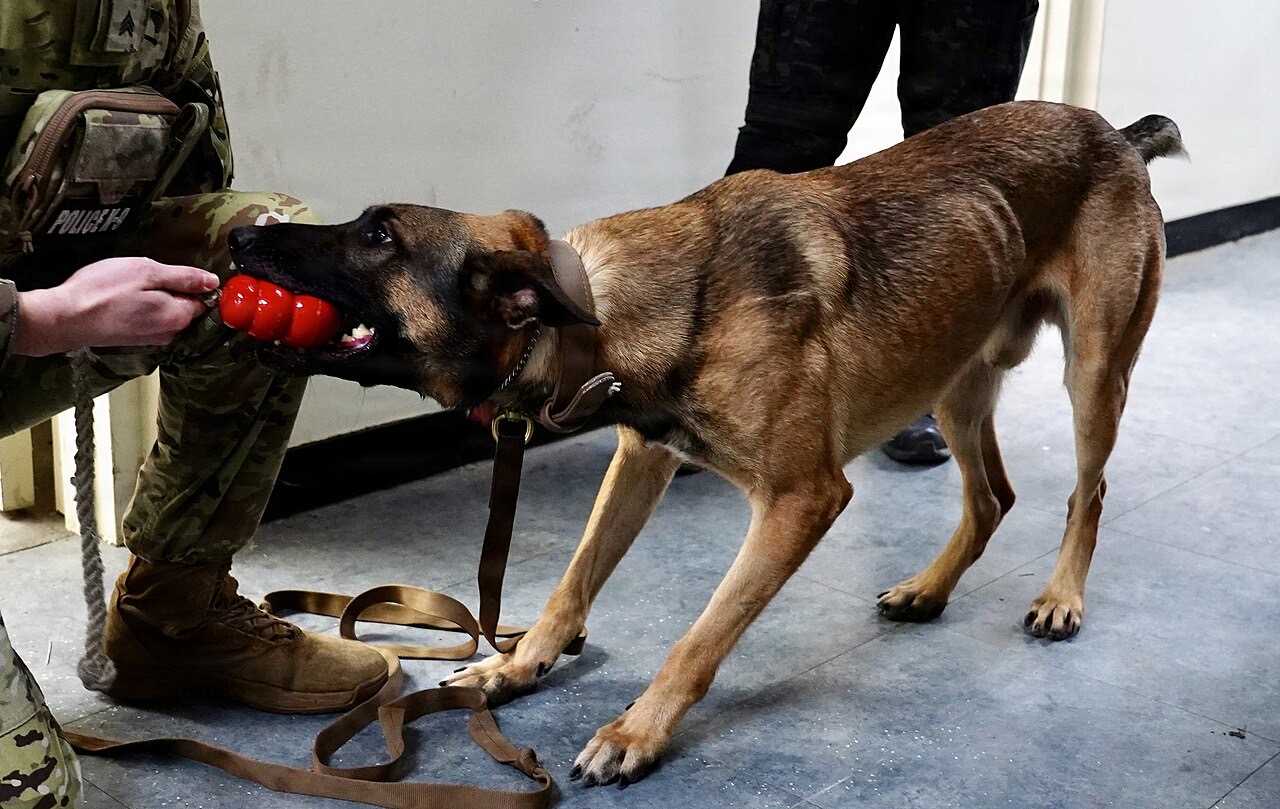
Visual AidThe instant reward
Photograph of a military working dog taking its reward toy from a handler the moment a training task ends — the third rule the Knowledge Bank gives, reward instantly, because a dog’s mind ties praise to whatever it did seconds before. Modern handlers use a toy where a hill hunter used his hands and his voice; the setting is a training floor, not a night in the timber. Nothing here is a coonhound and nothing here is Billy’s drag line, but the principle in the picture is the one that turned a summer of drills into a craft.
Military working dog rewarded during training; U.S. Department of Defense photograph distributed through DVIDS. Source: Wikimedia Commons, File:Military working dog rewarded during training (9551982).jpg, public domain.
Picture a hole bored into a fallen log on a riverbank. At the bottom of the hole lies a scrap of bright tin, and around its mouth a ring of nails slants inward like teeth. Nothing about it looks dangerous, and that is the genius of it: the trap has no spring, no jaws, and no bait that a careful animal would fear. It asks only one question — will a curious coon reach in, close its fist on something shiny, and refuse to let go? Part 3 is the summer Billy turns two roly-poly pups into hunting dogs. It begins with a homecoming and a pair of names found carved inside a heart on a tree, runs through an old man’s trickery and a father’s lesson about fairness, and ends on a cool autumn night with a lantern, an ax, and a promise: if the dogs can tree a coon, Billy will do the rest. The dogs keep their half of the bargain almost at once. Keeping his half will take everything the boy has.
Original passage written for Garden Heights — not a quotation from the novel.
1Claim: “Part 3 shows that the two dogs succeed as a pair because their opposite natures complete each other.” — choose the two details that best prove it.Claim & Evidence
2Old Dan’s boldness, or Little Ann’s brains? Tap each detail to send it left or right.Sort into two
◄ Old Dan’s boldnessLittle Ann’s brains ►
3Match each cause to its result. For each cause, pick its result.Cause & Effect
Grandpa shares his old brace-and-bit trick→
Billy’s scent clings to the fresh trap logs→
Papa judges the nail trap unfair→
A summer of drills with the dragged hide→
🧠Knowledge Bank question
4Fill both blanks to complete the reasoning.Build the Argument
According to the Knowledge Bank, a summer of drills turns raw instinct into a craft because , and the reward has to come instantly because .
Part 5
Standardized Test
The Nose That Reads the Ground · Reading & Vocabulary · SAT & TOEFL-style practice
Read the passage — the highlighted words are tested — then answer. Tap an answer, then tap it again to confirm.
SATCentral Ideas — the passage's main point
SATInference — a conclusion the passage implies
SATAuthor’s Purpose — what the author wants to achieve
SATWords in Context — a word's meaning in this passage
TOEFLFactual Information — a fact stated in the passage
TOEFLVocabulary — a tested word's meaning here
The Nose That Reads the Ground
Run a hand over ground an animal crossed an hour ago, and you feel nothing. A hound smells a story there. Inside a dog’s nose lie hundreds of millions of scent receptors — nerve endings that catch odor particles — while a human nose holds only five or six million. The part of a dog’s brain that sorts smells is, for its size, dozens of times larger. When a hound presses its nose to the earth, it reads a page that is blank to a person.
The story it reads is written in almost nothing. Every animal sheds a drifting cloud of skin flakes, body oils, and breath, and this minute residue settles on grass and soil wherever it travels. Time rewrites the page. A fresh line of scent — hunters call it a hot trail — is easy to follow, while an old, cold trail has been thinned by sunlight and scattered by wind until only a faint trace remains. Cool, damp night air holds scent close to the ground, which is one reason coon hunters work in darkness.
A good hound turns all this chemistry into sound. It bawls — gives a long, rolling cry — whenever it holds the trail, so a hunter can follow a chase he cannot see, and the voice quickens as the scent grows fresher. When the quarry climbs, the hound plants itself at the trunk and barks steadily upward; hunters say the animal is treed, and the dog holds that spot until its owner arrives. The nose itself is pure instinct, alive in a pup that has never hunted, but reading it takes practice, so a young hound is drilled by repetition until some clinging trace of scent betrays every trick a wily quarry can invent.
Original passage written for Garden Heights — not a quotation from the novel.
1What is the main idea of the passage?SAT · Central Ideas
2According to the passage, a dog’s nose differs from a human’s because it holds ___.TOEFL · Factual Information
3The passage says a scent trail is written in ___.TOEFL · Factual Information
4The passage suggests that a coon crossing a stream will ___.SAT · Inference
5According to the passage, a hound’s voice quickens when ___.TOEFL · Factual Information
6Why does the author open by asking the reader to run a hand along the ground?SAT · Author’s Purpose
7According to the passage, a hound that has treed its quarry will ___.TOEFL · Factual Information
8In the passage, minute most nearly means ___.SAT · Words in Context
9In the passage, instinct most nearly means ___.TOEFL · Vocabulary
10In the passage, wily most nearly means ___.TOEFL · Vocabulary
Part 6 · Optional
Creative Writing
A bonus challenge to practice your English. Take your time and have fun with it.
About This Section
This writing task is optional and is not part of your auto-graded score. The feedback below checks only the basics — length, spelling, and grammar — not whether your ideas are right or wrong. It is meant for classroom discussion and creative practice, so feel free to use your imagination!
Writing Task — Part 3 “The Summer You Practiced”
Billy turns two clumsy pups into partners with one long summer of repeated drills — the same trail, again and again, a little harder each time. Write about a skill you built through repetition: a sport, an instrument, a language, anything. Describe what the boring middle part felt like, one moment when you wanted to quit, and the first moment the skill finally worked. 6–10 sentences. End with one sentence of advice for someone just starting out.
You can start with: “At first I was terrible at it, and nobody knew that better than I did...”
0 / 40 words minimum
🗣 Teach It · Just for Fun (optional)
No right or wrong — close the screen and tell someone nearby what happened in this part. Can’t find anyone? Tell yourself out loud. The moment you teach it, you truly understand it.
Part 3 Complete!
You finished Chapters 6–8 of Where the Red Fern Grows.
Independent study guide by Garden Heights. Not affiliated with or endorsed by Wilson Rawls. Contains original analysis only; no text from the novel is reproduced. Reference text: This workbook follows Wilson Rawls’s classic text (the standard Puffin edition sold worldwide). Revised 2023 UK editions change some wording and may not match the vocabulary studied here.