New here? Just sign up with Google — your account includes Matilda, our gift book, forever.
Where the Red Fern Grows · Garden Heights
Part 4
for Where the Red Fern Grows · Part 4 · Chapters 9–10
8 Parts40 min
What Happens in Part 4
Billy keeps his promise, chopping down the giant sycamore, then hunts through a booming season.
The big treeThe night Billy has ached for all summer arrives. Lantern lit and axe on his shoulder, he follows Old Dan and Little Ann into the river bottoms, and the old ringtail they strike runs its tricks before climbing the one tree no boy should have to face: the giant sycamore the hunters call the big tree. Billy's heart sinks, and he almost calls his dogs away.
The scarecrow trickHe remembers the bargain he made them, and chops until he can barely lift the axe. Grandpa arrives with a trick worthy of an old fox: prop a scarecrow under the tree, and the treed coon, watching that still figure, will not dare come down. It buys Billy a supper and a night's sleep, though Old Dan will not leave, has to be hauled home, and is back at the trunk by morning.
The windBilly chops all the next day until his blistered hands give out. Beaten, he asks God for the strength to finish the job, and the air stirs: a wind moves in the top of the big tree while the other trees stand still, and the giant goes down with a roar. The dogs take their first coon, and Billy walks home telling his father he believes the wind was sent.
Coon crazyAfter that the season begins in earnest. Billy hunts almost every night, coon crazy, and fur prices climb just as Grandpa predicted; he sells his hides at the store, hands every dollar to his father, and soaks up the older hunters' stories while they tease him about his small dogs. The teasing does not last: Little Ann hunts with brains, Old Dan with reckless heart, digging into a muskrat den and climbing a hollow tree.
What We Will Learn
Section
What you will practice
Vocabulary
The axe, the hunt, and the hard-won hide: bawl, quarry, pledge, persevere, prime…
Literary Elements
Internal conflict fought with an axe, a sycamore that grows into a symbol, and an unexplained wind that leaves room for both faith and weather
Cross-Curricular
The raccoon — hands that read the dark, night rounds and hollow-tree dens, water tricks that can drown a hound, and hides worth cash in the 1930s
Chapter Summary
Ch.
What happens
Chapter 9
The Big Tree — On their first real hunt, Old Dan and Little Ann tree their first coon in the giant sycamore of the river bottoms. Remembering his pledge — if the dogs treed one, he would do the rest — Billy chops until his hands blister. Grandpa’s scarecrow holds the coon treed overnight, and when Billy’s strength finally fails, a strange wind finishes what the axe began. The dogs take their first coon, and Billy believes the wind was sent.
Chapter 10
Coon Crazy — The season opens in earnest. Billy hunts almost every night, sells his hides at Grandpa’s store as fur prices climb, and hands every dollar to his father. Older hunters tease him about his small dogs — until the stories start: Little Ann hunting with brains, and Old Dan with so much reckless heart that Billy must dig him out of a muskrat den and fetch him down out of a hollow tree.
Part 1
Vocabulary
Study 10 key words from Chapters 9–10, then answer each question.
✋Knowledge Bank · Hands That See in the Dark
Zoology · The Raccoon’s TouchWatch a raccoon at the edge of a creek and you will understand why hunters respect it. Its front paws are nearly as dexterous as human hands — five long fingers that can turn a mussel, lift a latch, or work a knot loose. Those fingers are packed with nerve endings, and a larger share of the raccoon’s brain is devoted to touch than to any other sense. Water makes the whole system sharper still: wet skin carries more feeling, so a raccoon standing in a stream will douse its paws and roll its food over and over, reading it the way we read with our eyes. Scientists even named the species Procyon lotor — the second word means the washer — because of this habit. But the old myth has it backward. The animal is not cleaning its dinner at all. It is sharpening its finest tool, its sense of touch.
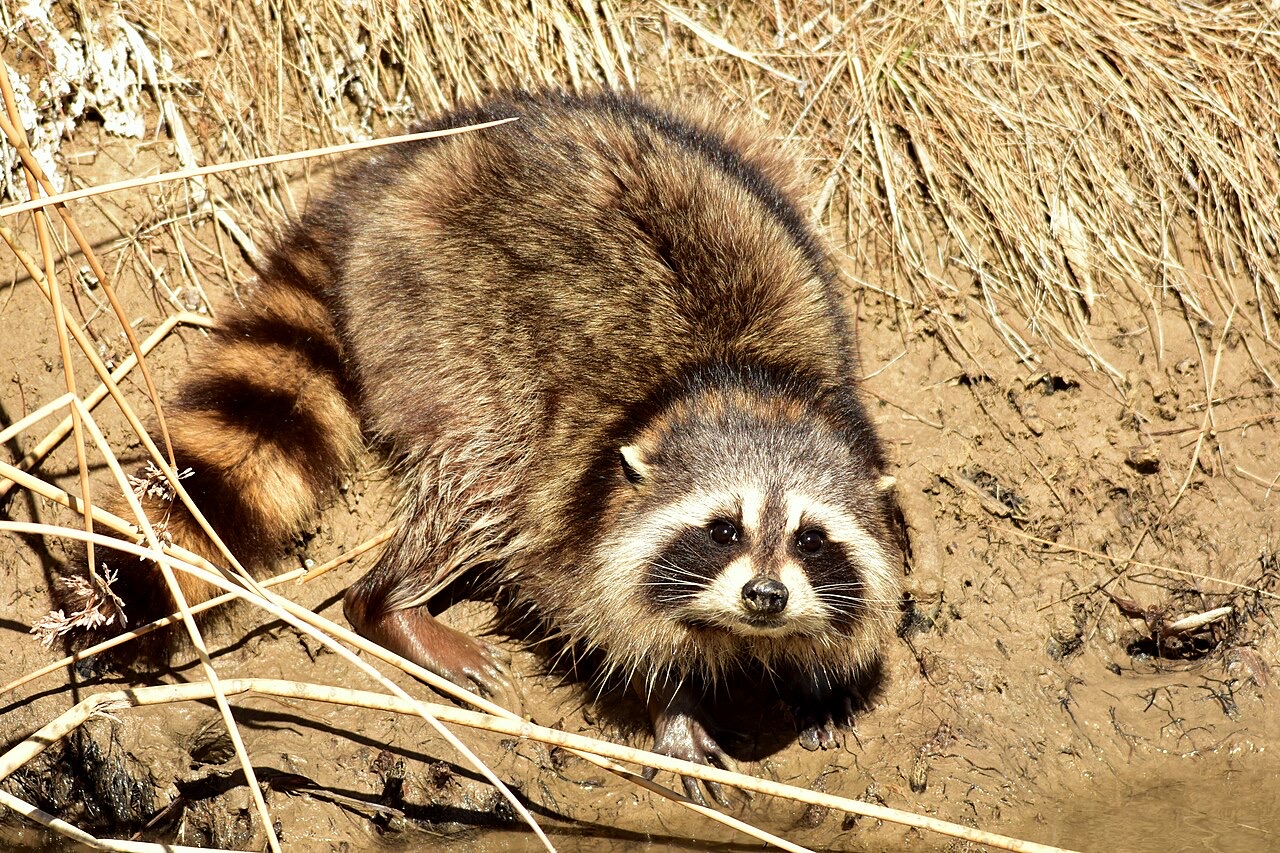
Visual AidFive fingers on a mudbank
Photograph of a raccoon at the edge of the water on a national wildlife refuge in Wyoming, its front paws flat on the wet mud with the long dark fingers spread. Those fingers are the tool the Knowledge Bank is about: packed with nerve endings, sharpened further by water, and used to read a mussel or a latch the way we read with our eyes. What no photograph can show is the share of the animal’s brain given over to touch, or the fact that it is not washing its food. The refuge is far from the Ozarks; the paws are the same everywhere.
Raccoon on Seedskadee National Wildlife Refuge, Wyoming; photograph by Tom Koerner, U.S. Fish and Wildlife Service, March 2017. Source: Wikimedia Commons, File:Raccoon on Seedskadee National Wildlife Refuge (32911040513).jpg, public domain.
bawln.Ch.9
The long, deep cry a hound gives on a trail or at a tree
“Old Dan’s bawl rolled down the river bottoms like a bell.”
quarryn.Ch.9
The animal that a hunter or a predator is chasing
“The ringtail quarry headed straight for the biggest tree on the river.”
pledgen.Ch.9
A serious, binding promise
“Billy had made his dogs a pledge, and he meant to keep it.”
blistern.Ch.9
A sore bubble of skin caused by rubbing
“By noon, every swing of the axe broke another blister.”
perseverev.Ch.9
To keep working at something difficult without giving up
“Billy persevered long after his arms began to shake.”
dumbfoundedadj.Ch.9
So astonished that you cannot speak
“Billy stood dumbfounded under the giant sycamore.”
gustn.Ch.9
A sudden, strong rush of wind
“One long gust leaned into the weakened sycamore.”
primeadj.Ch.10
Of the very best quality
“A prime winter hide brought the highest price at the store.”
hiden.Ch.10
The skin of an animal, often with the fur still on it
“A well-stretched hide brought a better price at the store.”
triumphn.Ch.9
A great victory, or the joy that comes with one
“He walked home in triumph with the season’s first coon.”
ⓘ The vocabulary words in this list are selected to help you understand and complete this workbook. Some may not appear verbatim in the original novel.
🧠Knowledge Bank question
1According to the Knowledge Bank, a raccoon — often a hunter's quarry — that rolls its food over in a stream is really ___.Ch.9
2A ‘quarry’ is the animal that a hunter is chasing.Ch.9
3A ‘pledge’ is ___.Ch.9
4To ‘persevere’ means to ___.Ch.9
5Fill in each blank with the correct word.Ch.9
Word choices:blisterpledgequarrybawl- some words will not be used
Every axe stroke rubbed up another .
Billy refused to break his .
6A ‘gust’ is ___.Ch.9
7A ‘prime’ hide is one of poor, thin quality.Ch.10
8Someone who is ‘dumbfounded’ is ___.Ch.9
9Fill in each blank with the correct word.Ch.9–10
Word choices:triumphhidegustprime- some words will not be used
Billy stretched each with pride.
He walked home in at last.
10A ‘gust’ is a sudden, strong rush of wind.Ch.9
Part 2
Comprehension
Show you understood what happens in Chapters 9–10.
🌙Knowledge Bank · The Night Shift on the River
Ecology · Nocturnal ForagingAlmost everything in Part 4 happens after dark, because almost everything a raccoon does happens after dark. The raccoon is nocturnal: it leaves its den at dusk, works the streams and field edges through the night, and is asleep again before the sun clears the ridge. Its rounds follow water — shallow riffles where clever fingers feel out crayfish, and mudbanks stitched with tracks shaped like small human hands. Its diet is nearly everything: an omnivore’s menu of frogs, mussels, corn, wild grapes, eggs, and whatever a farm leaves unguarded. By day it sleeps out of sight in a hollow tree, a rock crevice, or a burrow some other animal dug. In the coldest weeks it does not truly hibernate; it simply holes up, living on autumn fat, and comes out again on mild nights. That schedule writes the rules of the sport: to meet a raccoon, a boy and his hounds must give up sleep and learn the night.
🧠Knowledge Bank question
1The Knowledge Bank explains that through the coldest weeks of winter a raccoon ___.Ch.9
2Why does Billy refuse to call his dogs away from the big tree?Ch.9
3Billy cuts the big sycamore down in a single afternoon.Ch.9
4What trick does Billy’s grandfather teach him at the big tree?Ch.9
5Write the numbers 1–5 in the boxes to show the correct order of events. Number 1 = what happens first.Chapters 9–10
Billy carries his first coon hide home in triumph.
Grandpa’s scarecrow guards the tree while Billy rests.
A sudden wind sends the big sycamore crashing down.
Old Dan strikes the season’s first trail along the river.
The coon takes refuge high in the giant sycamore.
6Why does the scarecrow keep the raccoon in the tree?Ch.9
7Billy believes the wind that fells the big tree is an answer to his prayer.Ch.9
8What happens to Billy’s hands during the long chopping job?Ch.9
9Billy gives up and goes home for good before the big tree falls.Ch.9
10What does Billy do with the money his coon hides bring in?Ch.10
Part 3
Literary Elements
Understanding HOW and WHY Wilson Rawls tells the story across Chapters 9–10.
🌬Knowledge Bank · The Wind Rawls Never Explains
Authorial Craft · AmbiguityThe most argued-about moment in Part 4 is a gust of wind. Billy has chopped for two days; his hands are ruined; his arms are done. He asks for the strength to finish the job — and the air stirs, the wind leans on the weakened sycamore, and the big tree comes down. Wilson Rawls (author) makes a careful choice here: he never tells the reader what that wind was. Billy, remembering the day as a grown man, believes it was an answer. A reader is free to believe it was ordinary weather arriving at an extraordinary moment. This is ambiguity — a question a writer leaves deliberately open — and it is a form of respect, because the story trusts you to weigh the evidence yourself. Notice, too, who is telling the tale: an adult looking back on his boyhood, and memory, unlike weather, keeps its own faith.
Internal Conflict
The real battle at the big tree is fought inside Billy — the longing to quit against the promise he gave two pups when keeping it cost nothing.
Symbolism
A sycamore too big for a boy’s axe stands for a promise too big for a night’s work; when it falls, more than a tree comes down.
Ambiguity
Billy asks for strength, and a wind rises. Wilson Rawls (author) never says whether it is weather or an answer — the question is left open on purpose.
🧠Knowledge Bank question
1According to the Knowledge Bank, Wilson Rawls (author) never says what the wind at the big tree was because ___.Ch.9
2The giant sycamore, far too big for a boy’s axe, works as a symbol of ___.Ch.9
3A symbol is an object that stands for something bigger than itself.Ch.9
4Rawls never states whether the wind is chance or an answered prayer. This choice mainly creates ___.Ch.9
5Internal conflict is a struggle between a character and an outside enemy.Ch.9
6Fill in each blank with the correct literary term.Ch.9
Word choices:symbolinternalrhymeindex- some words will not be used
The big sycamore works as a of Billy’s promise.
His urge to quit fights his vow in an conflict.
7Which moment shows internal conflict most clearly?Ch.9
8Writers create ambiguity when they leave a question deliberately open.Ch.9
9When the big tree finally falls, the moment mainly symbolizes ___.Ch.9
10Fill in each blank with the correct literary term.Ch.9
Word choices:ambiguityconflictsymbolindex- some words will not be used
Leaving the wind unexplained creates .
A struggle inside one mind is an internal .
Part 4
Think Deeper
Four deeper challenges — no single-word recall. Read, weigh the evidence, and reason it out.
💵Knowledge Bank · What a Hide Was Worth
Economic History · The Coonskin TradeWhen Billy carries his first hide home, he is not just winning a trophy — he is joining a national industry. In the 1920s, a college fad for long coonskin coats sent raccoon fur prices soaring, and although that boom cooled in the 1930s, a good hide was still cash in a nearly cashless countryside. Fur was graded: a prime hide — taken in midwinter, when the coat grows longest and thickest — brought several times the price of a thin early-autumn one. The chain ran from a boy with an axe to a country store like Grandpa’s, and from there by rail to the big-city fur houses, where hides became coats, caps, collars, and trim. For hill families who handled little money from one year’s end to the next, a son with two good hounds was no hobby. Forty cents to a few dollars a hide, night after night across a long winter season, added up to real money.
Visual AidFrom one hide to a winter’s wages
Sequence and measure diagram of the trade the Knowledge Bank describes: a night’s hunt, a hide stretched and dried at home, a country store that paid in cash or trade, and the rail line to the city fur houses that turned hides into coats and caps. The two bars compare grades only in proportion — a prime midwinter hide against a thin early-autumn one — and they are not quoted prices from any single year; fur markets swung hard from season to season. The chain shown is the ordinary one; it does not track any particular hide in the novel.
Fur grading by season and the country-store-to-fur-house chain as described in standard histories of the North American fur and hide trade. Drawn for Garden Heights Academy.
Picture a boy standing at the foot of a sycamore so big that grown men joining hands could not reach around it. Somewhere up in that dark crown sits the first raccoon his hounds have ever put in a tree. Any sensible person would tell him to call the dogs and come back for an easier one — any sensible person who had not heard the promise he made his pups back in the summer: you tree one, and I will do the rest. So he spits on his hands and swings the axe. For two days the river bottoms ring with that one small sound against that one enormous tree, while an old man’s scarecrow stands night guard under the branches and two young hounds refuse to leave their post. And at the very end, when the boy’s arms are used up and the giant still stands, a wind moves in the top of the big tree while every other tree in the bottoms stays still. Whether that wind is weather or an answer is a question this book hands, very deliberately, to you.
Original passage written for Garden Heights — not a quotation from the novel.
1Claim: “Part 4 argues that a promise is measured by what you will pay to keep it.” — choose the two details that best prove it.Claim & Evidence
2Billy’s grit, or The coon’s cunning? Tap each detail to send it left or right.Sort into two
◄ Billy’s gritThe coon’s cunning ►
3Match each cause to its result. For each cause, pick its result.Cause & Effect
The pups tree their first coon in the giant sycamore→
Billy’s hands blister and his strength runs low→
Billy asks for the strength to finish the job→
The big sycamore finally falls→
🧠Knowledge Bank question
4Fill both blanks to complete the reasoning.Build the Argument
According to the Knowledge Bank, a boy's coon hides mattered to a hill household because , and a midwinter hide paid best because .
Part 5
Standardized Test
The Masked Survivor · Reading & Vocabulary · SAT & TOEFL-style practice
Read the passage — the highlighted words are tested — then answer. Tap an answer, then tap it again to confirm.
SATCentral Ideas — the passage's main point
SATInference — a conclusion the passage implies
SATAuthor’s Purpose — what the author wants to achieve
SATWords in Context — a word's meaning in this passage
TOEFLFactual Information — a fact stated in the passage
TOEFLInsert Text — where a sentence best fits
TOEFLVocabulary — a tested word's meaning here
The Masked Survivor
The raccoon wears a black mask, and the costume fits: little in North America is harder to outwit. Its first tool is a pair of front paws nearly as dexterous as human hands, fingers wrapped in nerve endings. A huge share of its brain is given over to reading what those fingers feel. Beside a stream, a raccoon will dunk its paws and turn a stone over and over, because wet skin feels more. The famous ‘washing’ of food is not about cleanliness at all — the animal is sharpening its sense of touch.
The mind behind the mask is just as remarkable. In 1908, an early animal psychologist gave captive raccoons a set of thirteen boxes fastened with hooks, bolts, buttons, and latches, and the animals worked eleven of the locks open. Raccoons put that cleverness to use after dark: they forage by night, feeling through shallow water for crayfish and mussels, stripping ears from cornfields, and robbing nests. By day they sleep out of sight in dens — hollow trees, rock crevices, abandoned burrows, or a corner of a barn loft.
A raccoon makes an inventive quarry once a hunter’s hounds are on its trail. A chased coon will wade up a creek to drown its scent, trot along a fence rail, or leap from one tree into another so its trail ends. Only hounds that persevere, circling wide until the scent returns, will finish such a chase. In deep water the coon becomes a formidable opponent: it can climb onto a swimming hound’s head and hold it under, so wise hunters call their dogs off at the water’s edge. Biologists believe more raccoons live in North America today than when the first settlers arrived, and the mask looks earned.
Original passage written for Garden Heights — not a quotation from the novel.
1What is the main idea of the passage?SAT · Central Ideas
2According to the passage, why does a raccoon wet its paws?TOEFL · Factual Information
3The 1908 experiment showed that captive raccoons could ___.TOEFL · Factual Information
4The passage suggests that people who say raccoons wash their food are ___.SAT · Inference
5Insert Text (TOEFL). Look at the four squares [1]–[4] in the excerpt below. They show where this sentence could be added: “Some of the animals still remembered exactly how those fastenings worked when they were tested again long afterward.”
Raccoons put that cleverness to use after dark: they forage by night, feeling through shallow water for crayfish and mussels, stripping ears from cornfields, and robbing nests. [1] By day they sleep out of sight in dens — hollow trees, rock crevices, abandoned burrows, or a corner of a barn loft. [2] In 1908, an early animal psychologist gave captive raccoons a set of thirteen boxes fastened with hooks, bolts, buttons, and latches, and the animals worked eleven of the locks open. [3] The mind behind the mask is just as remarkable. [4]
Where would the sentence fit best?TOEFL · Insert Text
6Why does the author include the story of the locked boxes?SAT · Author’s Purpose
7What can be inferred about a hound that swims after a raccoon in deep water?SAT · Inference
8In the passage, dexterous most nearly means ___.SAT · Words in Context
9In the passage, quarry most nearly means ___.TOEFL · Vocabulary
10In the passage, persevere most nearly means ___.TOEFL · Vocabulary
Part 6 · Optional
Creative Writing
A bonus challenge to practice your English. Take your time and have fun with it.
About This Section
This writing task is optional and is not part of your auto-graded score. The feedback below checks only the basics — length, spelling, and grammar — not whether your ideas are right or wrong. It is meant for classroom discussion and creative practice, so feel free to use your imagination!
Writing Task — Part 4 “The Promise That Got Heavy”
At the foot of the big sycamore, Billy learns what a promise really weighs: he gave his word to two dogs back when keeping it cost nothing, and then paid for it with two days of blisters. Write about a promise, a commitment, or a goal that turned out to be far heavier than it looked when you took it on. Describe what you promised, the moment you most wanted to quit, and what made you finish — or what you learned if you could not. 6–10 sentences. End with what you now think about before giving your word.
You can start with: “It sounded easy when I said I would do it...”
0 / 40 words minimum
🗣 Teach It · Just for Fun (optional)
No right or wrong — close the screen and tell someone nearby what happened in this part. Can’t find anyone? Tell yourself out loud. The moment you teach it, you truly understand it.
Part 4 Complete!
You finished Chapters 9–10 of Where the Red Fern Grows.
Independent study guide by Garden Heights. Not affiliated with or endorsed by Wilson Rawls. Contains original analysis only; no text from the novel is reproduced. Reference text: This workbook follows Wilson Rawls’s classic text (the standard Puffin edition sold worldwide). Revised 2023 UK editions change some wording and may not match the vocabulary studied here.