New here? Just sign up with Google — your account includes Matilda, our gift book, forever.
Where the Red Fern Grows · Garden Heights
Part 7
for Where the Red Fern Grows · Part 7 · Chapters 16–18
8 Parts40 min
What Happens in Part 7
Three coons carry Billy's dogs into the finals, where a blizzard nearly kills them and wins the cup.
Qualifying nightBilly's set has drawn one of the last qualifying nights, and Grandpa drives the buggy toward swampy ground no other cast has hunted over. The night is a masterpiece of teamwork: the first coon leaps into the river and the dogs take it in the water; the second is treed across the river, and Grandpa falls in crossing; before morning a third is caught and the judge shakes his head in admiration.
The jackpotThree coons put Billy's set through to the finals, and on the eve of the last hunt the hunters announce a jackpot they have raised themselves, more than three hundred dollars for the winner. The final round starts well, with a coon taken early. Then the weather turns: wind and sleet come howling down from the north, and when Papa talks of quitting, Billy cannot bear to leave his dogs, so the men push on.
Three coons at oncePapa fells the tree where Old Dan is raging, and instead of one coon, three burst out. Each dog takes one; the third escapes, and the dogs vanish into the blizzard after it. In the terrible search that follows, Grandpa goes down in the dark and twists his ankle so badly that he cannot walk.
Ice and gold cupAt daylight, men from camp plow through the snow to help, and the dogs are found sheathed in ice at the foot of a tree they have guarded all night, a circle worn in the snow where they kept themselves alive by never standing still. The men rub them back to life and take the coon: the skin that wins the championship. Billy comes home with the gold cup and the jackpot, and Mama cries.
What We Will Learn
Section
What you will practice
Vocabulary
Contest and storm words: qualify, eliminated, jackpot, sleet, dumbfounded…
Literary Elements
A climax staged inside a blizzard, person-versus-nature conflict, and a gold cup that carries far more meaning than the metal it is made of
Cross-Curricular
How organized coonhound championships worked — casts, judges, scored trees, elimination nights, and a purse the hunters raised themselves
Chapter Summary
Ch.
What happens
Chapter 16
Three Coons to Qualify — On their qualifying night the dogs hunt swampy ground no cast has touched. The first coon leaps into the river and is caught in the water, Grandpa takes an icy bath crossing after the second, and after one false alarm from Old Dan the third is taken by morning. Billy’s set advances to the finals, and the hunters announce a jackpot of more than three hundred dollars for the winner.
Chapter 17
The Storm Breaks — The final round opens with an early coon, and then a norther arrives: wind, sleet, and driving cold. Billy refuses to abandon his dogs, so the men push on. A felled tree pours out three coons at once; each dog takes one, the third escapes with the dogs behind it, and in the storm-blind search Grandpa falls and badly twists his ankle.
Chapter 18
The Gold Cup — The storm blows out and snow comes down. Searchers from camp help find the dogs sheathed in ice at their tree, a worn circle in the snow showing how they kept from freezing. Revived by a fire, they take the coon that clinches the championship. Billy carries home the gold cup and the jackpot, and Mama cries over the money on the mantle.
Part 1
Vocabulary
Study 10 key words from Chapters 16–18, then answer each question.
🤝Knowledge Bank · The Code of the Camp
Civics · SportsmanshipA judged hunt held at night, in rough country, in any weather, only works if the people in it can be trusted, so the sport ran on an unwritten code that was enforced more strictly than the printed rules. Its first article was honesty. A judge cannot see everything in the dark; he depends on a handler’s word about which hound is speaking and what its voice means, and a man caught lying about a tree was finished in that world — no club would take his entry again. The second article was restraint: once the dogs were loose, no touching, no leading, no help. The third was the one that looks strangest next to modern sports: your competitors were also your keepers. Hunters shared fires, hauled one another’s gear across rivers, and when a cast failed to come in, the contest simply stopped while the whole camp turned out to search. That is exactly what happens for Billy’s party in the snow. The men breaking trail to reach him were not his friends from home. They were his rivals.
contestantn.Ch.16
A person or team entered in a competition
“Nearly every contestant in camp had brought a fine registered hound.”
eliminatedv.Ch.16
Removed from a contest after losing a round
“Sets that treed too few coons were eliminated night by night.”
qualifyv.Ch.16
To earn the right to move on to the next round
“Three coons in one night let Billy’s set qualify for the finals.”
jackpotn.Ch.16
A pooled prize of money that goes to the winner
“The hunters raised a jackpot of more than three hundred dollars.”
sleetn.Ch.17
Rain that freezes into ice pellets as it falls
“The sleet stung their faces and crusted on the branches overhead.”
galen.Ch.17
A very strong, dangerous wind
“The gale drove the snow sideways through the river bottoms.”
flounderedv.Ch.17
Struggled and stumbled clumsily
“The men floundered through the drifts, calling for the dogs.”
revivev.Ch.18
To bring back to strength or consciousness
“The men rubbed the frozen dogs beside the fire to revive them.”
ordealn.Ch.18
A long, painful, and difficult experience
“The freezing night on the riverbank was an ordeal none of them forgot.”
dumbfoundedadj.Ch.18
So astonished that you cannot speak
“The pile of prize money left the whole family dumbfounded.”
ⓘ The vocabulary words in this list are selected to help you understand and complete this workbook. Some may not appear verbatim in the original novel.
🧠Knowledge Bank question
1According to the Knowledge Bank, a contestant caught lying about a tree was ___.Ch.16
2A ‘contestant’ is a person or team entered in a competition.Ch.16
3‘Sleet’ is ___.Ch.17
4Fill in each blank with the correct word.Ch.16
Word choices:eliminatedjackpotreviveordeal- some words will not be used
Losing sets were night by night.
The hunters raised a of more than three hundred dollars.
5‘Floundered’ means ___.Ch.17
6A ‘gale’ is a gentle breeze that barely stirs the leaves.Ch.17
7‘Revive’ means to ___.Ch.18
8Fill in each blank with the correct word.Ch.18
Word choices:ordealsleetcontestanteliminated- some words will not be used
The frozen night in the bottoms was an for everyone.
Crusts of frozen had to be rubbed from the dogs’ coats.
9A ‘jackpot’ is a small entry fee each hunter pays to a judge.Ch.16
10Someone who is ‘dumbfounded’ is ___.Ch.18
Part 2
Comprehension
Show you understood what happens in Chapters 16–18.
🌨Knowledge Bank · The Wind That Turns in an Hour
Meteorology · Blue NorthersThe storm that closes over the final hunt is a real creature of the southern plains and the Ozark hills; old-timers called it a blue norther. It is a fast-moving Arctic cold front, a wall of dark cloud on the north horizon, and when it arrives the wind swings around and the temperature can fall forty degrees Fahrenheit in a few hours. Rain turns to sleet — raindrops that freeze into ice pellets on the way down — and sleet turns to wind-driven snow. In a wooded bottom at night this makes a whiteout, blowing snow that erases every landmark, and people who trust their sense of direction begin to walk in circles. The killer in such weather is rarely the cold alone but hypothermia — a dangerous drop in the body’s core temperature — which wet clothes and wind bring on fast, and which muddles a person’s judgment first of all. Heat comes from working muscle, so two ice-coated hounds pacing around a tree until dawn were not being stubborn; they lived because they never stopped moving.
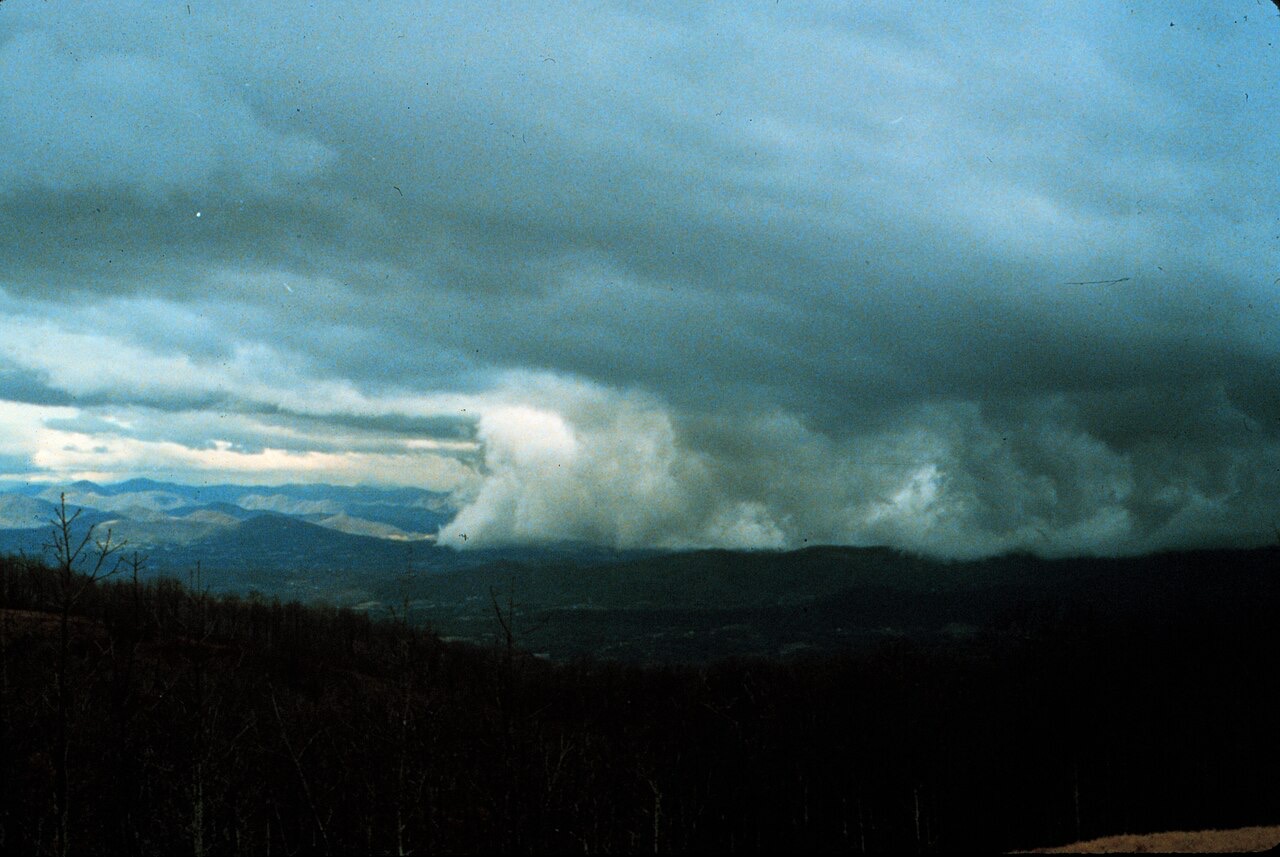
Visual AidA wall of cloud on the horizon
Photograph from the National Weather Service collection of the cloud wall that runs ahead of a fast-moving cold front: a dark deck pushing in over wooded ridges, its pale leading edge boiling up, while the far hills at the left still stand in clear air. That advancing wall is what the Knowledge Bank calls a blue norther — the temperature can drop forty degrees Fahrenheit within hours of its arrival, and rain turns to sleet and then to driven snow. This is one front over one range of hills on one afternoon, not the storm in the book, and no photograph can show the wind or the falling thermometer.
Cloud wall associated with a fast-moving cold front; NOAA Photo Library, historic National Weather Service collection (wea00121). Source: Wikimedia Commons, File:Cloud wall associated with fast moving cold front - NOAA.jpg, public domain.
🧠Knowledge Bank question
1The Knowledge Bank explains that the two ice-covered hounds lived through the storm because ___.Ch.16
2What happens when the first qualifying coon is treed?Ch.16
3Old Dan gives one false alarm before the third qualifying coon is taken.Ch.16
4What is announced on the eve of the final round?Ch.16
5Write the numbers 1–5 in the boxes to show the correct order of events. Number 1 = what happens first.Chapters 16–18
Searchers find the ice-covered dogs still holding their tree.
A felled tree pours out three coons, and one gets away.
The head judge hands Billy the gold cup and the jackpot.
A storm of wind and sleet breaks over the final hunt.
Old Dan and Little Ann take three coons on their qualifying night.
6The men give up the final hunt as soon as the storm begins.Ch.17
7What happens to Grandpa during the storm?Ch.17
8How are the dogs found after the night of the storm?Ch.18
9Other hunters leave camp to search for Billy’s party in the storm.Ch.18
10What does winning the championship bring Billy?Ch.18
Part 3
Literary Elements
Understanding HOW and WHY Wilson Rawls tells the story across Chapters 16–18.
🎭Knowledge Bank · An Opponent With No Face
Literature · Nature as AntagonistAn antagonist is whatever force stands between a character and what that character wants, and it does not have to be a person. For most of Part 7 the opposition seems obvious — a camp full of costly, registered hounds — yet when the climax arrives, Wilson Rawls (author) retires every human rival and hands the last night to the weather. The choice matters. A human opponent can be outsmarted, out-talked, or shamed; a blizzard cannot. It has no plan, takes no pleasure, and hears no appeal, so person-versus-nature conflict strips a story down to endurance, preparation, and loyalty — exactly the virtues this book has been building since the dogs were pups. Watch what the weather does to the human rivals, too: the instant nature becomes the enemy, the other hunters stop being competitors and turn into a search party. The contest was never truly boy against boy or hound against hound. It was all of them, together, against the storm.
Climax
The blizzard hunt is the peak of the whole hunting storyline — every skill and every bond the dogs have built is tested in a single frozen night.
Conflict — Person vs. Nature
The last opponent is not a rival hound but the storm itself: wind, sleet, and a cold that can kill, an enemy with no plan and no mercy to appeal to.
Symbolism
The gold cup stands for heart beating money and pedigree, and the circle worn in the snow around the tree is loyalty made visible.
🧠Knowledge Bank question
1According to the Knowledge Bank, a storm makes a harder final opponent than a rival hunter because ___.Ch.18
2The storm that nearly kills the hunters is an example of conflict between ___.Ch.17
3An antagonist can be a force of nature rather than a character.Ch.17
4The gold cup is best read as a symbol of ___.Ch.18
5Symbolism means an object carries a meaning beyond its plain use.Ch.18
6Fill in each blank with the correct literary term.Ch.18
Word choices:climaxsymbolismsettingdialogue- some words will not be used
The frozen final hunt is the of the contest story.
Treating the gold cup as more than a trophy is .
7By setting the final hunt in a blizzard, Wilson Rawls (author) mainly builds ___.Ch.17
8Person-versus-nature conflict means the hero struggles against the customs of a town.Ch.17
9Which detail best shows nature acting as the antagonist?Ch.18
10Fill in each blank with the correct literary term.Ch.17
Word choices:antagonistconflictclimaxnarrator- some words will not be used
The blizzard acts as the of the final hunt.
A struggle between a character and a storm is person-versus-nature .
Part 4
Think Deeper
Four deeper challenges — no single-word recall. Read, weigh the evidence, and reason it out.
💰Knowledge Bank · What Three Hundred Dollars Could Do
Economics · The Championship PurseThe jackpot the judges hand over is not a gift from anywhere; it is money the hunters themselves raised, pooled contribution by contribution until the pot held more than three hundred dollars. What that sum meant depended entirely on who was holding it. A traveling sportsman with a sedan and a blooded hound might have spent it on his next dog. An Ozark farm family lived inside a different arithmetic. A hill farm produced nearly everything except cash — food came from the garden and the gun, and eggs, cream, and hides were bartered at the store for whatever the farm could not make — so actual dollars arrived in a thin trickle. A hired hand working for a dollar a day would have needed most of a year of labor to earn what Billy carries home from one hunt, and Billy himself once needed two full years to save fifty dollars for his pups. That is why Mama goes quiet at the sight of the money. Stacked on the mantle, the purse finishes a plan she has prayed over for years: leaving the farm so her children can finally attend school.
Visual AidWhat the purse was worth
Measure diagram of the comparison the Knowledge Bank insists on: the same money means different things to different households, so the purse is drawn against a hired hand’s daily dollar and against the fifty dollars a boy needed two years to save. The three bars share one scale and can be compared directly; the wage is a round figure for the period, not a rate anyone was guaranteed, and the purse is shown at the sum the Knowledge Bank gives. The drawing does not price the hunt’s cost or the cups, and it says nothing about what the money was later spent on — only how far it reached.
Purse figure as given in the Knowledge Bank; day-labor wages and cash scarcity on hill farms per standard accounts of the rural 1930s. Drawn for Garden Heights Academy.
Picture a boy kneeling between two hounds at the edge of a dark swamp, whispering that everything they have ever done together comes down to tonight. A judge stands behind him with a scorecard, a watch, and a lantern. All week a canvas town of tents beside the river has been emptying out — set after set of fine, registered hounds sent home for treeing too few coons — and now it is his night to qualify, with a gold cup waiting in the biggest tent for whichever team survives to the end. His dogs cost the saved-up coins of a boy who sold bait and berries; some of the hounds in this camp cost more than his family’s farm earns in cash all year. None of that will matter in the dark, where a judge can score only what he hears and what a lantern shows him in the branches. And far off to the north, where nobody is looking, the sky is already turning the color of a bruise. The real opponent of Part 7 is on its way — not a rival hunter, but a storm.
Original passage written for Garden Heights — not a quotation from the novel.
1Claim: “Part 7 argues that the championship is won by heart — endurance and loyalty — not by money or fine breeding.” — choose the two details that best prove it.Claim & Evidence
2Builds the contest’s rules, or Shows heart beating pedigree? Tap each detail to send it left or right.Sort into two
◄ Builds the contest’s rulesShows heart beating pedigree ►
3Match each cause to its result. For each cause, pick its result.Cause & Effect
The first treed coon leaps into the icy river→
Old Dan and Little Ann tree three coons on their night→
A blizzard buries the trail during the final hunt→
The dogs refuse to leave the frozen tree→
🧠Knowledge Bank question
4Fill both blanks to complete the reasoning.Build the Argument
The purse changes everything for Billy's family because , which shows that .
Part 5
Standardized Test
Scoring the Night Hunt · Reading & Vocabulary · SAT & TOEFL-style practice
Read the passage — the highlighted words are tested — then answer. Tap an answer, then tap it again to confirm.
SATCentral Ideas — the passage's main point
SATInference — a conclusion the passage implies
SATAuthor’s Purpose — what the author wants to achieve
SATWords in Context — a word's meaning in this passage
TOEFLFactual Information — a fact stated in the passage
TOEFLVocabulary — a tested word's meaning here
Scoring the Night Hunt
A championship for tree hounds is decided in the dark, which changes everything about judging it. Teams are divided into small groups called casts, and each cast walks into the woods with a judge carrying a scorecard, a watch, and a light. Once the hounds are released, no contestant — no handler entered in the hunt — may touch or lead a dog; whatever the dogs find, they find alone. From then on the judge mostly listens: on a black riverbank, sound is nearly the only evidence there is.
Every experienced handler knows each voice in the dark. A hound that opens — begins to bawl on a fresh trail — earns strike points, and a hound that trees, switching to a fast, chopping bark at a trunk, earns more. The points are not final yet: the cast must reach the tree, shine a light into the branches, and let the judge see the raccoon. If the animal is there, the score stands; if the tree is empty, the team forfeits points, because a hound that calls falsely is worth less than one that is merely slow. Judges also settle disputes, keep the time, and can send a whole cast home for poor sportsmanship.
A big hunt runs by elimination. Casts go out on different nights, the lowest scores drop away, and the teams that qualify meet in a final round where one storm can undo years of training. The prize money is not donated: entry fees and side contributions are pooled into one purse that grows with every entry, so the hunters fund the fortune one of them carries home. The cup costs far less than the purse, and most champions would tell you it is worth far more.
Original passage written for Garden Heights — not a quotation from the novel.
1What is the main idea of the passage?SAT · Central Ideas
2According to the passage, who goes into the woods with each cast?TOEFL · Factual Information
3What must happen before tree points become final?TOEFL · Factual Information
4Based on the passage, why is an empty tree punished instead of simply ignored?SAT · Inference
5According to the passage, where does the prize money come from?TOEFL · Factual Information
6What does the passage suggest about the final round?SAT · Inference
7Why does the author end with the sentence about the cup and the purse?SAT · Author’s Purpose
8In the passage, contestant most nearly means ___.SAT · Words in Context
9In the passage, forfeits most nearly means ___.TOEFL · Vocabulary
10In the passage, qualify most nearly means ___.SAT · Words in Context
Part 6 · Optional
Creative Writing
A bonus challenge to practice your English. Take your time and have fun with it.
About This Section
This writing task is optional and is not part of your auto-graded score. The feedback below checks only the basics — length, spelling, and grammar — not whether your ideas are right or wrong. It is meant for classroom discussion and creative practice, so feel free to use your imagination!
Writing Task — Part 7 “The Night You Refused to Quit”
In the blizzard, everyone has a sensible reason to turn back — and nobody takes it, because the dogs are still out there. Write about a time you kept going through something genuinely hard — cold, tired, scared, or losing — because someone or something depended on you, or about a time someone refused to quit on you. Describe what made quitting tempting, what kept you moving, and what you found at the end. 6–10 sentences. Close with what the night taught you about yourself.
You can start with: “Everyone said we should turn back, and part of me agreed...”
0 / 40 words minimum
🗣 Teach It · Just for Fun (optional)
No right or wrong — tell someone nearby what happened in this part. Can’t find anyone? Tell yourself out loud. The moment you teach it, you truly understand it.
Part 7 Complete!
You finished Chapters 16–18 of Where the Red Fern Grows.
Independent study guide by Garden Heights. Not affiliated with or endorsed by Wilson Rawls. Contains original analysis only; no text from the novel is reproduced. Reference text: This workbook follows Wilson Rawls’s classic text (the standard Puffin edition sold worldwide). Revised 2023 UK editions change some wording and may not match the vocabulary studied here.