New here? Just sign up with Google — your account includes Matilda, our gift book, forever.
The Wild Robot · Garden Heights
Part 1
for The Wild Robot · Part 1 · Chapters 1–10
8 Parts40 min
What Happens in Part 1
A hurricane swallows a cargo ship, and hundreds of crated robots sink into the sea. One crate survives, tossed onto the rocky shore of a wild island — and when a band of curious otters pokes at the strange box and presses a button, a voice speaks: ‘I am ROZZUM unit 7134, but you may call me Roz.’ Roz is brand new, polite, and programmed to complete tasks — but there is no one here to give her any. Her survival instincts switch on instead: she studies a crab to learn how to climb the sea cliffs, walks into the forest, and discovers that every animal flees from her, shrieking that a monster has come. Pelted by wind-blown pinecones, standing statue-still in a clearing, Roz begins doing the one thing she does best: observing. From the island’s highest peak she finally sees the truth of her situation — ocean in every direction. No ship. No humans. No tasks. Just a robot, alone in the wilderness, who has decided to learn her way in.
A robot narrator’s outside view, and a fish-out-of-water opening
Cross-Curricular
What actually makes a robot a robot
Chapter Summary
Ch.
What happens
1–10
Washed ashore — a hurricane sinks the robot cargo ship; otters accidentally activate ROZZUM unit 7134; Roz learns cliff-climbing from a crab, meets a forest that calls her monster, endures a pinecone storm, and discovers from the peak that she is alone on an island.
Part 1
Vocabulary
Study 10 key words from Chapters 1–10, then answer each question.
🚢Knowledge Bank · Cargo Lost at Sea
Maritime Trade · Cargo at SeaAlmost everything the world buys travels inside steel boxes stacked high on enormous ships. When a hurricane throws such a ship around, whole stacks slide off the deck, and in a bad year thousands of containers vanish overboard. What is inside them keeps floating. In 1992 a storm dumped a container of about twenty-eight thousand plastic bath toys into the Pacific, and oceanographers spent years tracking the drifting ducks to map how ocean currents travel. Sneakers, hockey gloves, and stacks of timber have all come ashore the same way, sometimes on beaches an ocean away. So the crate that opens this novel is invented, but the delivery is honest science: the sea really does mail strange cargo to wild shores, and one violent storm really can turn an ordinary crossing into a scattered wreck.
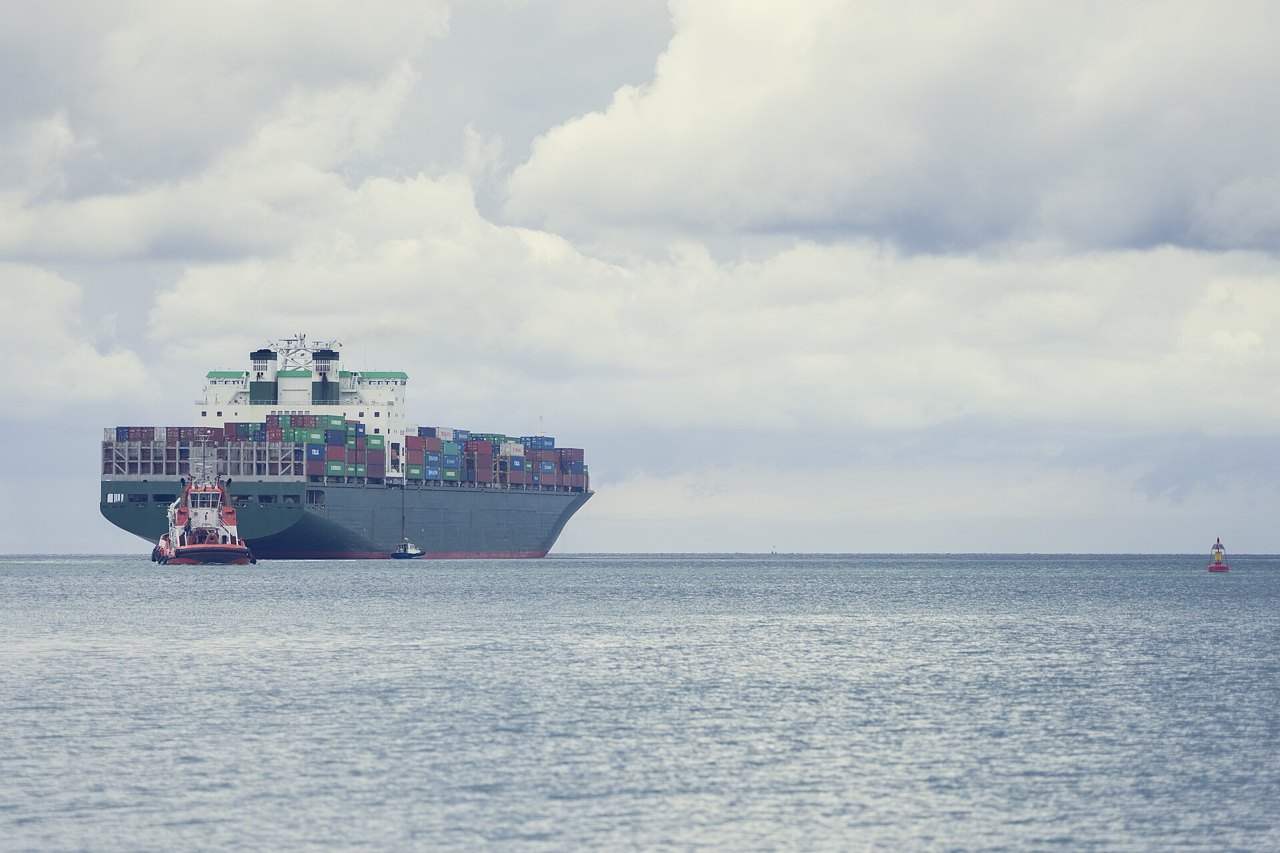
Visual AidSteel boxes on the sea
Photograph of a container ship leaving the port of Koper, Slovenia, in 2013, with a tugboat beside it. The Knowledge Bank explains that almost everything the world buys travels in steel boxes stacked on ships like this, and that in a bad storm whole stacks slide off the deck and their contents float ashore on distant beaches. This ship is in calm water and lost nothing; it is not the ship from the novel. Notice how high the boxes are stacked above the rail — that is the height a hurricane has to throw them from.
“The ship’s cargo was five hundred crated robots.”
hurricanen.Ch.1–10
A huge, violent ocean storm
“Only one crate survived the hurricane.”
activatev.Ch.1–10
To switch something on
“Curious otters managed to activate the robot.”
survivaln.Ch.1–10
Staying alive through danger
“Survival programming sent Roz up the cliffs.”
wildernessn.Ch.1–10
Wild land untouched by people
“The island was pure wilderness, end to end.”
observev.Ch.1–10
To watch closely and carefully
“Roz could observe a crab and copy its climb.”
instinctn.Ch.1–10
A built-in urge to act a certain way
“The animals’ instinct said: run from the monster.”
clearingn.Ch.1–10
An open space in a forest
“Roz stood statue-still in the clearing.”
summitn.Ch.1–10
The very top of a mountain
“From the summit, Roz saw ocean in every direction.”
politeadj.Ch.1–10
Having good, respectful manners
“Even to shrieking animals, Roz stayed perfectly polite.”
ⓘ The vocabulary words in this list are selected to help you understand and complete this workbook. Some may not appear verbatim in the original novel.
🧠Knowledge Bank question
1According to the Knowledge Bank, why did oceanographers track thousands of plastic bath toys in the Pacific?Ch.1–10
2To ‘activate’ something is to switch it off.Ch.1–10
3Wild land untouched by people is ___.Ch.1–10
4An ‘instinct’ is a built-in urge to act a certain way.Ch.1–10
5Fill in each blank with the correct word.Ch.1–10
Word choices:summitobservehurricanepolite- some words will not be used
Only one crate survived the .
From the , Roz saw ocean in every direction.
6To watch closely and carefully is to ___.Ch.1–10
7A ‘clearing’ is the thickest, darkest part of a forest.Ch.1–10
8Staying alive through danger is ___.Ch.1–10
9Fill in the blanks with the correct words.Ch.1–10
Word choices:activatecargoinstinctclearing- some words will not be used
The otters pressed a button to Roz.
Roz stood still in the forest .
10Someone with good, respectful manners is ___.Ch.1–10
Part 2
Comprehension
Show you understood what happens in Chapters 1–10.
🏝Knowledge Bank · An Island Full of Jobs
Island Ecology · NichesIslands work like closed laboratories. Whatever the animals eat, build with, or hunt must already be on the island, because no help arrives from a mainland. That limit forces every species into a precise role — what ecologists call a niche. One bird cracks seeds, another spears fish in the shallows; otters take the surf, mice take the grass roots. Over long stretches of time the jobs fill up, and a crowded island has almost no room left for a newcomer. Scientists studying real islands find that arrivals usually starve, get eaten, or push some resident out. That is the true trouble facing a robot who walks out of a broken crate: not the cliffs and not the weather, but a fully staffed ecosystem with no listing for her skills.
Visual AidEvery job on the island is already filled
Diagram for the Knowledge Bank on niches. It draws the island as a jobs board, using the four roles the Knowledge Bank lists, and adds one red line for the newcomer. It does not claim these are the only jobs on the island; a real island has thousands. Notice that nothing is wrong with the robot’s skills — there is simply nowhere to put them, which is the trouble the Knowledge Bank describes.
Roles listed in the Knowledge Bank. Drawn for Garden Heights Academy.
🧠Knowledge Bank question
1The Knowledge Bank says the true trouble facing Roz is ___.Ch.1–10
2Who accidentally activates Roz?Ch.1–10
3Roz introduces herself as ROZZUM unit 7134, ‘but you may call me Roz.’Ch.1–10
4How does Roz learn to climb the sea cliffs?Ch.1–10
5Write the numbers 1–5 in the boxes to show the correct order of events in Chapters 1–10. Number 1 = what happens first.Ch.1–10
Otters press the button and Roz wakes.
Roz copies a crab to climb the cliffs.
From the summit, Roz sees she is on an island.
A storm wrecks the ship carrying Roz.
Forest animals flee from the ‘monster.’
6The forest animals welcome Roz warmly from the first day.Ch.1–10
7What does Roz do in the clearing when the animals fear her?Ch.1–10
8What bombards Roz in the windstorm?Ch.1–10
9From the highest point, Roz discovers a bridge connecting the island to the mainland.Ch.1–10
10What is Roz’s true problem at the end of Part 1?Ch.1–10
Part 3
Literary Elements
Understanding HOW and WHY Peter Brown tells the story across Chapters 1–10.
⏱Knowledge Bank · A Story in Small Pieces
Literary Craft · PacingOpen this novel and something strange shows up before a single sentence is read: the chapters are tiny, several barely longer than a page. That is a deliberate control on pacing, the speed at which a writer releases events. Short chapters work like quick camera shots — a robot on wet rocks, curious otters, a smashed crate — so a reader finishes one beat and is already inside the next. Long chapters ask for endurance; short ones ask only for curiosity, which is why reluctant readers often race through books built this way. The clipped rhythm also matches the heroine, who thinks in tidy numbered steps like the machine she is. Whenever a book seems to move fast, look at its structure, because speed in fiction is never accidental — it is design.
Fish out of water
A character dropped where they don’t belong — a factory robot in a wilderness with no jobs.
Dramatic irony
Readers know the ‘monster’ is polite and harmless while the animals flee screaming.
Log-entry chapters
Short, titled, precise chapters — the book’s form mirrors a robot’s records.
🧠Knowledge Bank question
1According to the Knowledge Bank, the tiny chapters work like ___.Ch.1–10
2Fill in the blank with the correct literary term.Ch.1–10
Word choices:ironylogsimilemoral- some words will not be used
Readers knowing the monster is harmless is dramatic .
The short titled chapters read like a robot’s entries.
3The animals calling polite Roz a ‘monster’ teaches the book’s early lesson that ___.Ch.1–10
4Roz’s lack of habits and fears makes her descriptions of the island unusually clear.Ch.1–10
5The crab-climbing scene establishes the book’s most important pattern: ___.Ch.1–10
6Brown makes Roz polite even to shrieking animals to show that ___.Ch.1–10
7Dramatic irony here means the animals know more about Roz than readers do.Ch.1–10
8Fill in the blank with the correct literary term.Ch.1–10
Word choices:waterfireforestisland- some words will not be used
A character dropped where they don’t belong is a fish out of .
9Ending Part 1 at the summit — ocean in every direction — gives the story ___.Ch.1–10
10The pinecone storm — nature pelting a polite robot — works as ___.Ch.1–10
Part 4
Think Deeper
Four deeper challenges — no single-word recall. Read, weigh the evidence, and reason it out.
🧠Knowledge Bank · Instinct Against Learning
Behavioral Science · Instinct and LearningEvery animal on the island arrived with instructions already loaded. A newborn gosling knows to follow, a fox kit knows to pounce, a spider knows its web pattern without a lesson — biologists call inherited behavior like this instinct, and it is fast, reliable, and completely inflexible. Learning is the opposite trade: slow, error-filled, but able to handle a situation nobody planned for. Roz arrives with almost no instincts and a great deal of learning capacity, which is why her first days look so useless beside a squirrel’s. Notice what a learning system does when the instructions run out, though. It does not freeze or break down; it gathers examples, tests them, and keeps the ones that work. Slowness bought with flexibility is the oldest bargain in survival.
Think back over these chapters. On a beach littered with splinters, one crate lies unbroken. Small wet paws pry and poke; a button clicks; and a voice as calm as a doorbell says hello to an island that has never heard a machine. The cliffs are climbed the way a crab climbs. The forest empties at the sight of her. Pinecones rattle off her hull like applause gone wrong. And on the mountaintop, under the wide gray sky, a robot built to complete tasks looks out at ocean in every direction and files the only report she can: alone, undamaged, and beginning to learn.
Original passage written for Garden Heights — not a quotation from the novel.
1Claim: “Roz’s survival in Part 1 comes from learning, not from luck.” — choose the two details that best prove it.Claim & Evidence
2What Roz was built for, or What the island demands? Tap each detail to sort it — tap again to switch sides. You can keep tapping to change your answer.Sort into two
◄ What Roz was built forWhat the island demands ►
3Match each cause to its result. For each cause, pick its result.Cause & Effect
The hurricane sinks the cargo ship→
Otters poke the strange box→
Roz observes a crab on the rocks→
The animals flee the ‘monster’→
🧠Knowledge Bank question
4Fill both blanks to complete the reasoning.Build the Argument
The Knowledge Bank calls instinct fast and reliable but says learning is the better trade for Roz because , which shows that .
Part 5
Standardized Test
Reading passage · What Makes a Robot a Robot · SAT & TOEFL-style practice
Read the passage — the highlighted words are tested — then answer. Tap an answer, then tap it again to confirm.
SATCentral Idea — the passage's main point
SATDetail — a fact stated in the passage
SATFunction — the job a sentence is doing
SATInference — a conclusion the passage implies
SATWords in Context — a word's meaning in this passage
SATComparison — how two things line up
SATAuthor’s Purpose — what the author wants to achieve
SATApplying Evidence — using a detail to support a conclusion
What Actually Makes a Robot
A washing machine follows orders, but nobody calls it a robot, so what earns the name? Engineers say a true robot needs three connected parts. First come sensors — cameras, microphones, touch pads — the machine’s eyes and ears, gathering information about the world. Next comes a processor, the computer brain that weighs that information and chooses what to do. Last come actuators — the motors and joints that turn a decision into action: rolling, gripping, walking. Sense, decide, act: activate that loop over and over, and you have a robot.
The most advanced robots add a fourth ingredient: learning. Instead of following one fixed program forever, a learning robot compares each result with what it expected and quietly adjusts — changing its own behavior to do better next time. Engineers call this machine learning, and it is why some robots can improve at tasks nobody specifically programmed: they practice, like students. It is worth keeping this checklist beside a certain fictional castaway. A machine that can observe a crab and then climb, that watches frightened animals and chooses stillness, is running the full loop — sensing, deciding, acting, and above all adapting. Peter Brown’s island story is invented; the engineering inside his heroine is textbook.
Original passage written for Garden Heights — not a quotation from the novel.
1What is the main idea of the passage?SAT · Central Idea
2In the passage, sensors are ___.SAT · Detail
3What does the processor do?SAT · Function
4In the passage, actuators are ___.SAT · Detail
5Why is a washing machine NOT a true robot, by this checklist?SAT · Inference
6In the passage, to activate a loop is to ___.SAT · Words in Context
7What makes learning robots special, according to the passage?SAT · Comparison
8In the passage, a machine that can observe a crab ___.SAT · Words in Context
9The passage calls the engineering inside Roz ‘textbook’ because ___.SAT · Author’s Purpose
10Which Part 1 moment shows Roz running the FULL loop, learning included?SAT · Applying Evidence
Part 6 · Optional
Creative Writing
A bonus challenge to practice your English. Take your time and have fun with it.
About This Section
This writing task is optional and is not part of your auto-graded score. The feedback below checks only the basics — length, spelling, and grammar — not whether your ideas are right or wrong. It is meant for classroom discussion and creative practice, so feel free to use your imagination!
Writing Task — Part 1 “Robot Log, Day One”
Write Roz’s very first log entry — or your own, as a robot waking somewhere strange (your school? your kitchen?). Use short, precise, polite sentences. Record: what your sensors notice, one thing you decide, one action you take, and one thing you will do differently tomorrow. 6–10 sentences. End with your battery percentage.
You can start with: “Systems on. Location unknown. The first thing my sensors report is...”
0 / 40 words minimum
🗣 Teach It · Just for Fun (optional)
No right or wrong — close the screen and tell someone nearby what happened in this part. Can’t find anyone? Tell yourself out loud. The moment you teach it, you truly understand it.
Part 1 Complete!
You finished Chapters 1–10 of The Wild Robot.
Here are your auto-graded results:
-
points out of 100
Teach it to someone
The best last step is to teach it. In your own words, explain what happened — retell a favorite scene, teach a character’s big choice, or sum up the main idea for a parent, friend, or classmate. When you can teach it clearly, you truly own it.
Independent study guide by Garden Heights. Not affiliated with or endorsed by Peter Brown. Contains original analysis only; no text from the novel is reproduced. Reference text: This workbook follows Peter Brown’s classic text (the standard Puffin edition sold worldwide). Revised 2023 UK editions change some wording and may not match the vocabulary studied here.
SAT® is a registered trademark of College Board, which is not affiliated with, and does not endorse, these materials. TOEFL® is a registered trademark of ETS. These materials are not endorsed or approved by ETS. Garden Heights is an independent provider of test-style reading practice.