New here? Just sign up with Google — your account includes Matilda, our gift book, forever.
The Wild Robot · Garden Heights
Part 2
for The Wild Robot · Part 2 · Chapters 11–20
8 Parts40 min
What Happens in Part 2
Surviving the island turns out to be a full-time education. Roz learns to power down at night like a sleeping animal; a savage storm sends her sliding through a mudslide and up a pine tree; and the soaked, battered morning after teaches her a humbling truth: the animals she frightens are all survival experts, and she is not. So the student gets to work. Roz finds shelter, studies the creatures around her, and makes two discoveries that change everything. First, camouflage: coated in mud, draped in leaves and flowers, a robot can disappear into the scenery — and watch the wild up close. Second, and greater: the animals are not making noise. They are talking. Every chirp, growl, and honk belongs to one shared language of the wild, and day after patient day, the listening robot begins to understand it — then, carefully, to speak it. The island still calls her monster. But the monster now knows what the word means — and can finally, politely, begin to argue.
Humility as a turning point, and a language-learning montage
Cross-Curricular
How anyone — child, adult, or robot — learns a language by listening
Chapter Summary
Ch.
What happens
11–20
Learning the island — night shutdowns, a storm and mudslide, a pine-tree escape, and a hard morning truth: the animals are survival experts. Roz answers with camouflage — mud, leaves, stillness — and the discovery that animal sounds are a language she can learn.
Part 1
Vocabulary
Study 10 key words from Chapters 11–20, then answer each question.
🌿Knowledge Bank · The Art of Not Being Seen
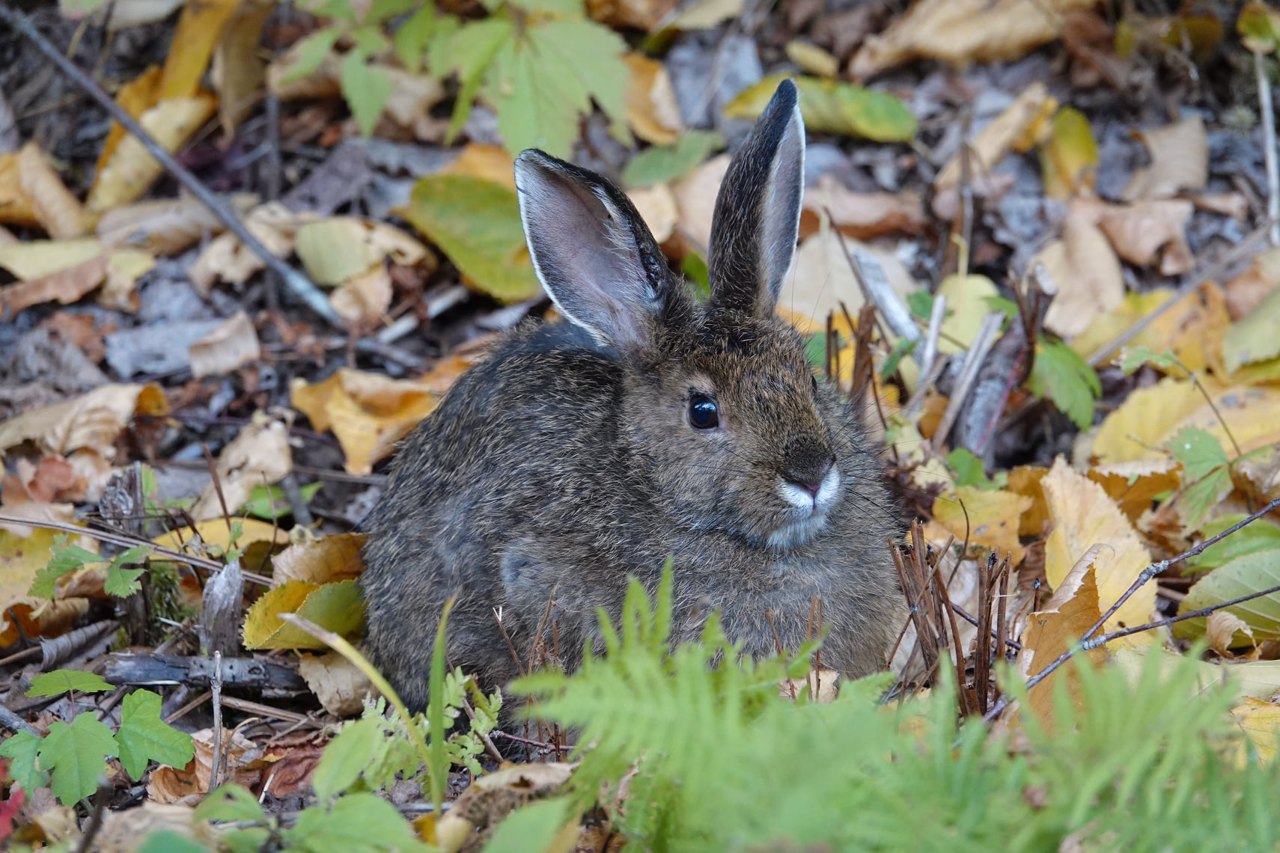
Zoology · Camouflage and ConcealmentBlending into a background is the oldest trick in the wild, and it runs in two directions. Animals hunted as prey hide to avoid being eaten: a snowshoe hare swaps brown fur for white before the snow arrives, a walking stick insect passes for a twig, a flounder settles on sand and fades into it. Hunters hide too, since a fox that can be seen from far off rarely eats. Human researchers borrowed the same idea. Wildlife scientists sit for hours inside leaf-covered blinds, because animals only behave normally when nothing strange seems to be watching. A robot who plasters herself with moss, grass, and flowers has independently invented the field biologist’s hide, and her camouflage buys her exactly what it buys a hunting fox: the freedom to observe.
Visual AidA coat that changes with the season
Photograph of a snowshoe hare in autumn at a national wildlife refuge in the northeastern United States, taken by a government wildlife agency; the photographer noted it was beginning to turn white for winter. The Knowledge Bank explains that a snowshoe hare swaps brown fur for white before the snow arrives, so that prey animals can hide from what hunts them. This hare is not on Roz’s island. Notice how well the brown coat already matches the dead leaves — and imagine the same animal, still brown, sitting on fresh snow.
Snowshoe hare in autumn, Silvio O. Conte National Fish and Wildlife Refuge; U.S. Fish and Wildlife Service. Source: Wikimedia Commons, public domain.
mudsliden.Ch.11–20
A rush of wet earth sliding downhill
“The storm sent Roz tumbling through a mudslide.”
sheltern.Ch.11–20
A place of protection from weather or danger
“A hole in the mountainside became her shelter.”
camouflagen.Ch.11–20
Disguise that blends into the surroundings
“Mud and leaves made surprisingly good camouflage.”
blendv.Ch.11–20
To mix in until you cannot be told apart
“A still, muddy robot can blend into the scenery.”
mimicv.Ch.11–20
To copy sounds or actions exactly
“Roz began to mimic the chirps and honks she heard.”
expertn.Ch.11–20
A person or creature with deep skill
“Every animal was a survival expert; Roz was not.”
humbleadj.Ch.11–20
Not proud; ready to admit what you don’t know
“The hard morning left Roz humble and ready to learn.”
patientadj.Ch.11–20
Able to keep trying calmly for a long time
“Language learning demands a patient listener.”
fluentadj.Ch.11–20
Able to use a language smoothly
“Day by day, the robot grew fluent in the wild’s speech.”
conservev.Ch.11–20
To use carefully so nothing is wasted
“At night Roz powers down to conserve energy.”
ⓘ The vocabulary words in this list are selected to help you understand and complete this workbook. Some may not appear verbatim in the original novel.
🧠Knowledge Bank question
1According to the Knowledge Bank, wildlife scientists sit inside leaf-covered blinds because ___.Ch.11–20
2‘Camouflage’ is a disguise that blends into the surroundings.Ch.11–20
3To copy sounds or actions exactly is to ___ them.Ch.11–20
4Someone ‘humble’ believes they already know everything.Ch.11–20
5Fill in each blank with the correct word.Ch.11–20
Word choices:shelterconserveexpertblend- some words will not be used
A mountainside hole became Roz’s .
Powering down at night helps energy.
6A creature with deep skill is an ___.Ch.11–20
7To ‘blend’ in is to stand out as much as possible.Ch.11–20
8Able to use a language smoothly is ___.Ch.11–20
9Fill in the blanks with the correct words.Ch.11–20
Word choices:camouflagemimicpatientmudslide- some words will not be used
Mud and leaves made excellent .
The storm swept Roz into a .
10Able to keep trying calmly for a long time is ___.Ch.11–20
Part 2
Comprehension
Show you understood what happens in Chapters 11–20.
📣Knowledge Bank · What Animals Actually Say
Linguistics · Animal SignalsAnimal calls are not random noise. Prairie dogs give different alarm barks for a hawk overhead and a coyote on the ground, and the colony reacts differently to each. Vervet monkeys do the same, with separate warnings for eagles, snakes, and leopards; play a recording of the eagle call and the troop looks up. Honeybees dance a figure eight whose angle and length report the direction and distance of flowers. Researchers describe these as signals: sounds or movements that carry a fixed, shared meaning within a species. What no wild species has is a true grammar for combining signals into brand-new sentences, which is why translating between species is so hard. Anyone hoping to speak with a forest must first collect thousands of examples and hunt for the pattern.
Visual AidSignals: one sound, one fixed meaning
Diagram for the Knowledge Bank on animal signals. Each row is one of the three examples the Knowledge Bank gives, with the signal on the left and its fixed meaning on the right. The last row states what no wild species has. It does not claim the island animals in the novel really share one language. Notice that every meaning is fixed in advance — a signal cannot be rearranged into a new sentence, which is exactly why Roz must collect examples first.
Examples given in the Knowledge Bank. Drawn for Garden Heights Academy.
🧠Knowledge Bank question
1The Knowledge Bank says prairie dogs give different alarm barks for ___.Ch.11–20
2What happens to Roz during the great storm?Ch.11–20
3After the storm, Roz realizes the animals are survival experts and she is not.Ch.11–20
4What is Roz’s camouflage made of?Ch.11–20
5Write the numbers 1–5 in the boxes to show the correct order of events in Chapters 11–20. Number 1 = what happens first.Ch.11–20
Camouflage lets her watch the wild up close.
The storm and mudslide batter her.
Roz begins to understand the animals’ language.
Roz learns to power down at night.
The hard morning teaches her humility.
6Roz learns the animal language from a dictionary she finds in her crate.Ch.11–20
7What great discovery does Roz make about the animals’ sounds?Ch.11–20
8Why does camouflage help Roz learn faster?Ch.11–20
9By the end of Part 2, the animals have stopped calling Roz a monster.Ch.11–20
10What can Roz finally do at the end of Part 2 that she could not at the start?Ch.11–20
Part 3
Literary Elements
Understanding HOW and WHY Peter Brown tells the story across Chapters 11–20.
🔄Knowledge Bank · The Robot Who Disappeared
Literary Craft · IronyThere is a joke buried in these chapters, and craft has a name for it: irony, the gap between what a reader expects and what actually arrives. Expect a seven-foot machine to be the loudest, shiniest, most unmissable thing in a forest. Instead she spends the middle chapters learning to smear herself with mud, drape herself in plants, and go completely unnoticed. The newcomer who wanted to be greeted becomes the quietest shadow on the hillside. Peter Brown uses the reversal to make a point too gentle to state outright: fitting in sometimes means shrinking rather than announcing. Irony always carries a second meaning under the first, so when a story hands over the opposite of a sensible prediction, slow down — an author has just winked.
Montage
Many small practice scenes compressed together — a training sequence in prose.
Humility turn
The storm re-ranks Roz from machine-above to student-among — the part’s true hinge.
Invisibility irony
To join the island’s life, Roz must first vanish from its sight.
🧠Knowledge Bank question
1According to the Knowledge Bank, the irony of these chapters is that a seven-foot machine ___.Ch.11–20
2Fill in the blank with the correct literary term.Ch.11–20
Word choices:montagehumilityrhymesequel- some words will not be used
Compressed practice scenes form a .
The storm’s re-ranking of Roz is the turn.
3The storm chapter matters MOST because it ___.Ch.11–20
4The book treats Roz’s camouflage as cheating rather than as intelligence.Ch.11–20
5The irony of Part 2 is that to join the island’s life, Roz must first ___.Ch.11–20
6Brown gives ALL the animals one shared language mainly to ___.Ch.11–20
7A montage slows the story down to cover every single day in detail.Ch.11–20
8Fill in the blank with the correct literary term.Ch.11–20
Word choices:ironymetersettingchorus- some words will not be used
Joining the living by becoming invisible is the part’s central .
9‘The monster now knows what the word means’ marks progress because ___.Ch.11–20
10Part 2 ends with skills but not yet friendship — a structure that ___.Ch.11–20
Part 4
Think Deeper
Four deeper challenges — no single-word recall. Read, weigh the evidence, and reason it out.
🎓Knowledge Bank · Who Is the Expert Here
Learning Science · Expertise and HumilityExpertise is local. A person who can survive a desert may drown in a marsh, because knowing a place means knowing its particular water, weather, food, and dangers. Every creature on this island holds inherited and practiced knowledge about this exact shoreline; the robot holds none of it. Researchers who study how people learn find the same starting point again and again: learners improve fastest once they can say plainly what they do not yet know. Pretending to know blocks the question that would fix the gap. A storm and a mudslide arrive in these chapters to make that lesson physical — soaked, scraped, and outclassed by a squirrel, Roz stops being a machine studying weaker creatures and becomes a student. Real learning begins with honest humility.
Think back over these chapters. A robot discovers night, and learns to sleep like the hills. A storm picks her up, drags her downhill in a fist of mud, and leaves her clinging to a pine like the island’s strangest fruit. In the gray soaked morning she files an honest report: every creature here outranks her. So she coats herself in mud, dresses in leaves and flowers, and becomes a boulder that listens. And slowly, chirp by honk by growl, the noise of the wild resolves into the one thing she never expected: words.
Original passage written for Garden Heights — not a quotation from the novel.
1Claim: “The storm was the best thing that happened to Roz in Part 2.” — choose the two details that best prove it.Claim & Evidence
2Lessons Roz is taught, or Lessons Roz invents? Tap each detail to sort it — tap again to switch sides. You can keep tapping to change your answer.Sort into two
◄ Lessons Roz is taughtLessons Roz invents ►
3Match each cause to its result. For each cause, pick its result.Cause & Effect
Night falls on a machine that never slept→
The storm flings her through a mudslide→
Mud and leaves hide the metal→
Thousands of patient listening hours→
🧠Knowledge Bank question
4Fill both blanks to complete the reasoning.Build the Argument
The Knowledge Bank says learners improve fastest once they , which shows that .
Part 5
Standardized Test
Reading passage · Learning a Language by Listening · SAT & TOEFL-style practice
Read the passage — the highlighted words are tested — then answer. Tap an answer, then tap it again to confirm.
SATCentral Idea — the passage's main point
SATWords in Context — a word's meaning in this passage
SATDetail — a fact stated in the passage
SATAuthor’s Purpose — what the author wants to achieve
SATCause and Effect — what led to what
SATInference — a conclusion the passage implies
TOEFLProse Summary — the three sentences that sum it up
How Babies Learn Language by Listening
No one hands a baby a dictionary. Yet by age three, children speak the language spoken around them — and scientists say the method is beautifully simple: immersion, being surrounded by a language until it soaks in. Long before babies speak, they are working. They listen for months, sorting the stream of sound into separate words. They match: this sound arrives with food, that one with bedtime. Researchers call babies ‘pattern-finding machines’ — from thousands of examples, they quietly build the rules nobody ever states out loud.
Then comes the brave stage: imitation. The learner tries to mimic what it hears, and first tries are wonderfully wrong — half-words, backwards grammar — but every mistake gets gently corrected by the answers the world gives back, and the learner refines — polishes and improves — each attempt. Listen, match, imitate, refine: the loop that carries a helpless newborn to fluent chatter. It works for grown-ups moving to new countries, and no expert gets to skip it; it powers the software that learns languages from mountains of examples, and on one fictional island it works for a mud-covered robot in the bushes, sorting chirps from growls month after patient month. Peter Brown never explains HOW Roz learns the wild’s language — he doesn’t need to. He simply shows her doing what every successful language learner in history has done: shutting up, and listening first.
Original passage written for Garden Heights — not a quotation from the novel.
1What is the main idea of the passage?SAT · Central Idea
2In the passage, to mimic a sound is to ___.SAT · Words in Context
3What do babies do during their long silent months?SAT · Detail
4Why are babies called ‘pattern-finding machines’?SAT · Author’s Purpose
5In the passage, imitation is ___.SAT · Words in Context
6In the passage, an expert is someone who ___.SAT · Words in Context
7How do a learner’s mistakes get corrected, according to the passage?SAT · Cause and Effect
8The passage says the same loop powers ___.SAT · Detail
9Why doesn’t Peter Brown need to explain HOW Roz learns the language?SAT · Inference
10Prose Summary (TOEFL).The passage explains how languages are truly learned. This TOEFL task lists six sentences; choose the THREE that best capture the passage’s main ideas. The other three do not belong — they state minor details or ideas the passage does not present.TOEFL · Prose Summary
Part 6 · Optional
Creative Writing
A bonus challenge to practice your English. Take your time and have fun with it.
About This Section
This writing task is optional and is not part of your auto-graded score. The feedback below checks only the basics — length, spelling, and grammar — not whether your ideas are right or wrong. It is meant for classroom discussion and creative practice, so feel free to use your imagination!
Writing Task — Part 2 “The Language I Would Crack”
Roz cracks the wild’s language by patient listening. Choose a ‘language’ YOU would love to understand — animals at the park, babies, a sport’s signals, music, a real foreign language — and describe your Roz-style plan: where you would hide and listen, what patterns you would hunt for, and your first brave imitation. 6–10 sentences. End with the first sentence you hope to understand.
You can start with: “Step one would be finding the perfect place to listen without being noticed...”
0 / 40 words minimum
🗣 Teach It · Just for Fun (optional)
No right or wrong — close the screen and tell someone nearby what happened in this part. Can’t find anyone? Tell yourself out loud. The moment you teach it, you truly understand it.
Part 2 Complete!
You finished Chapters 11–20 of The Wild Robot.
Here are your auto-graded results:
-
points out of 100
Teach it to someone
The best last step is to teach it. In your own words, explain what happened — retell a favorite scene, teach a character’s big choice, or sum up the main idea for a parent, friend, or classmate. When you can teach it clearly, you truly own it.
Independent study guide by Garden Heights. Not affiliated with or endorsed by Peter Brown. Contains original analysis only; no text from the novel is reproduced. Reference text: This workbook follows Peter Brown’s classic text (the standard Puffin edition sold worldwide). Revised 2023 UK editions change some wording and may not match the vocabulary studied here.
SAT® is a registered trademark of College Board, which is not affiliated with, and does not endorse, these materials. TOEFL® is a registered trademark of ETS. These materials are not endorsed or approved by ETS. Garden Heights is an independent provider of test-style reading practice.