New here? Just sign up with Google — your account includes Matilda, our gift book, forever.
The Wild Robot · Garden Heights
Part 3
for The Wild Robot · Part 3 · Chapters 21–30
8 Parts40 min
What Happens in Part 3
Learning the island’s language does not make Roz belong — and then, in one terrible moment, it makes her responsible. Crossing a steep slope, Roz triggers an accident: a slide of rock and robot crushes a hidden goose nest, and a whole goose family is gone. In the wreckage, one egg survives. Roz does not know what she feels — her programming has no word for it — but she knows what to do: she carries the egg to safety, guards it from a sly fox named Fink who would very much like it for breakfast, and keeps it warm until it cracks open and a tiny gosling tumbles out. The newborn takes one look at the towering machine and decides the obvious: this is Mama. An old goose, Loudwing, confirms the sentence Roz never expected: like it or not, she is a mother now. The gosling gets a name — Brightbill — and the monster of the island suddenly has the most demanding task of her life: raising a son who is small, loud, hungry, and absolutely certain she is his.
Guilt a robot can’t name, and a family nobody planned
Cross-Curricular
Imprinting: why a gosling follows the first thing it sees
Chapter Summary
Ch.
What happens
21–30
The accident and the egg — a slide of rock and robot destroys a goose nest; one egg survives. Roz guards it from Fink the fox, keeps it warm until it hatches, and — on Loudwing’s verdict — becomes mother to a gosling named Brightbill.
Part 1
Vocabulary
Study 10 key words from Chapters 21–30, then answer each question.
🦊Knowledge Bank · The Fox’s Job Description
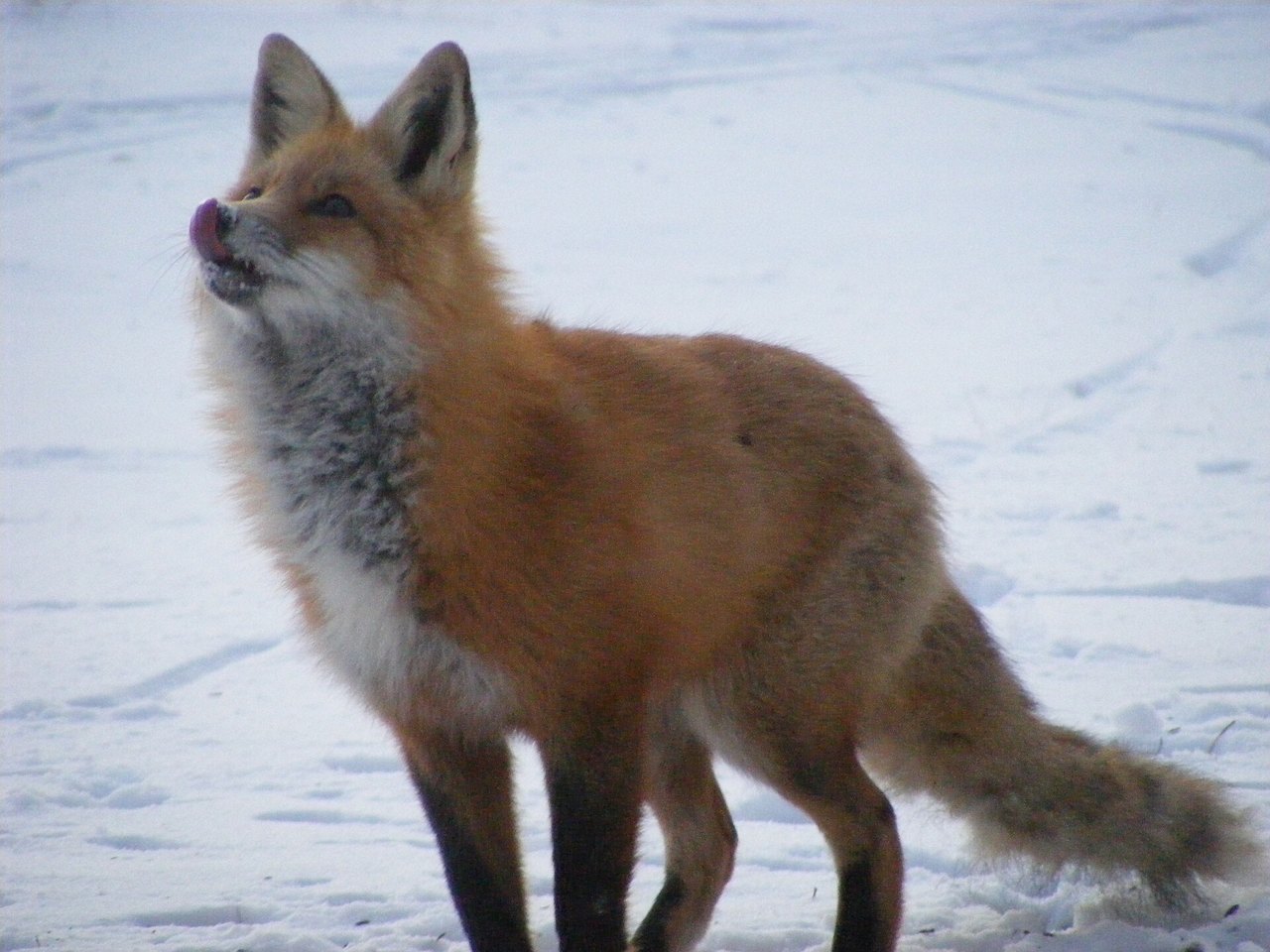
Animal Behavior · Opportunistic FeedingA fox is not a villain; a fox is an opportunist. Biologists use that word for animals that eat whatever the day happens to offer instead of specializing in one food. A red fox will take mice, voles, beetles, berries, fallen apples, crayfish, carrion, and — very much yes — unguarded eggs. This flexible diet is why foxes thrive from arctic tundra to city parks while fussier hunters fade out. Foxes also cache, burying extra food under leaves or soil and returning to it later, which is why a single egg can be worth a long, patient stalk. Reading these chapters with that in mind turns the fox from a story villain into an animal doing his job honestly, which is a far more interesting creature to watch.
Visual AidAn opportunist at work
Photograph of a red fox on snow, taken in 2008 by a United States wildlife agency; the caption notes the fox appeared to be licking its chops while looking up at something. The Knowledge Bank explains that a fox is an opportunist, eating whatever the day offers — mice, beetles, berries, carrion, and unguarded eggs — and that this flexible diet is why foxes thrive from tundra to city parks. This is a real fox, not the one in the novel. Notice the raised head and the tongue: an animal doing its job honestly, which the Knowledge Bank says is more interesting than a villain.
Red fox (Vulpes vulpes) on snow, 2008; U.S. Fish and Wildlife Service. Source: Wikimedia Commons, public domain.
accidentn.Ch.21–30
Harm that happens without being intended
“The accident on the slope was nobody’s plan.”
fragileadj.Ch.21–30
Easily broken; delicate
“An egg is the most fragile treasure on the island.”
survivev.Ch.21–30
To stay alive through disaster
“Only one egg managed to survive the slide.”
guardv.Ch.21–30
To watch over and protect
“Roz must guard the egg from a hungry fox.”
hatchv.Ch.21–30
To break out of an egg
“At last the egg began to hatch.”
goslingn.Ch.21–30
A baby goose
“The gosling looked up and chose his Mama.”
adoptv.Ch.21–30
To take someone into your family
“A robot can, it turns out, adopt a goose.”
responsibleadj.Ch.21–30
Owing care because of what you did or promised
“Roz feels responsible for the nest she destroyed.”
slyadj.Ch.21–30
Clever in a sneaky way
“Fink the fox is sly, hungry, and honest about both.”
verdictn.Ch.21–30
A final judgment
“Loudwing’s verdict: like it or not, you are his mother.”
ⓘ The vocabulary words in this list are selected to help you understand and complete this workbook. Some may not appear verbatim in the original novel.
🧠Knowledge Bank question
1According to the Knowledge Bank, a fox caches food, which means it ___.Ch.21–30
2Something ‘fragile’ is easily broken.Ch.21–30
3A baby goose is a ___.Ch.21–30
4To ‘adopt’ someone is to send them away from your family.Ch.21–30
5Fill in each blank with the correct word.Ch.21–30
Word choices:hatchguardverdictsly- some words will not be used
Roz had to the egg from Fink.
At last the egg began to .
6Clever in a sneaky way is ___.Ch.21–30
7Someone ‘responsible’ owes care because of what they did or promised.Ch.21–30
8A final judgment is a ___.Ch.21–30
9Fill in the blanks with the correct words.Ch.21–30
Word choices:goslingfragileresponsibleadopt- some words will not be used
The newborn chose Roz on sight.
Roz felt for the broken nest.
10To stay alive through disaster is to ___.Ch.21–30
Part 2
Comprehension
Show you understood what happens in Chapters 21–30.
🐣Knowledge Bank · How a Goose Family Works
Ornithology · Nesting and GoslingsWild geese run a strict family business. A pair builds a shallow bowl of grass and down near water, and the female lays a clutch of about five eggs, one every day or two. She sits on them for roughly a month while the gander stands guard nearby, hissing at anything that approaches. Goslings hatch precocial, meaning they arrive covered in down, eyes open, able to walk, swim, and pick at food within a day — a sharp contrast to blind, naked songbird chicks. What they cannot do is find safety alone. For their first weeks they depend entirely on adults for warmth, direction, and defense, staying close in a tight line. That is why an orphaned gosling in the wild almost never survives without an adopted guardian.
🧠Knowledge Bank question
1The Knowledge Bank says goslings hatch precocial, which means they ___.Ch.21–30
2What survives the accident?Ch.21–30
3Roz walks away from the egg because her programming gives her no reason to care.Ch.21–30
4Who tries to take the egg from Roz?Ch.21–30
5Write the numbers 1–5 in the boxes to show the correct order of events in Chapters 21–30. Number 1 = what happens first.Ch.21–30
Fink the fox comes hunting for the egg.
Roz finds one surviving egg.
The gosling is named Brightbill.
The egg hatches into a gosling.
The slide on the slope destroys the goose nest.
6The newborn gosling immediately decides that Roz is his mother.Ch.21–30
7What does Loudwing tell Roz?Ch.21–30
8What name does the gosling receive?Ch.21–30
9Roz’s programming contains a clear word for the guilt she seems to feel.Ch.21–30
10How does the accident change Roz’s place on the island?Ch.21–30
Part 3
Literary Elements
Understanding HOW and WHY Peter Brown tells the story across Chapters 21–30.
🤫Knowledge Bank · Feelings Never Named
Literary Craft · RestraintThe hardest moment in these chapters is written with almost no emotional words in it at all. That restraint is a deliberate technique usually taught as show, not tell. Rather than reporting that a character felt crushing sorrow, an author places her beside the one surviving egg, guarding it, warming it, refusing to leave — and lets the reader do the feeling. It lands harder that way, because an emotion a reader assembles is believed, while an emotion announced is merely accepted. The choice also suits this particular heroine, who has no vocabulary for grief and would never declare it anyway; her devotion can only appear as action. When a scene moves you and you cannot point to the sad sentence, look again at the plain gestures, because a writer has hidden the whole heart inside a verb.
Visual AidThe heart hidden inside a verb
Diagram for the Knowledge Bank on restraint. It sets the sentence the book could have written beside the plain gestures the book gives instead, and names what happens to each in a reader’s mind. The gestures are the ones the Knowledge Bank lists. It does not tell you what Roz feels. Notice that the right-hand box has no feeling words in it at all — and is the one that moves you.
Gestures listed in the Knowledge Bank. Drawn for Garden Heights Academy.
Moral weight
The hero causes real harm — and becomes real herself: no more innocent watching.
Shown, not named
No word for guilt in her programming — so her actions spell it out instead.
Tonal pivot
One cracking egg flips the part from grief to joy — both trusted to young readers.
🧠Knowledge Bank question
1According to the Knowledge Bank, the hardest moment is written with almost no emotional words because ___.Ch.21–30
2Fill in the blank with the correct literary term.Ch.21–30
Word choices:pivotweightrhymesequel- some words will not be used
The hatching flips grief to joy in a tonal .
Causing real harm gives the hero moral .
3Roz’s guilt is conveyed through ___.Ch.21–30
4Brown makes Fink a pure villain so readers know whom to hate.Ch.21–30
5The imprinting moment — Mama! — works as both biology and ___.Ch.21–30
6Loudwing’s verdict matters structurally because it ___.Ch.21–30
7A tonal pivot means the story’s mood stays the same for many chapters.Ch.21–30
8Fill in the blank with the correct literary term.Ch.21–30
Word choices:actiondialoguesettingmeter- some words will not be used
Guilt shown through deeds is character revealed by .
9The name ‘Brightbill’ signals to readers that ___.Ch.21–30
10Part 3 answers the island’s question ‘what is a robot for?’ with ___.Ch.21–30
Part 4
Think Deeper
Four deeper challenges — no single-word recall. Read, weigh the evidence, and reason it out.
⚖Knowledge Bank · A Debt No Program Names
Ethics · Responsibility and RepairPhilosophers separate two ideas that usually travel together. Feeling guilty is an inner experience; taking responsibility is a set of actions — admitting the harm, protecting what remains, repairing what can be repaired. Human courts and repair shops care almost entirely about the second one, because actions can be checked and feelings cannot. Roz has no file labeled guilt anywhere in her programming, yet after the accident she behaves precisely as responsibility would instruct. So the novel quietly opens a real question in machine ethics: is she feeling the duty, or calculating it? From the egg’s point of view the answer is plain, because warmth is warmth and somebody stayed. Perhaps a duty is measured less by what it feels like and more by what it costs.
Think back over these chapters. On a steep slope, stone and steel slide together, and when the dust settles a nest is gone — all but one pale egg, absurdly whole in the wreckage. A robot picks it up with more care than her hands were built for. A fox circles, honest about his appetite. Warmth is kept; days pass; a shell cracks. And a creature the size of a teacup looks up past the dents and the glowing eyes, and announces to the entire island the one fact he will never once doubt: Mama.
Original passage written for Garden Heights — not a quotation from the novel.
1Claim: “Roz’s care for the egg is a choice, not just programming.” — choose the two details that best prove it.Claim & Evidence
2What the accident takes, or What the accident leaves? Tap each detail to sort it — tap again to switch sides. You can keep tapping to change your answer.Sort into two
◄ What the accident takesWhat the accident leaves ►
3Match each cause to its result. For each cause, pick its result.Cause & Effect
Rock and robot slide onto the nest→
Fink comes hunting the unguarded prize→
The egg cracks open at last→
Loudwing rules on the strange case→
🧠Knowledge Bank question
4Fill both blanks to complete the reasoning.Build the Argument
The Knowledge Bank separates feeling guilty from taking responsibility because , which shows that .
Part 5
Standardized Test
Reading passage · Why Goslings Follow: The Science of Imprinting · SAT & TOEFL-style practice
Read the passage — the highlighted words are tested — then answer. Tap an answer, then tap it again to confirm.
SATCentral Idea — the passage's main point
SATDetail — a fact stated in the passage
SATWords in Context — a word's meaning in this passage
SATCause and Effect — what led to what
SATText Evidence — the line that backs up an answer
SATInference — a conclusion the passage implies
SATApplying Evidence — using a detail to support a conclusion
Konrad Lorenz and Imprinting
In the 1930s, an Austrian scientist named Konrad Lorenz divided a clutch of goose eggs. Half hatched under their mother; the other half hatched beside Lorenz himself — and those goslings followed HIM: to the lake, across the lawn, waddling in a devoted line behind his boots. Lorenz had demonstrated imprinting: many young birds are born with an urgent rule — bond to the first large moving thing you see, and stay close to it. The rule usually finds the right target, because the first thing a wild gosling sees is almost always its mother.
Imprinting has strict clockwork. It happens only during a brief window after hatching — scientists call it the critical period — and once the window closes, the bond is set and nearly impossible to reverse. The rule is also blind: goslings have imprinted on boots, wagons, and researchers in raincoats, because the instinct checks only ‘large’ and ‘moving,’ never ‘goose.’ That blindness sounds like a flaw, but it is really a shortcut: in the wild, a fast simple rule beats a slow careful one, because a fragile newborn has no time to study faces while sly foxes patrol the reeds. All of which explains, with complete scientific seriousness, how a newly hatched gosling on a fictional island could look up at a dented, glowing-eyed machine and reach the sturdiest conclusion of his life: Mama.
Original passage written for Garden Heights — not a quotation from the novel.
1What is the main idea of the passage?SAT · Central Idea
2What happened to the goslings that hatched beside Lorenz?SAT · Detail
3In the passage, a fragile newborn is ___.SAT · Words in Context
4The critical period is ___.SAT · Detail
5Why does the imprinting rule usually find the right target?SAT · Cause and Effect
6The passage says goslings have imprinted on ___.SAT · Text Evidence
7In the passage, a shortcut is ___.SAT · Words in Context
8Why is a FAST rule better than a careful one for a newborn gosling?SAT · Inference
9Once the critical period closes, the imprinted bond is ___.SAT · Detail
10Which Part 3 moment does this passage explain with ‘complete scientific seriousness’?SAT · Applying Evidence
Part 6 · Optional
Creative Writing
A bonus challenge to practice your English. Take your time and have fun with it.
About This Section
This writing task is optional and is not part of your auto-graded score. The feedback below checks only the basics — length, spelling, and grammar — not whether your ideas are right or wrong. It is meant for classroom discussion and creative practice, so feel free to use your imagination!
Writing Task — Part 3 “The First Thing I Saw”
Brightbill’s whole life is shaped by the first thing he saw. Write a scene from the EGG’s point of view: the muffled sounds before hatching, the crack of light, and the first huge blurry shape — and the moment of absolute certainty that follows. 6–10 sentences, ending with the newborn’s first word.
You can start with: “Inside the shell, the world was a warm drum of sounds, and then came the crack...”
0 / 40 words minimum
🗣 Teach It · Just for Fun (optional)
No right or wrong — close the screen and tell someone nearby what happened in this part. Can’t find anyone? Tell yourself out loud. The moment you teach it, you truly understand it.
Part 3 Complete!
You finished Chapters 21–30 of The Wild Robot.
Here are your auto-graded results:
-
points out of 100
Teach it to someone
The best last step is to teach it. In your own words, explain what happened — retell a favorite scene, teach a character’s big choice, or sum up the main idea for a parent, friend, or classmate. When you can teach it clearly, you truly own it.
Independent study guide by Garden Heights. Not affiliated with or endorsed by Peter Brown. Contains original analysis only; no text from the novel is reproduced. Reference text: This workbook follows Peter Brown’s classic text (the standard Puffin edition sold worldwide). Revised 2023 UK editions change some wording and may not match the vocabulary studied here.
SAT® is a registered trademark of College Board, which is not affiliated with, and does not endorse, these materials. TOEFL® is a registered trademark of ETS. These materials are not endorsed or approved by ETS. Garden Heights is an independent provider of test-style reading practice.