New here? Just sign up with Google — your account includes Matilda, our gift book, forever.
The Wild Robot · Garden Heights
Part 4
for The Wild Robot · Part 4 · Chapters 31–40
8 Parts40 min
What Happens in Part 4
Motherhood needs a home. With the beavers’ help — master builder Mr. Beaver chief among them — Roz raises a snug lodge the island comes to call the Nest, and on the first night inside it, Brightbill ignores his own bed entirely and sleeps in his mother’s arms. The household grows roots fast. A deer family led by Crownpoint arrives unafraid, and the doe Tawny strikes the island’s friendliest bargain: she will help Roz plant a garden — if the deer may eat from it. Soon moles and groundhogs are tilling soil, forest animals are donating droppings as fertilizer, and green rows rise around the Nest. Brightbill grows with the garden: swimming, exploring, asking questions, occasionally hearing from other goslings exactly how strange it is to have a robot for a mother. And the island quietly rewrites its opinion: the monster has become a neighbor — odd, gleaming, unfailingly helpful — whose door, it turns out, is worth knocking on.
A home as proof of belonging, and kindness as strategy
Cross-Curricular
Beavers: nature’s engineers
Chapter Summary
Ch.
What happens
31–40
The Nest and the garden — the beavers help raise Roz’s lodge; Brightbill sleeps in her arms on the first night; Crownpoint’s deer arrive unafraid and Tawny’s bargain plants a garden the whole forest fertilizes; the monster becomes a neighbor.
Part 1
Vocabulary
Study 10 key words from Chapters 31–40, then answer each question.
🌱Knowledge Bank · How Soil Is Built
Soil Science · Nutrients and TillingGood soil is not found; it is manufactured, and mostly by animals. Moles, groundhogs, and earthworms tunnel through packed dirt, loosening it so air and rain can reach plant roots — gardeners pay for machines that do a worse job. Grazing animals carry seeds in fur and gut and drop them far from the parent plant. Droppings and dead leaves rot down into nutrients, especially nitrogen, which growing plants cannot manufacture for themselves. Biologists call creatures that reshape a landscape for everyone else engineers, and a healthy patch of ground is usually the work of dozens of them at once. So a garden dug by deer, moles, and donated manure is not a joke about silly animals. It is an accurate picture of how any field becomes fertile.
lodgen.Ch.31–40
A sturdy shelter or den
“The beavers helped raise a lodge called the Nest.”
bargainn.Ch.31–40
A deal where each side gives and gets
“Tawny’s bargain traded help for harvest.”
tillv.Ch.31–40
To turn and loosen soil for planting
“Moles and groundhogs came to till the ground.”
fertilizern.Ch.31–40
Material that feeds the soil
“The forest donated its own natural fertilizer.”
nutrientsn.Ch.31–40
The food substances living things need
“Good soil returns nutrients to growing plants.”
harvestn.Ch.31–40
The gathering of grown crops
“The deer would share in the garden’s harvest.”
neighborn.Ch.31–40
Someone who lives nearby
“The monster was becoming a neighbor.”
unafraidadj.Ch.31–40
Feeling no fear
“Crownpoint’s deer walked up unafraid.”
teasev.Ch.31–40
To make fun of someone
“Some goslings tease Brightbill about his mother.”
thrivev.Ch.31–40
To grow strong and well
“Beside the Nest, the garden began to thrive.”
ⓘ The vocabulary words in this list are selected to help you understand and complete this workbook. Some may not appear verbatim in the original novel.
🧠Knowledge Bank question
1According to the Knowledge Bank, biologists call creatures that reshape a landscape for everyone else ___.Ch.31–40
2A ‘bargain’ is a deal where one side gives everything and gets nothing.Ch.31–40
3To turn and loosen soil for planting is to ___ it.Ch.31–40
4‘Nutrients’ are the food substances living things need.Ch.31–40
5Fill in each blank with the correct word.Ch.31–40
Word choices:harvestunafraidlodgetease- some words will not be used
The deer walked up to Roz .
The garden’s would be shared with the deer.
6Material that feeds the soil is ___.Ch.31–40
7To ‘thrive’ is to weaken and slowly fail.Ch.31–40
8Someone who lives nearby is a ___.Ch.31–40
9Fill in the blanks with the correct words.Ch.31–40
Word choices:bargaintillthrivenutrients- some words will not be used
Tawny struck a fair with Roz.
Moles arrived to the garden soil.
10To make fun of someone is to ___ them.Ch.31–40
Part 2
Comprehension
Show you understood what happens in Chapters 31–40.
📅Knowledge Bank · Timing a Northern Garden
Horticulture · Growing SeasonsA northern garden runs on a countdown. Between the last spring frost and the first autumn one lies the growing season, and in cold coastal places it may be only a hundred days long. Every seed carries a number — days to maturity — and a gardener who plants a slow crop too late simply harvests nothing. That is why the work comes in a fixed order: clear ground, sow hardy crops early, add tender ones once the soil warms, weed constantly, water in dry spells, and gather everything before the cold returns. Root vegetables such as carrots, turnips, and potatoes earn their place because they store for months without spoiling. A garden begun in these chapters is therefore a bet on the calendar, and every hour of tending argues with the coming frost.
Visual AidA countdown between two frosts
Diagram for the Knowledge Bank on growing seasons. It draws the season as a line between the two frosts the Knowledge Bank names and hangs the work from it in the fixed order the Knowledge Bank gives. The length of the line is not to scale; the Knowledge Bank says a cold coastal season may be only about a hundred days. Notice that the last box is a different color — the harvest is a race against the red dot, not a reward after it.
Order of work given in the Knowledge Bank. Drawn for Garden Heights Academy.
🧠Knowledge Bank question
1The Knowledge Bank says root vegetables earn their place in a northern garden because they ___.Ch.31–40
2What does Brightbill do on the first night in the Nest?Ch.31–40
3The deer family led by Crownpoint approaches Roz without fear.Ch.31–40
4What is Tawny’s condition for helping with the garden?Ch.31–40
5Write the numbers 1–5 in the boxes to show the correct order of events in Chapters 31–40. Number 1 = what happens first.Ch.31–40
Tawny’s bargain launches the garden.
Crownpoint’s deer arrive unafraid.
The beavers help raise the lodge called the Nest.
Moles till and the forest fertilizes the rows.
Brightbill spends the first night in Roz’s arms.
6Roz plants and tends the garden entirely alone.Ch.31–40
7How do the forest animals contribute to the garden’s soil?Ch.31–40
8What do some goslings do to Brightbill?Ch.31–40
9By the end of Part 4, the island still treats Roz exactly as it did on her first day.Ch.31–40
10What does the Nest prove that camouflage never could?Ch.31–40
Part 3
Literary Elements
Understanding HOW and WHY Peter Brown tells the story across Chapters 31–40.
🏠Knowledge Bank · When a Home Means More
Literary Craft · SymbolismSome objects in a story do double duty. A lodge built of sticks and mud keeps rain off, which is the plain, useful meaning. But a home is also where a family lives, where the young are raised, where somebody waits for you — so once an author starts returning to the same shelter again and again, that building begins carrying a second layer as well. Craft calls this a symbol: an ordinary thing that also stands for an idea. Symbols work best when the writer never explains them, because the reader who notices feels clever rather than lectured. Watch how often the new lodge appears here and how much weight small mentions of it carry. When a plain object keeps glowing with extra meaning, read it twice and ask what larger truth it is quietly holding.
Visual AidA lodge that is only a lodge
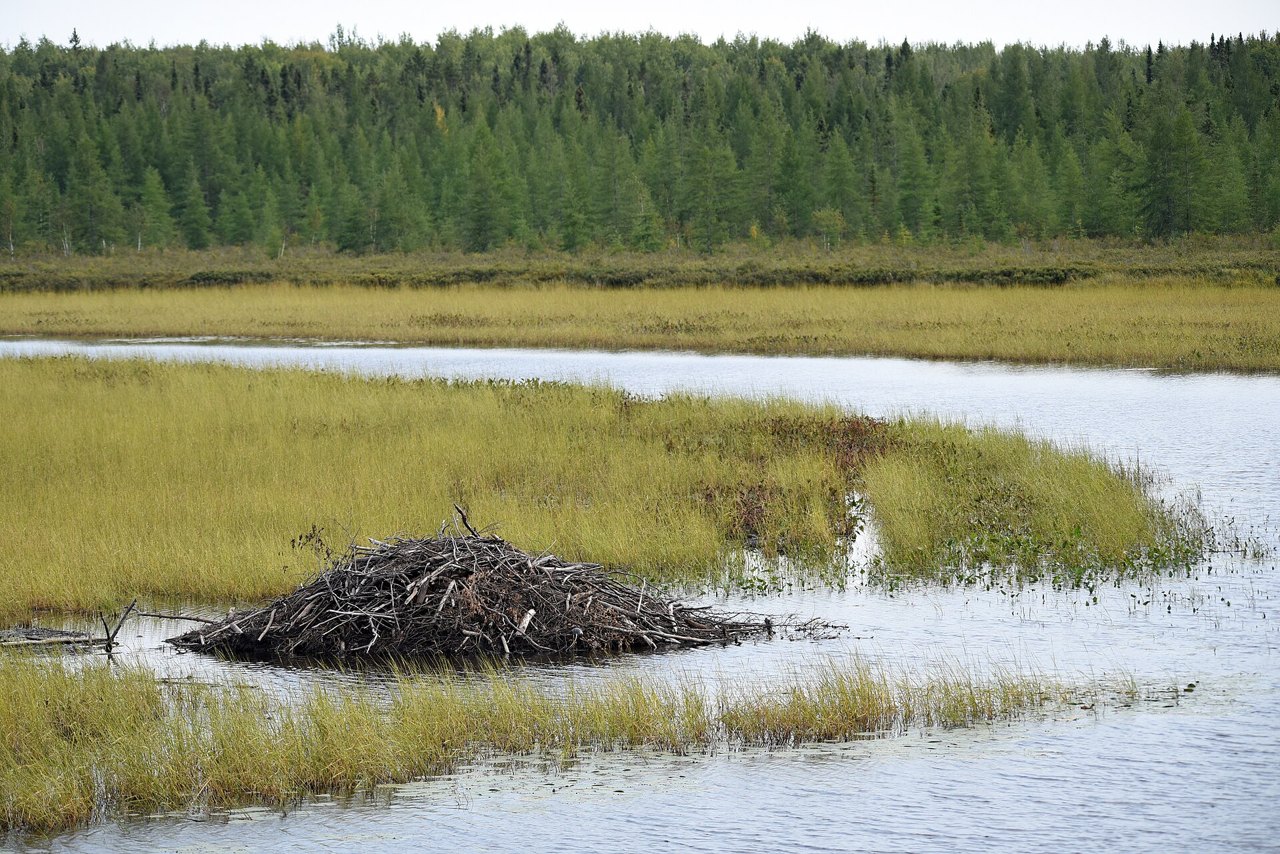
Photograph of a beaver lodge in a marsh in the Superior National Forest in Minnesota, taken by a United States wildlife agency. The Knowledge Bank explains that a lodge of sticks and mud has a plain, useful meaning, keeping rain off, and that a story can give such a shelter a second layer of meaning by returning to it again and again. This lodge carries no second meaning; it is a real one, built by beavers for beavers. Notice how ordinary it looks from outside — the extra weight a symbol carries is added by the story, not by the sticks.
Beaver lodge, Superior National Forest, Minnesota; photograph by Courtney Celley, U.S. Fish and Wildlife Service. Source: Wikimedia Commons, public domain.
Symbol: the Nest
A fixed address with visitors — belonging, built out of sticks and kept promises.
Reciprocity
Every bond is a fair trade kept — help for harvest, shelter for friendship.
Reputation arc
‘Monster’ to ‘neighbor’ — a name changed not by argument but by usefulness.
🧠Knowledge Bank question
1According to the Knowledge Bank, symbols work best when ___.Ch.31–40
2Fill in the blank with the correct literary term.Ch.31–40
Word choices:reciprocitysymbolcliffhangermeter- some words will not be used
A home standing for belonging is a .
Fair trades kept on both sides show .
3Tawny’s bargain is the book’s template for ___.Ch.31–40
4Roz wins the island over mainly by making speeches about friendship.Ch.31–40
5Brightbill choosing Roz’s arms over his new bed shows ___.Ch.31–40
6The goslings’ teasing of Brightbill plants ___.Ch.31–40
7Reciprocity means one side gives charity and expects nothing back.Ch.31–40
8Fill in the blank with the correct literary term.Ch.31–40
Word choices:reputationsettingdialoguechorus- some words will not be used
‘Monster’ becoming ‘neighbor’ is a arc.
9The garden deepens the book’s irony because the island’s feared machine now ___.Ch.31–40
10Part 4’s calm, warm chapters serve the larger story by ___.Ch.31–40
Part 4
Think Deeper
Four deeper challenges — no single-word recall. Read, weigh the evidence, and reason it out.
🤝Knowledge Bank · Deals That Build Trust
Economics · Trade and MutualismCooperation in nature usually starts as a trade, not a kindness. A cleaner wrasse picks parasites off a much larger fish and is not eaten, because the big fish gets a cleaning and the small one gets a meal. Oxpecker birds ride buffalo for the same reason. Bees carry pollen between flowers while collecting food they need anyway. Biologists call an arrangement where both sides gain mutualism, and it is far more common than pure generosity, because a deal that pays keeps repeating on its own. Human societies grow the same way: a first exchange is risky, a second is easier, and after enough kept bargains the parties stop calculating and start relying. Notice how every friendship on this island begins as a fair swap, which suggests that trust is mostly a bargain that worked.
Think back over these chapters. Sticks rise into walls under expert beaver teeth, and a lodge takes shape with a robot-sized door. On the first night, a small goose bypasses his handsome new bed for the crook of a metal arm. Deer arrive without flinching; a doe names her price; moles plow like furry machines; and the forest makes its donations, politely unmentioned at dinner. By harvest, green rows circle the Nest like a moat of vegetables — and the island, mid-bite, quietly retires the word monster.
Original passage written for Garden Heights — not a quotation from the novel.
1Claim: “Roz earns belonging through usefulness and fair deals, not through arguments.” — choose the two details that best prove it.Claim & Evidence
2What Roz gives the island, or What the island gives Roz? Tap each detail to sort it — tap again to switch sides. You can keep tapping to change your answer.Sort into two
◄ What Roz gives the islandWhat the island gives Roz ►
3Match each cause to its result. For each cause, pick its result.Cause & Effect
Mr. Beaver takes the building contract→
Tawny names her price for garden help→
Moles till and the forest fertilizes→
The monster keeps every bargain made→
🧠Knowledge Bank question
4Fill both blanks to complete the reasoning.Build the Argument
The Knowledge Bank says cooperation in nature usually starts as a trade because , which shows that .
Part 5
Standardized Test
Reading passage · Beavers: Nature’s Engineers · SAT & TOEFL-style practice
Read the passage — the highlighted words are tested — then answer. Tap an answer, then tap it again to confirm.
SATCentral Idea — the passage's main point
SATDetail — a fact stated in the passage
SATCause and Effect — what led to what
SATWords in Context — a word's meaning in this passage
SATInference — a conclusion the passage implies
SATText Evidence — the line that backs up an answer
SATAuthor’s Purpose — what the author wants to achieve
SATRhetorical Function — the job a sentence is doing
TOEFLInsert Text — where a sentence best fits
Beavers the Ecosystem Engineers
If the animal kingdom gave out engineering degrees, beavers would collect them by the pawful. A beaver’s front teeth never stop growing, and never stop working: with them, a single family can fell hundreds of trees a year, dragging branches to build the two great beaver projects. The first is the dam — a wall of wood, stone, and mud across a stream that backs the water up into a calm, deep pond. The second is the lodge: a dome of stacked branches plastered with mud, so solid that bears cannot break in, with hidden doors that open underwater — a fortress whose only keys are held by swimmers.
The remarkable part is what beaver construction does for everyone else. The ponds behind beaver dams create wetlands — watery habitats rich in plants and nutrients — where fish spawn, frogs sing, herons hunt, and moose wade. Scientists call beavers a keystone species: like the center stone of an arch, remove them and whole ecosystems sag. Their flooding can frustrate human farmers, but wildlife thrives around beaver works so reliably that some regions now re-release beavers on purpose, hiring the rodents as unpaid restoration engineers. So when a fictional robot needs a home raised quickly, sturdily, and to code, the author’s choice of contractor is not whimsy. On any real island, a beaver neighbor would simply be the best builder in town.
Original passage written for Garden Heights — not a quotation from the novel.
1What is the main idea of the passage?SAT · Central Idea
2What is special about a beaver’s front teeth?SAT · Detail
3What does a beaver dam create?SAT · Cause and Effect
4In the passage, nutrients are ___.SAT · Words in Context
5In the passage, a beaver neighbor is a beaver that ___.SAT · Words in Context
6Why are beavers called a keystone species?SAT · Inference
7Which animals does the passage say benefit from beaver ponds?SAT · Text Evidence
8Why do some regions re-release beavers on purpose?SAT · Author’s Purpose
9The passage calls the beavers building Roz’s home ‘not whimsy’ because ___.SAT · Rhetorical Function
10Insert Text (TOEFL). Look at the four squares [1]–[4] in the excerpt below. They show where this sentence could be added: “That underwater entrance is the whole security system: no swimming, no entry.”
The lodge’s walls of branch and mud dry nearly as hard as concrete. [1] Its doors are hidden below the waterline, reachable only by diving. [2] Predators that cannot swim underwater simply have no way in. [3] Inside, the beaver family rests on a dry platform above the water. [4]
Where would the sentence fit best?TOEFL · Insert Text
Part 6 · Optional
Creative Writing
A bonus challenge to practice your English. Take your time and have fun with it.
About This Section
This writing task is optional and is not part of your auto-graded score. The feedback below checks only the basics — length, spelling, and grammar — not whether your ideas are right or wrong. It is meant for classroom discussion and creative practice, so feel free to use your imagination!
Writing Task — Part 4 “The Bargain I Would Strike”
Tawny trades garden help for a share of the harvest. Imagine YOU may strike one bargain with any animal — real ones, Roz-style. Choose the animal, name what you offer and what you ask, and describe the first day of the deal, in 6–10 sentences. End with the moment you both know the bargain will hold.
You can start with: “The terms were simple, and we shook on it — paw, hoof, or wing...”
0 / 40 words minimum
🗣 Teach It · Just for Fun (optional)
No right or wrong — close the screen and tell someone nearby what happened in this part. Can’t find anyone? Tell yourself out loud. The moment you teach it, you truly understand it.
Part 4 Complete!
You finished Chapters 31–40 of The Wild Robot.
Here are your auto-graded results:
-
points out of 100
Teach it to someone
The best last step is to teach it. In your own words, explain what happened — retell a favorite scene, teach a character’s big choice, or sum up the main idea for a parent, friend, or classmate. When you can teach it clearly, you truly own it.
Independent study guide by Garden Heights. Not affiliated with or endorsed by Peter Brown. Contains original analysis only; no text from the novel is reproduced. Reference text: This workbook follows Peter Brown’s classic text (the standard Puffin edition sold worldwide). Revised 2023 UK editions change some wording and may not match the vocabulary studied here.
SAT® is a registered trademark of College Board, which is not affiliated with, and does not endorse, these materials. TOEFL® is a registered trademark of ETS. These materials are not endorsed or approved by ETS. Garden Heights is an independent provider of test-style reading practice.