
The Wild Robot cover
Garden Heights

The Wild Robot

This workbook is for Garden Heights members. Sign in to continue.

Sign in with Google →
New here? Just sign up with Google — your account includes Matilda, our gift book, forever.
The Wild Robot · Garden Heights

Part 5

for The Wild Robot · Part 5 · Chapters 41–50
8 Parts40 min
What Happens in Part 5

Brightbill is a goose, and geese must fly — but how does a robot teach what she can never do? Roz solves it the Roz way: she studies wings and wind, recruits Loudwing and the flock as instructors, and runs her son through takeoff drills until the day his flapping finally holds air and a small goose rises over the island with his mother cheering from the ground. Then Part 5 shows its teeth. A furious bear confrontation — the chapter called The Fight — ends with Roz victorious but broken: she has lost a foot. The island answers as a neighborhood now: Mr. Beaver carves her a new foot of wood, fitted and strong, and the robot walks again on island craftsmanship. Brightbill soars higher every day; his mother limps, mends, and marvels. Between a first flight and a wooden foot, the message of these chapters is carved plain: on this island, what you lose in battle, your friends give back.

What We Will Learn
SectionWhat you will practice
VocabularyFlight-and-fight words: flap, takeoff, furious, carve, mend…
Literary ElementsTriumph and damage in one part, and a gift that answers a loss
Cross-CurricularHow young birds actually learn to fly
Chapter Summary
Ch.What happens
41–50Flight school and the fight — Roz and Loudwing’s flock train Brightbill until he flies; a furious bear fight costs Roz a foot; Mr. Beaver carves her a wooden one, and the island’s craftsmanship walks her home.
Part 1
Vocabulary
Study 10 key words from Chapters 41–50, then answer each question.
🦴Knowledge Bank · Replacing What Is Lost
Medical History · ProstheticsReplacing a missing body part is one of the oldest crafts humans practice. Archaeologists found a carved wooden toe, strapped with leather, on an Egyptian mummy roughly three thousand years old, and the wear on it shows it was walked in, not merely buried. For most of history a prosthesis was made of wood, leather, and cloth; metal and microchips are recent arrivals. The method, though, has never changed. Measure what is gone, shape a substitute that matches the load it must carry, then fit it patiently, adjusting again and again until the wearer can move without pain. A skilled woodworker with sharp teeth and a good eye is doing exactly what a modern clinic does, which is why a beaver’s workshop is a reasonable place to get a new foot.
flapv.Ch.41–50
To beat wings up and down
“Brightbill flapped until his wings finally held air.”
takeoffn.Ch.41–50
The moment of leaving the ground
“Every takeoff begins with a running start into the wind.”
soarv.Ch.41–50
To fly high with ease
“Soon the young goose could soar over the whole island.”
instructorn.Ch.41–50
A person or creature who teaches a skill
“Loudwing made a patient flight instructor.”
furiousadj.Ch.41–50
Full of violent anger
“The furious bear would not back down.”
damagen.Ch.41–50
Harm done to a body or thing
“The fight left real damage: a missing foot.”
carvev.Ch.41–50
To shape by cutting
“Mr. Beaver offered to carve a new foot of wood.”
prosthesisn.Ch.41–50
A crafted replacement for a lost body part
“The wooden foot was a true prosthesis.”
mendv.Ch.41–50
To repair; to heal
“The island helped its robot mend.”
triumphn.Ch.41–50
A great victory or its joyful feeling
“A first flight is a family triumph.”

ⓘ The vocabulary words in this list are selected to help you understand and complete this workbook. Some may not appear verbatim in the original novel.
1To beat wings up and down is to ___.Ch.41–50
2A ‘takeoff’ is the moment of leaving the ground.Ch.41–50
3A crafted replacement for a lost body part is a ___.Ch.41–50
4Someone ‘furious’ is calm and easily pleased.Ch.41–50
5Fill in each blank with the correct word.Ch.41–50
Word choices:carvesoarinstructordamage- some words will not be used
Mr. Beaver offered to a new foot.
Soon Brightbill could over the island.
6A creature who teaches a skill is an ___.Ch.41–50
7To ‘mend’ is to break something further.Ch.41–50
8Harm done to a body or thing is ___.Ch.41–50
9Fill in the blanks with the correct words.Ch.41–50
Word choices:takeofffuriousmendtriumph- some words will not be used
A first flight is a family .
The bear would not back down.
10To fly high with ease is to ___.Ch.41–50
Part 2
Comprehension
Show you understood what happens in Chapters 41–50.
🐻Knowledge Bank · What a Bear Actually Wants
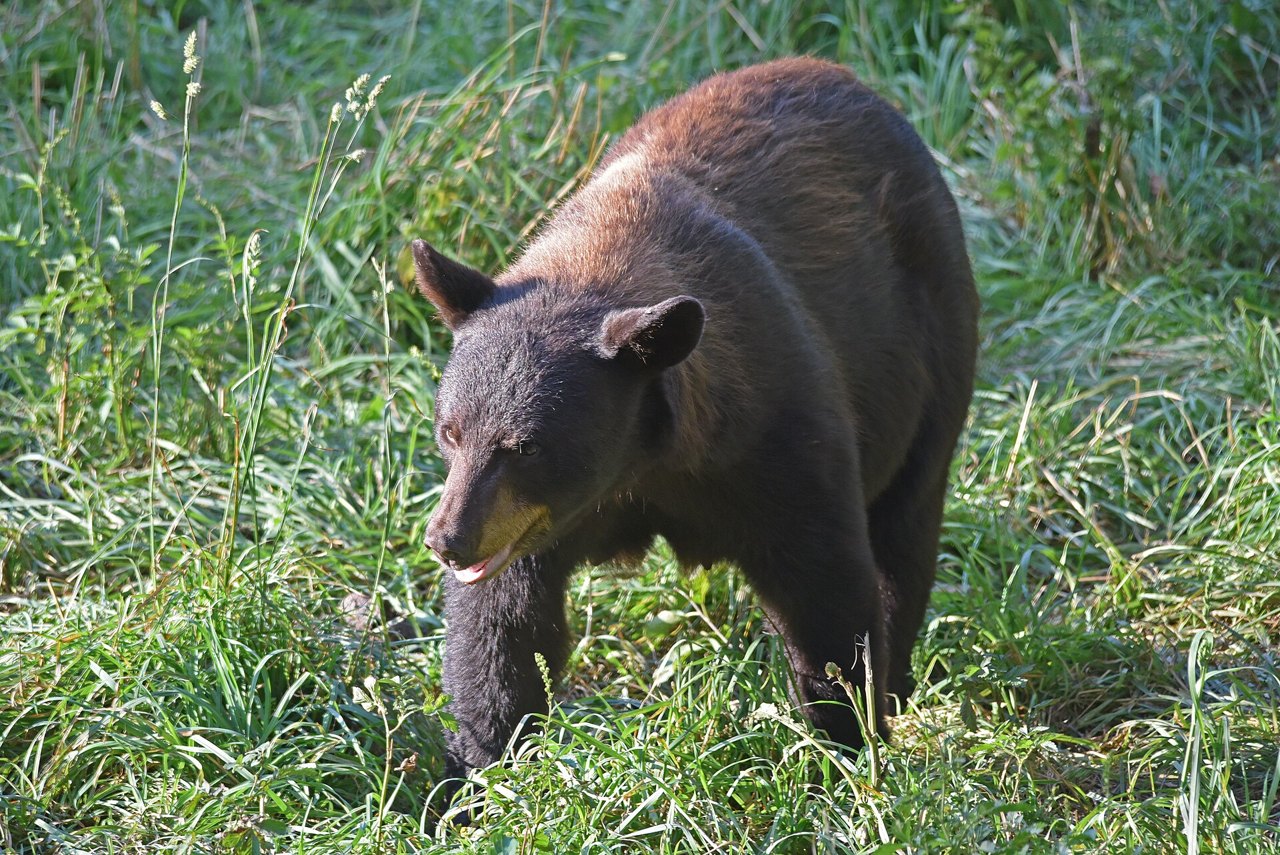
Wildlife Science · BearsBears are not monsters, and knowing what they are makes the danger clearer, not smaller. A black bear is an omnivore that spends most of its waking life eating plants, berries, insects, and whatever else is easy, and it will walk away from trouble whenever walking away is cheap. Fights are expensive: a torn muscle in a wild animal can end a life. So bears warn first, huffing, slapping the ground, and making short bluff charges that stop before contact. When a bear does commit, it is usually because it was startled at close range, is guarding a food source, or is protecting cubs, and at that point size and strength settle the matter quickly. A wild neighborhood can be friendly for a whole season and still remain genuinely dangerous.
1What is Roz’s problem with teaching flight?Ch.41–50
2Who helps train Brightbill to fly?Ch.41–50
3Brightbill eventually rises into the air and flies.Ch.41–50
4What happens in the chapter called The Fight?Ch.41–50
5Write the numbers 1–5 in the boxes to show the correct order of events in Chapters 41–50. Number 1 = what happens first.Ch.41–50
  • Brightbill’s practice finally lifts him into the air.
  • Roz recruits the flock as flight instructors.
  • Roz wins — but loses a foot.
  • A furious bear fight breaks out.
  • Mr. Beaver carves and fits a wooden foot.
6Roz escapes the bear fight completely unharmed.Ch.41–50
7Who makes Roz’s replacement foot?Ch.41–50
8What is the new foot made of?Ch.41–50
9The wooden foot works, and Roz walks again.Ch.41–50
10What is Part 5’s carved-plain message?Ch.41–50
Part 3
Literary Elements
Understanding HOW and WHY Peter Brown tells the story across Chapters 41–50.
🪵Knowledge Bank · The Story in a Scar
Literary Craft · Objects That Carry MeaningFactories make things identical; life makes them particular. That difference is a tool writers use constantly, because an object that has been damaged and mended carries a history no fresh object can. A dented pocket watch, a mended flag, a limb rebuilt by a friend — each one silently records where a character has been and what it cost to get there. Craft sometimes calls this a marker: a physical detail that measures change. Notice that the reader is never told to find it meaningful; the object simply keeps appearing until its weight becomes obvious. Compare a character at the start of a book with the same character carrying such a token later, and the whole distance traveled shows in one glance. Damage, on the page, is frequently how a story keeps score.
Braided opposites
The son’s ascent and the mother’s injury cross in one part — joy and cost together.
Symbol: the wooden foot
Part of Roz is now literally made of island — belonging, carved and fitted.
Compounding kindness
The builder of her house rebuilds her body — bonds in this book pay interest.
1Placing Brightbill’s first flight beside Roz’s injury creates ___.Ch.41–50
2Fill in the blank with the correct literary term.Ch.41–50
Word choices:symboloppositessequelmeter- some words will not be used
The wooden foot works as a of belonging.
Ascent beside injury forms braided .
3The wooden foot symbolizes that Roz ___.Ch.41–50
4The bear fight breaks the book’s promise that the island is peaceful.Ch.41–50
5Mr. Beaver repairing Roz’s body after building her house shows the book’s idea that ___.Ch.41–50
6Roz cheering from the GROUND during the first flight is a quiet image of ___.Ch.41–50
7‘Compounding kindness’ means each act of help stands alone and is forgotten.Ch.41–50
8Fill in the blank with the correct literary term.Ch.41–50
Word choices:echorhymevillainclimax- some words will not be used
The beaver rebuilding body after house is a structural .
9Brown lets Roz WIN the fight but LOSE a foot so that victory ___.Ch.41–50
10After Part 5, when danger comes again, readers will expect the island to ___.Ch.41–50
Part 4
Think Deeper
Four deeper challenges — no single-word recall. Read, weigh the evidence, and reason it out.
🛡Knowledge Bank · The Price of Protection
Behavioral Ecology · Defending the YoungDefending offspring is expensive, and biologists have measured exactly how expensive. A killdeer drags a wing along the ground, faking injury to lure a fox away from her nest, risking her own life to do it. Musk oxen form an outward-facing ring around calves while wolves circle. Moose and elephant seals will charge animals far larger than themselves. Researchers explain the pattern with a simple accounting they call parental investment: once an adult has poured months of food, warmth, and teaching into a young animal, abandoning it wastes everything already spent, so extreme risk becomes the reasonable choice. Notice that this logic never asks whether the adult shares blood with the young one. It only asks who has invested. By that standard a machine who has spent a season guarding a gosling is behaving like a parent.

Think back over these chapters. On a windy meadow, a young goose runs, flaps, stumbles, runs again — while a flock calls instructions and a metal mother counts wingbeats she will never make. One day the running becomes rising, and the island tilts below him. Elsewhere, fury on four legs collides with patience on two, and when the roaring stops, the patient one stands winner — minus a foot. Then sawdust, measuring, whittling: a beaver at his bench, building an ankle. The robot walks home on a piece of the island.

Original passage written for Garden Heights — not a quotation from the novel.
1Claim: “Roz’s solution to the flight problem shows her best kind of intelligence.” — choose the two details that best prove it.Claim & Evidence
2What Part 5 gives, or What Part 5 takes? Tap each detail to send it left or right.Sort into two
◄ What Part 5 givesWhat Part 5 takes ►
3Match each cause to its result. For each cause, pick its result.Cause & Effect
Roz cannot demonstrate flight
Weeks of running, flapping, stumbling
A furious bear will not back down
Mr. Beaver opens his workshop
4Fill both blanks to complete the reasoning.Build the Argument
Brown gives the foot-carving to Mr. Beaver rather than letting Roz repair herself because , which shows that .
Part 5
Standardized Test
Reading passage · How Birds Learn to Fly · SAT & TOEFL-style practice
🎯 You already have the skills from the sections above — this is just a fun way to meet real SAT & TOEFL-style questions. Read the passage (the highlighted words are tested below), then answer the questions below. Tap an answer to select it, then tap it again to confirm — you can change your choice until you confirm.

A bird’s first flight looks like magic — but it is homework. Young birds spend weeks preparing in a stage scientists call fledging: the period when a chick grows flight feathers and works up to leaving the nest. The training plan is surprisingly ordinary. First comes muscle: flightless days of vigorous wing-flapping — exercise, not failure — that builds the powerful chest muscles flight demands. Then come hops, then flapping leaps, then short ‘flights’ that are mostly falling with style. Waterfowl like geese add a special skill: the running takeoff, sprinting across water or ground, wings beating, until speed and lift agree to carry them.

Parents teach mostly by demonstration — flying short hops, circling back, calling encouragement — because flight cannot be explained, only shown and tried. The hardest lesson comes last: landing, which young birds famously flub, skidding, tumbling, and overshooting until practice smooths the crashes out. Ornithologists note that fledglings learn fastest in groups, where each youngster copies the boldest — a flock is a flying classroom. All of which explains the strangest flight school in children’s literature: a flightless robot mother who supplies the plan and the cheering, and borrows a flock to supply the wings. The method is fiction. The curriculum is real.

Original passage written for Garden Heights — not a quotation from the novel.
1What is the main idea of the passage?SAT · Central Idea
2In the passage, fledging is ___.SAT · Words in Context
3What is the purpose of the flightless days of wing-flapping?SAT · Cause and Effect
4In the passage, a running takeoff is ___.SAT · Words in Context
5In the passage, demonstration means teaching by ___.SAT · Words in Context
6Which lesson does the passage call the hardest?SAT · Detail
7Why do fledglings learn fastest in groups?SAT · Inference
8The passage calls short early flights ‘mostly falling with style’ to show ___.SAT · Figurative Language
9How does the passage describe Roz’s flight school?SAT · Detail
10Which Part 5 detail does this passage BEST help explain?SAT · Applying Evidence
Part 6 · Optional
Creative Writing
A bonus challenge to practice your English. Take your time and have fun with it.
About This Section

This writing task is optional and is not part of your auto-graded score. The feedback below checks only the basics — length, spelling, and grammar — not whether your ideas are right or wrong. It is meant for classroom discussion and creative practice, so feel free to use your imagination!

Writing Task — Part 5 “Falling With Style”

The passage calls early flights ‘mostly falling with style.’ Write about a skill YOU learned through glorious failure — biking, swimming, an instrument, a language. Describe the worst crash, the practice that followed, and the day the ‘running became rising.’ 6–10 sentences. End with advice for someone still in the crashing stage.

You can start with: “My first try was not flying — it was falling, with a little style...”
0 / 40 words minimum
πŸ—£ Teach It · Just for Fun (optional)

No right or wrong — close the screen and tell someone nearby what happened in this part. Can’t find anyone? Tell yourself out loud. The moment you teach it, you truly understand it.

Garden Heights

Part 5 Complete!

You finished Chapters 41–50 of The Wild Robot.

Here are your auto-graded results:

-
points out of 100
Your Writing

Your writing was checked automatically for length, spelling, grammar, and whether you included the key parts of the scene. Scroll back to Part 5 anytime to read your feedback and improve your work.

Move on to Part 6 →

Independent study guide by Garden Heights. Not affiliated with or endorsed by Peter Brown. Contains original analysis only; no text from the novel is reproduced. Reference text: This workbook follows Peter Brown’s classic text (the standard Puffin edition sold worldwide). Revised 2023 UK editions change some wording and may not match the vocabulary studied here.