New here? Just sign up with Google — your account includes Matilda, our gift book, forever.
The Wild Robot · Garden Heights
Part 6
for The Wild Robot · Part 6 · Chapters 51–60
8 Parts40 min
What Happens in Part 6
Autumn arrives with its orders. The island changes coats and habits, and the geese begin the oldest conversation of the season: the migration south. For Brightbill the pull is physical — an instinct beating in him with every cooling day — and it collides with the tug of home: how can he leave his mother? Roz, who has learned more than language on this island, answers like a mother: she tells him to go. Wings need winter skies, and love that clips them is not love. The farewell is the book’s quietest heartbreak — a flock rising, one goose looking back, a robot on the shore growing smaller. Then come the goose-less weeks: the Nest too tidy, the garden done, the first frost, then snow — and a mother with perfect memory discovering exactly what memory is for. Winter closes over the island, and Roz stands in it, waiting — for spring, and for a sky with one particular goose in it.
What We Will Learn
Section
What you will practice
Vocabulary
Season words: migration, instinct, farewell, frost, absence…
Literary Elements
A goodbye done right, and an empty nest written honestly
Cross-Curricular
The great migration: why birds fly south, and how they find the way
Chapter Summary
Ch.
What happens
51–60
The flock flies south — autumn wakes Brightbill’s migration instinct; Roz tells him to go; the farewell rises with the flock, and the goose-less weeks bring frost, snow, and a mother learning what memory is for.
Part 1
Vocabulary
Study 10 key words from Chapters 51–60, then answer each question.
🧭Knowledge Bank · The Autumn Restlessness
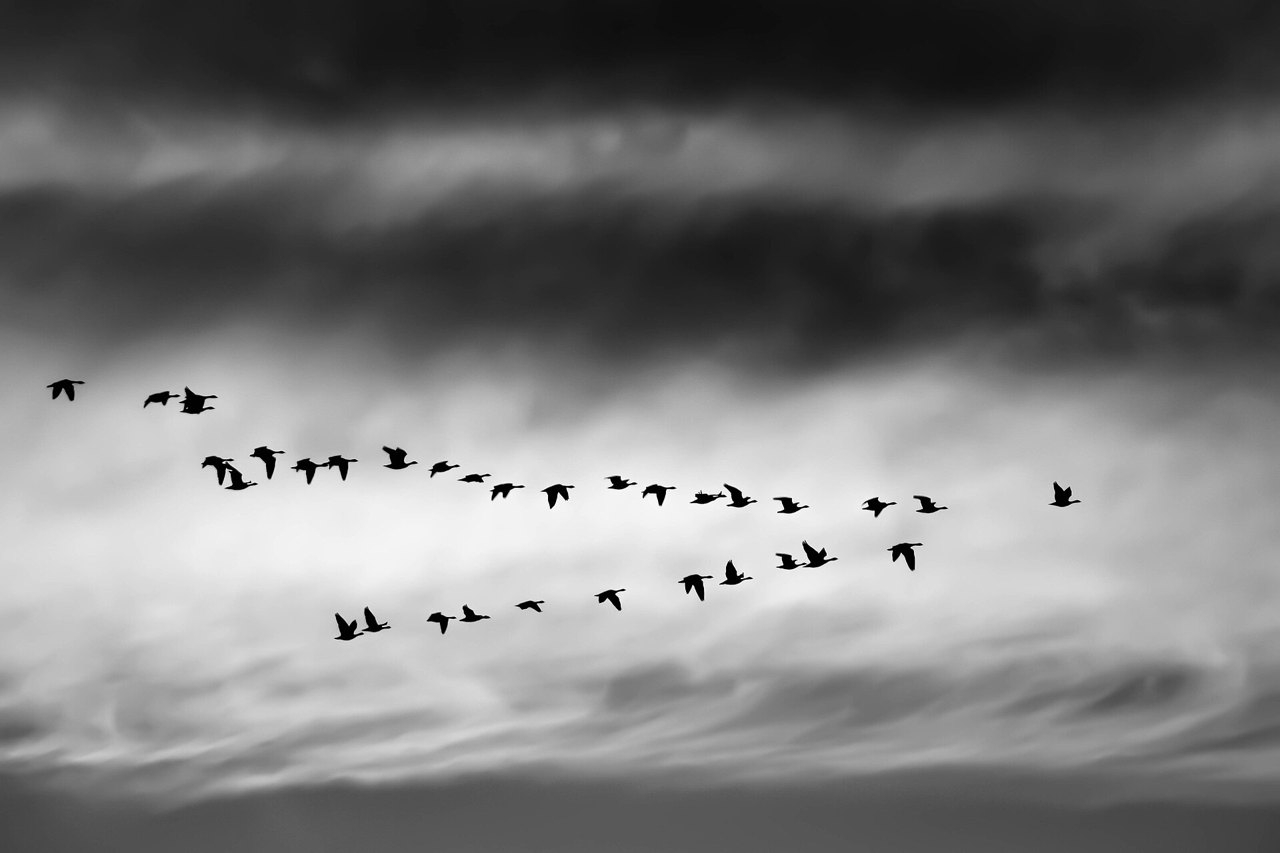
Ornithology · Migratory RestlessnessMigratory birds do not decide to leave; something inside them starts pushing. As daylight shortens, their bodies change: they eat far more, store fat, and become jumpy and sleepless. German scientists named the condition zugunruhe, which simply means migration restlessness. The strangest evidence comes from captivity. Caged migratory birds that have never flown anywhere begin hopping and fluttering at night, and they aim those hops toward the exact compass direction their wild relatives are traveling — researchers measured it by lining cages with paper that recorded every scratch. The urge, in other words, is inherited rather than learned, and it arrives on a schedule no companion and no comfort can argue with. A young goose growing restless in autumn is not being disloyal. He is being seasonal.
Visual AidThe urge that arrives on schedule
Photograph of a flock of geese in flight over Boulder, Colorado, printed in black and white. The Knowledge Bank explains that migratory birds do not decide to leave: as daylight shortens, their bodies change, they store fat and grow restless, and an inherited urge sends them off on a schedule no comfort can argue with. These birds are not Brightbill’s flock. Notice that the lines are ragged rather than a neat V — a real flock reshapes itself constantly in the air.
Geese in flight over Boulder, Colorado (Unsplash). Source: Wikimedia Commons, CC0.
migrationn.Ch.51–60
A seasonal journey to another region
“The great migration south begins each autumn.”
instinctn.Ch.51–60
An inherited urge that needs no teaching
“The instinct to fly south beats in every goose.”
restlessadj.Ch.51–60
Unable to stay still or settled
“Cooling days made Brightbill restless.”
farewelln.Ch.51–60
A goodbye, often for a long time
“The farewell rose with the flock.”
horizonn.Ch.51–60
The line where sky meets land or sea
“The flock shrank toward the horizon.”
frostn.Ch.51–60
A thin freeze that coats the ground
“First frost silvered the garden rows.”
absencen.Ch.51–60
The state of someone being gone
“The Nest echoed with Brightbill’s absence.”
tidyadj.Ch.51–60
Neat; everything in its place
“A too-tidy lodge is a lonely one.”
endurev.Ch.51–60
To bear something difficult over time
“Roz would endure the winter alone.”
reunionn.Ch.51–60
A meeting again after time apart
“Spring would bring — she hoped — a reunion.”
ⓘ The vocabulary words in this list are selected to help you understand and complete this workbook. Some may not appear verbatim in the original novel.
🧠Knowledge Bank question
1According to the Knowledge Bank, how did researchers learn that caged migratory birds hop toward their migration direction?Ch.51–60
2An ‘instinct’ must be carefully taught by parents.Ch.51–60
3The line where sky meets land or sea is the ___.Ch.51–60
4‘Absence’ is the state of someone being present.Ch.51–60
5Fill in each blank with the correct word.Ch.51–60
Word choices:frostrestlessenduretidy- some words will not be used
First silvered the garden rows.
Cooling days made Brightbill .
6To bear something difficult over time is to ___ it.Ch.51–60
7A ‘farewell’ is a greeting shouted at someone arriving.Ch.51–60
8Unable to stay still or settled is ___.Ch.51–60
9Fill in the blanks with the correct words.Ch.51–60
Word choices:absencereunionmigrationhorizon- some words will not be used
Spring might bring a .
The flock shrank toward the .
10A meeting again after time apart is a ___.Ch.51–60
Part 2
Comprehension
Show you understood what happens in Chapters 51–60.
❄Knowledge Bank · What the First Frost Starts
Ecology · First FrostThe first hard frost of the year is a switch, not a mood. Ice crystals form inside the cells of tender plants and burst them, so squash vines and bean leaves collapse overnight while tougher greens such as kale survive. Insects vanish the same week: most die after laying eggs, while others push under bark, leaf litter, or soil to wait as dormant forms. Frogs and turtles sink to pond bottoms. That disappearance strips the menu for everyone still awake, which is why the weeks before frost are the busiest of the year — squirrels bury nuts, jays hide seeds, and mammals of every size build caches and body fat. Afterward an animal lives on what it has already stored, and each cold night subtracts from that reserve.
🧠Knowledge Bank question
1The Knowledge Bank says the first hard frost kills tender plants because ___.Ch.51–60
2What worries Brightbill about the migration?Ch.51–60
3Roz begs Brightbill to stay with her for the winter.Ch.51–60
4How does Roz explain her decision?Ch.51–60
5Write the numbers 1–5 in the boxes to show the correct order of events in Chapters 51–60. Number 1 = what happens first.Ch.51–60
The flock begins its migration talk.
Autumn changes the island’s coats and habits.
Frost, then snow, close over the island.
Roz tells Brightbill to go.
The farewell rises with the flock.
6Brightbill leaves without a single backward glance.Ch.51–60
7What are the goose-less weeks like for Roz?Ch.51–60
8What does Roz discover about her perfect memory?Ch.51–60
9Winter arrives with frost and snow closing over the island.Ch.51–60
10What is Roz doing as Part 6 ends?Ch.51–60
Part 3
Literary Elements
Understanding HOW and WHY Peter Brown tells the story across Chapters 51–60.
🍂Knowledge Bank · When Autumn Tells the Story
Literary Craft · Season and MoodWriters choose weather the way composers choose keys. A scene of parting could happen in July, but placing it under falling leaves, thinning light, and the first cold snap does half the emotional work before anyone speaks. Critics call this technique atmosphere, and it succeeds because readers already carry feelings attached to seasons: spring means beginnings, autumn means endings and departures. Notice also that the season here is not merely decoration — it causes the plot, since shortening days are the actual reason a goose must go. When a setting both creates the mood and drives the events, the landscape has stopped being a backdrop and started acting like a character. Read any story twice and check what the weather is doing, because a careful author almost never lets it be random.
Visual AidWhat the weather is doing in Part 6
Diagram for the Knowledge Bank on season and mood. One box of autumn weather sends two arrows down, because the Knowledge Bank says the season here does two jobs at once: it makes the mood and it drives the plot. It does not claim every story uses weather this way. Notice that the right-hand arrow is the unusual one — weather that merely sets a mood is common, but weather that is the reason a character must leave has become a character itself.
Two jobs of the season as described in the Knowledge Bank. Drawn for Garden Heights Academy.
Villain-less conflict
Instinct against love, with no one to blame — the truest, hardest kind of trouble.
The selfless choice
‘Go’ — love proven by release; motherhood’s final exam, passed in one word.
Season as storyteller
Autumn runs the plot: restlessness, farewell, frost — weather ordering the chapters.
🧠Knowledge Bank question
1According to the Knowledge Bank, the season here is not merely decoration because it ___.Ch.51–60
2Fill in the blank with the correct literary term.Ch.51–60
Word choices:selflessvillainrhymemontage- some words will not be used
‘Go’ is the book’s great choice.
A conflict with no one to blame is -less.
3Roz telling Brightbill to go proves her motherhood because ___.Ch.51–60
4Brown blames the flock for taking Brightbill away from Roz.Ch.51–60
5‘Weather as storyteller’ means the plot of Part 6 is ordered by ___.Ch.51–60
6The single backward glance during the farewell works because ___.Ch.51–60
7The too-tidy Nest is the book’s image for loneliness.Ch.51–60
8Fill in the blank with the correct literary term.Ch.51–60
Word choices:seasondialoguevillainmeter- some words will not be used
Autumn running the plot makes the a storyteller.
9A robot’s perfect memory becoming her comfort is the book’s way of saying ___.Ch.51–60
10Ending Part 6 with waiting — not action — prepares readers for ___.Ch.51–60
Part 4
Think Deeper
Four deeper challenges — no single-word recall. Read, weigh the evidence, and reason it out.
🚪Knowledge Bank · Why the Young Leave
Family Science · Leaving HomeIn wild families, success looks like an empty nest. Biologists call the moment a young animal leaves its birthplace dispersal, and it is not a failure of the bond but the point of it. Dispersal spreads a species into new territory, prevents brothers and sisters from competing over the same shrinking food supply, and keeps close relatives from breeding together. Young wolves leave to find unclaimed range; young squirrels are actively pushed out by mothers who fed them all summer. Human families feel the same turn and even borrow the same image, calling the ache that follows an empty nest. What looks from inside like losing someone is, measured from outside, a completed job — and the parents who feel it worst are usually the ones who did the work most thoroughly.
Think back over these chapters. The island swaps its greens for golds, and in a young goose’s chest a compass wakes, pointing hard at a horizon he has never visited. He looks at the compass; he looks at his mother. She looks at him — and points the same direction the compass does. The flock gathers, thunders, rises. One goose looks back. On the shore, a metal figure grows smaller and smaller, then turns to a Nest too tidy, a garden finished, and a winter’s worth of remembering, filed under: until spring.
Original passage written for Garden Heights — not a quotation from the novel.
1Claim: “Roz’s ‘go’ is strength, not surrender.” — choose the two details that best prove it.Claim & Evidence
2What the instinct commands, or What love decides? Tap each detail to sort it — tap again to switch sides. You can keep tapping to change your answer.Sort into two
◄ What the instinct commandsWhat love decides ►
3Match each cause to its result. For each cause, pick its result.Cause & Effect
Days shorten and the air cools→
The pull collides with the tug of home→
Roz speaks her hardest word: go→
The island empties and frost arrives→
🧠Knowledge Bank question
4Fill both blanks to complete the reasoning.Build the Argument
The Knowledge Bank says dispersal is not a failure of the bond but the point of it because , which shows that .
Part 5
Standardized Test
Reading passage · The Great Migration · SAT & TOEFL-style practice
Read the passage — the highlighted words are tested — then answer. Tap an answer, then tap it again to confirm.
SATCentral Idea — the passage's main point
SATWords in Context — a word's meaning in this passage
SATDetail — a fact stated in the passage
SATText Evidence — the line that backs up an answer
SATCause and Effect — what led to what
SATInference — a conclusion the passage implies
SATFigurative Language — words meaning more than their literal sense
TOEFLProse Summary — the three sentences that sum it up
The Science of Bird Migration
Twice a year, the sky fills with travelers. Billions of birds ride the seasons between a summer home rich in food and nesting space and a winter refuge that stays warm and green — a round trip we call migration. The schedule is set not by weather alone but by daylight: as days shorten, migratory birds grow restless, feed hungrily to store fuel as body fat, and then — often on a single night’s signal — go. Geese are the commuters everyone knows, honking south in their famous V-formation: each bird rides the swirl of lifted air spilling off the wingtips ahead, saving so much energy that flocks fly farther together than any goose could alone. The lead position is hardest, so geese rotate it, trading the front like cyclists in a race.
How do they find the way? Scientists have documented a toolkit: the sun’s position by day, star patterns by night, mountains, rivers, and coastlines as living maps — and, most remarkably, a built-in compass that senses the earth’s magnetic field. Young birds inherit the urge and the direction, but the finest routes are learned by flying them beside experienced elders — which is why a first migration matters so much: it is not just a journey but an education. A young goose leaving his island for the first time carries all of it at once — the fuel, the compass, the elders’ guidance, and a promise stamped in every migratory species: when the season turns, we come back.
Original passage written for Garden Heights — not a quotation from the novel.
1What is the main idea of the passage?SAT · Central Idea
2In the passage, birds that grow restless ___.SAT · Words in Context
3What sets the migration schedule, according to the passage?SAT · Detail
4How do birds prepare fuel for the journey?SAT · Text Evidence
5Why does the V-formation save energy?SAT · Cause and Effect
6Why do geese rotate the lead position?SAT · Inference
7In the passage, the birds’ magnetic sense detects ___.SAT · Detail
8Why does a FIRST migration matter so much?SAT · Inference
9The ‘promise stamped in every migratory species’ is ___.SAT · Figurative Language
10Prose Summary (TOEFL).The passage explains how bird migration works. This TOEFL task lists six sentences; choose the THREE that best capture the passage’s main ideas. The other three do not belong — they state minor details or ideas the passage does not present.TOEFL · Prose Summary
Part 6 · Optional
Creative Writing
A bonus challenge to practice your English. Take your time and have fun with it.
About This Section
This writing task is optional and is not part of your auto-graded score. The feedback below checks only the basics — length, spelling, and grammar — not whether your ideas are right or wrong. It is meant for classroom discussion and creative practice, so feel free to use your imagination!
Writing Task — Part 6 “The Hardest Word”
Roz’s hardest word is ‘go.’ Write a farewell scene of your own — two characters, one leaving for something they need, one choosing to release them. No villain allowed: nobody may be at fault. 6–10 sentences, ending with one small gesture — like Brightbill’s backward glance — that carries the whole goodbye.
You can start with: “The season turned, the way seasons do, and we both knew what came next...”
0 / 40 words minimum
🗣 Teach It · Just for Fun (optional)
No right or wrong — close the screen and tell someone nearby what happened in this part. Can’t find anyone? Tell yourself out loud. The moment you teach it, you truly understand it.
Part 6 Complete!
You finished Chapters 51–60 of The Wild Robot.
Here are your auto-graded results:
-
points out of 100
Teach it to someone
The best last step is to teach it. In your own words, explain what happened — retell a favorite scene, teach a character’s big choice, or sum up the main idea for a parent, friend, or classmate. When you can teach it clearly, you truly own it.
Independent study guide by Garden Heights. Not affiliated with or endorsed by Peter Brown. Contains original analysis only; no text from the novel is reproduced. Reference text: This workbook follows Peter Brown’s classic text (the standard Puffin edition sold worldwide). Revised 2023 UK editions change some wording and may not match the vocabulary studied here.
SAT® is a registered trademark of College Board, which is not affiliated with, and does not endorse, these materials. TOEFL® is a registered trademark of ETS. These materials are not endorsed or approved by ETS. Garden Heights is an independent provider of test-style reading practice.