New here? Just sign up with Google — your account includes Matilda, our gift book, forever.
The Wild Robot · Garden Heights
Part 7
for The Wild Robot · Part 7 · Chapters 61–67
8 Parts40 min
What Happens in Part 7
The winter turns from hard to deadly. Cold like a predator stalks the island; food runs short, shelters fail, and animals begin to freeze. Roz — who does not feel cold, but feels every death — refuses to stand by. She masters fire, the one tool no animal commands, and turns the Nest and its grounds into a rescue station: warmth for the freezing, shelter for the lost. At the Dawn Truce — the island’s old sacred hour when no one hunts — Roz stands before the animals with an invitation without precedent: an Evening Truce, a peace under her roof, where predator and prey warm themselves at the same fire. It works. Foxes doze beside squirrels; enemies share a room and survive because of it. When the thaw finally comes, the island owes its winter to a robot — and spring pays her back with interest: honking out of the southern sky comes the flock, and with it, grown and glorious, Brightbill.
The winter truce — deadly cold stalks the island; Roz masters fire and opens the Nest as a rescue station; her Evening Truce seats predator beside prey at one hearth; and when the thaw comes, spring returns the flock — and Brightbill.
Part 1
Vocabulary
Study 10 key words from Chapters 61–67, then answer each question.
🔥Knowledge Bank · The Tool No Animal Has
Anthropology · Controlled FireEvery animal in a northern forest is better at winter than any human — except for one advantage humans hold alone. People control fire. Charred bone and ash layers show our ancestors keeping hearths burning hundreds of thousands of years ago, and anthropologists rank that control among the most important events in human history. Fire cooks food so bodies draw more energy from it, hardens wooden tools, drives predators back, extends the working day with light, and turns a lethal night into a survivable one. No other species manages it. A chimpanzee can wave a burning branch but cannot strike a spark, gather fuel, and keep a flame alive through a snowstorm. So a creature whose hands never freeze and whose patience never tires holds an enormous winter advantage.
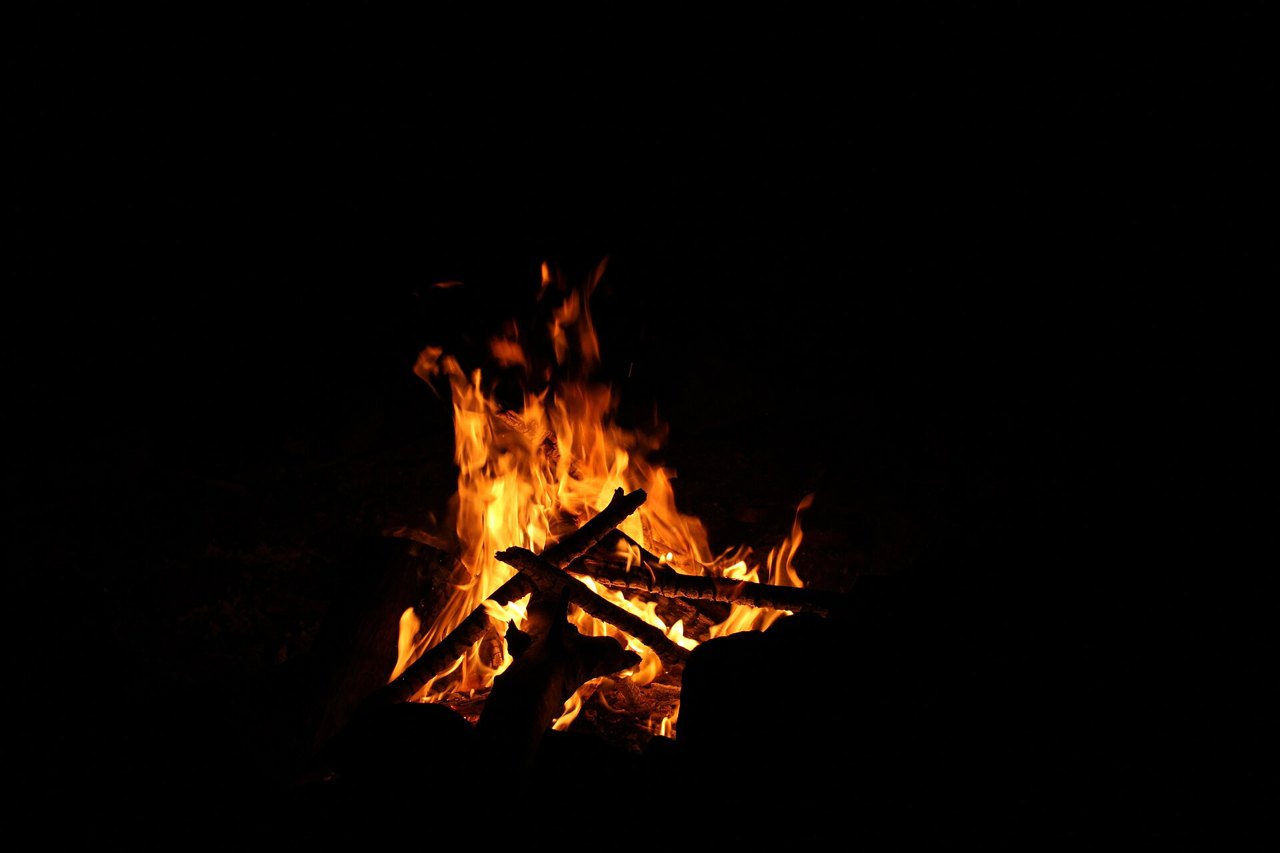
Visual AidThe one advantage humans hold alone
Photograph of a small campfire burning at night, taken in 2015. The Knowledge Bank explains that people control fire and no other species does: a chimpanzee can wave a burning branch but cannot strike a spark, gather fuel, and keep a flame alive through a snowstorm. This fire was lit by a camper, not by a robot, and it is not in a stone shelter. Notice that the flames are the only thing visible — everything else in the picture is exactly as dark and cold as a winter night without one.
Campfire at night, photograph by Noah Silliman, 2015 (Unsplash). Source: Wikimedia Commons, CC0.
deadlyadj.Ch.61–67
Able to cause death
“The cold turned deadly after the new year.”
freezev.Ch.61–67
To be harmed or killed by cold
“Small animals began to freeze in their shelters.”
hearthn.Ch.61–67
The floor of a fireplace; the fireside
“Enemies warmed themselves at one hearth.”
rescuen.Ch.61–67
The act of saving from danger
“The Nest became a station of rescue.”
trucen.Ch.61–67
An agreed pause in fighting
“The Evening Truce seated fox beside squirrel.”
invitationn.Ch.61–67
A request to come or take part
“Roz’s invitation had no precedent.”
precedentn.Ch.61–67
An earlier example to follow
“No precedent existed for a robot’s peace.”
predatorn.Ch.61–67
An animal that hunts others
“Even a predator freezes without shelter.”
thawn.Ch.61–67
The melting that ends a freeze
“The thaw came late but it came.”
gratituden.Ch.61–67
Thankfulness for help received
“The island’s gratitude outlasted the snow.”
ⓘ The vocabulary words in this list are selected to help you understand and complete this workbook. Some may not appear verbatim in the original novel.
🧠Knowledge Bank question
1According to the Knowledge Bank, what can a chimpanzee NOT do with fire?Ch.61–67
2A ‘predator’ is an animal that hunts others.Ch.61–67
3The melting that ends a freeze is the ___.Ch.61–67
4A ‘precedent’ is an earlier example to follow.Ch.61–67
5Fill in each blank with the correct word.Ch.61–67
Word choices:hearthdeadlyrescuethaw- some words will not be used
Enemies shared one through the worst nights.
The cold turned after the new year.
6A request to come or take part is an ___.Ch.61–67
7‘Gratitude’ is anger at those who helped you.Ch.61–67
8To be harmed or killed by cold is to ___.Ch.61–67
9Fill in the blanks with the correct words.Ch.61–67
Word choices:truceinvitationgratitudepredator- some words will not be used
The Evening seated fox beside squirrel.
The island’s outlasted the snow.
10The act of saving from danger is a ___.Ch.61–67
Part 2
Comprehension
Show you understood what happens in Chapters 61–67.
🕊Knowledge Bank · Truces in the Real Wild
Animal Behavior · Wary PeaceAn hour when nobody hunts sounds like pure fantasy, but nature does allow versions of it. At the last water holes of an African dry season, zebra, antelope, warthogs, and predators drink within sight of one another in a tense, watchful peace. Floods and wildfires produce the same effect, pushing enemies onto the same high ground until the emergency passes. Two facts explain it. First, hunting is expensive: a chase burns energy a starving animal cannot spare, and most chases fail anyway. Second, an animal focused on staying alive tonight discounts a meal it might not live to digest. Scientists describe the result as a truce of arithmetic rather than goodwill. Peace between predator and prey is rare, brief, and almost always produced by a shared emergency.
🧠Knowledge Bank question
1The Knowledge Bank calls peace between predator and prey a truce of arithmetic because ___.Ch.61–67
2What tool does Roz master to fight the cold?Ch.61–67
3Roz herself suffers badly from the cold.Ch.61–67
4What does the Nest become during the crisis?Ch.61–67
5Write the numbers 1–5 in the boxes to show the correct order of events in Chapters 61–67. Number 1 = what happens first.Ch.61–67
Roz masters fire against it.
The thaw brings the flock — and Brightbill — home.
The winter cold turns deadly.
At the Dawn Truce she proposes an Evening Truce.
Predator and prey share one warm hearth.
6Roz announces her invitation during the island’s Dawn Truce.Ch.61–67
7What is unprecedented about the Evening Truce?Ch.61–67
8Why does the truce hold?Ch.61–67
9Spring arrives, and the flock returns with Brightbill.Ch.61–67
10What does the island owe Roz by winter’s end?Ch.61–67
Part 3
Literary Elements
Understanding HOW and WHY Peter Brown tells the story across Chapters 61–67.
⏳Knowledge Bank · Saving the Best for Thaw
Literary Craft · Timing a PayoffWhere a writer places a happy event matters as much as whether it happens. Drop a joyful reunion into the middle of a crisis and it steals attention from the danger; the rescue stops mattering and the reunion itself feels cheap. Hold it until the crisis has been fully paid for, and the same scene lands with enormous force. Craft calls this the payoff, and its rule is simple: an audience must earn the reward by living through the cost first. Notice how long this novel makes readers wait, and notice exactly when it finally pays — not during the worst of the emergency, but after, when the accounting is complete. A reader who feels a scene has been earned is usually responding to nothing more mysterious than good timing.
Finest hour
The crisis that reveals what the hero was for — Roz’s is a deadly winter.
Peace as invention
The Evening Truce — engineered like a bridge, by the engineer of impossible things.
Earned reunion
Brightbill returns at the thaw — joy delayed until the debt is banked lands full-weight.
🧠Knowledge Bank question
1According to the Knowledge Bank, a joyful reunion dropped into the middle of a crisis ___.Ch.61–67
2Fill in the blank with the correct literary term.Ch.61–67
Word choices:inventionhoursequelrhyme- some words will not be used
The truce is peace as an .
A hero’s defining crisis is their finest .
3Calling the truce an ‘invention’ fits Roz because she ___.Ch.61–67
4The book has Brightbill return in mid-crisis, upstaging the rescue.Ch.61–67
5Fire in this part symbolizes ___.Ch.61–67
6Enemies sharing a hearth completes an idea planted at the Dawn Truce: ___.Ch.61–67
7Roz’s immunity to cold makes her winter heroism cost her nothing.Ch.61–67
8Fill in the blank with the correct literary term.Ch.61–67
Word choices:earnedsuddenfalsedouble- some words will not be used
A reunion delayed until deserved is an reunion.
9After the winter, the island’s debt to Roz functions in the story as ___.Ch.61–67
10Part 7 completes the island’s answer to chapter one’s question ‘what is this monster?’: ___.Ch.61–67
Part 4
Think Deeper
Four deeper challenges — no single-word recall. Read, weigh the evidence, and reason it out.
🌡Knowledge Bank · The Arithmetic of Cold
Physiology · Energy BudgetsWarm-blooded animals run a daily budget, and cold makes it brutal. A body must hold a steady inner temperature, so every degree the air drops means burning more fuel just to stay level; a small bird can spend most of a winter day simply keeping itself warm. Meanwhile the food that pays for this shrinks: seeds are buried, insects gone, water locked as ice. Anything that lowers the heating bill is therefore worth more in January than a meal is worth in June. Thicker fur, a sheltered hollow, huddled bodies, and above all an outside source of heat can decide whether an animal survives to spring. That is why a fire in a stone shelter is not merely comfortable. To a freezing animal it is straightforward arithmetic.
Visual AidWinter's arithmetic
Diagram for the Knowledge Bank on energy budgets. The two red boxes are the two halves of the problem the Knowledge Bank describes, the heating bill rising while the food supply falls, and the row beneath lists the four things the Knowledge Bank says can lower the bill. It gives no numbers, because the Knowledge Bank gives none. Notice that the last box is a different color: an outside source of heat is the one item on the list that no animal can grow or build for itself.
Budget described in the Knowledge Bank. Drawn for Garden Heights Academy.
Think back over these chapters. Cold comes down like a lid, and the island’s thousand small fires of life begin to gutter. In a lodge built by beavers, a machine who cannot shiver kneels over kindling until a spark takes — and then opens her door to everyone, hunter and hunted alike. All the long winter, enemies doze in one orange glow, dreaming their opposite dreams in peace. And when the world finally drips and greens, the southern sky fills with honking — and one goose drops out of the V, aiming straight for a metal figure by a lodge, exactly as fast as wings can go.
Original passage written for Garden Heights — not a quotation from the novel.
1Claim: “The Evening Truce worked because of Roz’s standing, not just the cold.” — choose the two details that best prove it.Claim & Evidence
2What the cold destroys, or What the cold creates? Tap each detail to sort it — tap again to switch sides. You can keep tapping to change your answer.Sort into two
◄ What the cold destroysWhat the cold creates ►
3Match each cause to its result. For each cause, pick its result.Cause & Effect
The cold turns from hard to deadly→
The Nest opens as a rescue station→
Roz proposes peace at the Dawn Truce→
The thaw finally unlocks the island→
🧠Knowledge Bank question
4Fill both blanks to complete the reasoning.Build the Argument
The Knowledge Bank says a fire in a stone shelter is straightforward arithmetic for a freezing animal because , which shows that .
Part 5
Standardized Test
Reading passage · How Animals Survive Deep Winter · SAT & TOEFL-style practice
Read the passage — the highlighted words are tested — then answer. Tap an answer, then tap it again to confirm.
SATCentral Idea — the passage's main point
SATWords in Context — a word's meaning in this passage
SATComparison — how two things line up
SATDetail — a fact stated in the passage
SATCause and Effect — what led to what
SATInference — a conclusion the passage implies
SATFigurative Language — words meaning more than their literal sense
SATApplying Evidence — using a detail to support a conclusion
How Animals Survive Deep Winter
When deep winter locks a northern island, its animals split into three survival schools. The first school leaves: migrators trade the frozen ground for southern warmth. The second school sleeps: true hibernators like ground squirrels drop into torpor — a state of drastically slowed heartbeat, breathing, and body temperature that stretches autumn fat through months of famine. (Bears sleep famously but less deeply, waking easily — scientists call theirs a lighter winter sleep.) The third school toughs it out awake, and its tricks are the season’s real curriculum: thicker coats, stored caches of food buried in autumn, and the surprising warmth of the subnivean world — the hidden space under the snow, where mice and voles tunnel in air kept near freezing by the snow’s own insulation while the wind above rages far colder.
The awake school’s greatest trick is huddling: bodies pressed together share heat, and a group can survive deadly cold that would kill each member alone. Deer yard up in sheltered stands; birds cram into tree cavities; even solitary animals bend their rules when the thermometer falls far enough. That last fact is worth underlining: extreme cold is one of the few forces that makes wild enemies tolerate each other, because a frozen predator profits nothing from a frozen meal. A fictional robot who seats fox beside squirrel at one hearth has, in truth, only widened a door that winter itself cracks open: when the real enemy is the cold, warmth becomes the only side worth taking.
Original passage written for Garden Heights — not a quotation from the novel.
1What is the main idea of the passage?SAT · Central Idea
2In the passage, torpor is ___.SAT · Words in Context
3How does bear sleep differ from true hibernation?SAT · Comparison
4In the passage, deadly cold is cold that ___.SAT · Words in Context
5What is the subnivean world?SAT · Detail
6Why is the subnivean space warmer than the air above?SAT · Cause and Effect
7In the passage, a hearth is ___.SAT · Words in Context
8Why does extreme cold make wild enemies tolerate each other?SAT · Inference
9The passage says Roz’s truce ‘only widened a door that winter itself cracks open’ — meaning ___.SAT · Figurative Language
10Which Part 7 detail does this passage BEST help explain?SAT · Applying Evidence
Part 6 · Optional
Creative Writing
A bonus challenge to practice your English. Take your time and have fun with it.
About This Section
This writing task is optional and is not part of your auto-graded score. The feedback below checks only the basics — length, spelling, and grammar — not whether your ideas are right or wrong. It is meant for classroom discussion and creative practice, so feel free to use your imagination!
Writing Task — Part 7 “The Truce Table”
Roz seats natural enemies at one fire. Imagine YOUR truce table: two people or groups who never get along, one shared emergency, and the rules you would set so the peace holds. Describe the emergency, the invitation, and one moment when the truce almost breaks — but holds. 6–10 sentences. End with what survives after the emergency ends.
You can start with: “The rule was simple: inside these walls, the fight waits outside...”
0 / 40 words minimum
🗣 Teach It · Just for Fun (optional)
No right or wrong — tell someone nearby what happened in this part. Can’t find anyone? Tell yourself out loud. The moment you teach it, you truly understand it.
Part 7 Complete!
You finished Chapters 61–67 of The Wild Robot.
Here are your auto-graded results:
-
points out of 100
Teach it to someone
The best last step is to teach it. In your own words, explain what happened — retell a favorite scene, teach a character’s big choice, or sum up the main idea for a parent, friend, or classmate. When you can teach it clearly, you truly own it.
Independent study guide by Garden Heights. Not affiliated with or endorsed by Peter Brown. Contains original analysis only; no text from the novel is reproduced. Reference text: This workbook follows Peter Brown’s classic text (the standard Puffin edition sold worldwide). Revised 2023 UK editions change some wording and may not match the vocabulary studied here.
SAT® is a registered trademark of College Board, which is not affiliated with, and does not endorse, these materials. TOEFL® is a registered trademark of ETS. These materials are not endorsed or approved by ETS. Garden Heights is an independent provider of test-style reading practice.