New here? Just sign up with Google — your account includes Matilda, our gift book, forever.
📚
Garden Heights Academy
Members sign in to continue.
Wonder · Garden Heights Academy
Part 3
for Wonder · Part 3 · Narrated by Summer
a novel by R.J. Palacio
25 min6 Parts
This workbook is built on a solid pedagogical foundation, effectively integrating content and language learning based on the CLIL framework (Content and Language Integrated Learning), elevated by our unique 5th C — Connection — and an integrated Standardized Test section that weaves every SAT & TOEFL question type right into the novel, so learners build real test skills easily, naturally, and with fun.
💭 Before You Read · Just for Fun
No right or wrong answers — just think or chat about it: Have you ever heard a rumor about yourself — and how far had it drifted from the truth? What is the bravest small thing you have seen someone do at lunch? And is refusing to repeat a story a kind of courage?
What Happens in Part 3
Summer Dawson tells how she became Auggie’s friend — not out of pity, but because she chose to sit with him on the very first day. When some students invent a cruel game called the plague, and Julian tries to pull Summer away from Auggie, she refuses to abandon him. At a Halloween party she feels uneasy and leaves. Later, sensing Auggie is upset with Jack, Summer gives Jack one small clue — ‘Bleeding Scream’ — that helps him understand what went wrong.
What We Will Learn
Literary Element
What It Means
Characterization
How an author reveals what a character is like
Symbol
An object or place that stands for a bigger idea
Theme
The big idea behind a story, such as true friendship
Chapter Summary
In This Part
Key Events
A Real Friend
Summer explains she befriended Auggie by choice, not out of pity
Pressure
Julian tries to get Summer to drop Auggie, but she stays loyal
The Clue
Summer gives Jack the clue ‘Bleeding Scream’ about Halloween
Copyright Notice
Independent study guide by Garden Heights Academy. Not affiliated with or endorsed by R.J. Palacio or Alfred A. Knopf. No text from the novel is reproduced. Students should read the original book.
Part 1
Vocabulary
Study 10 key words from Part Three (Summer), then answer each question.
🧠Knowledge Bank · Living with Stares
Lexicology · Living with Stares
A hard part of Auggie’s days is being stared at and whispered about. People with visible differences face this in real life, and charities now work to teach the public not to stare or judge by looks. The friends who matter most to Auggie are the ones who, after the first surprise, simply treat him as a normal kid — showing that real friendship is a choice, not pity. Understanding genuine first makes the later use of rumor more exact and less dependent on guesswork. Each genuine term earns its place by distinguishing exclude within Living with Stares. Living with Stares becomes clearer when genuine, exclude, and rumor are treated as related but nonidentical terms. Rumor is the last of these words and the cruellest, because it travels without anybody having to take responsibility.
ⓘ Vocabulary words are selected to help you understand and complete this workbook. Some may not appear verbatim in the novel.
loyaladj.Pt.3
Faithful; staying true to a friend
“Summer stays loyal to Auggie even under pressure.”
pityn.Pt.3
Feeling sorry for someone, sometimes in a way that looks down on them
“Summer’s friendship is not based on pity.”
genuineadj.Pt.3
Real and sincere, not faked
“Auggie can tell Summer’s kindness is genuine.”
excludev.Pt.3
To leave someone out
“Some students try to exclude Auggie.”
rumorn.Pt.3
A story passed around that may not be true
“A cruel rumor about a ‘plague’ spreads at school.”
compassionn.Pt.3
Caring concern for someone who is suffering
“Summer treats Auggie with real compassion.”
deservev.Pt.3
To be worthy of something
“Auggie deserves a friend who is loyal.”
defendv.Pt.3
To stand up for someone
“Summer is willing to defend her friend.”
hintn.Pt.3
A small clue
“Summer gives Jack one small hint.”
sincereadj.Pt.3
Honest and truly meant
“Summer’s sincere friendship means a lot to Auggie.”
🧠Knowledge Bank question
1According to the Knowledge Bank, what marks out the friends who matter most to Auggie?Pt.3
2“Pity” and genuine friendship are exactly the same thing.Pt.3
3Auggie can tell Summer’s kindness is real and sincere, not faked. It is —Pt.3
4Fill in each blank with the correct word.Pt.3
Word choices:excludecompassionloyalrumor- some words will not be used
To leave someone out is to
Summer treats Auggie with caring
5A “rumor” is a story passed around that may not be true.Pt.3
6To stand up for a friend is to — them.Pt.3
7Summer gives Jack one small clue. A small clue is a —Pt.3
8Someone “sincere” is honest and truly means what they say.Pt.3
9Fill in each blank with the correct word.Pt.3
Word choices:deservegenuineexcludehint- some words will not be used
Auggie is worthy of a loyal friend; he
Auggie can tell Summer’s warmth is
10Caring concern for someone who is suffering is —Pt.3
Part 2
Comprehension
How well do you understand Part Three (Summer)?
🧠Knowledge Bank · Choices Reveal Character
Narrative Logic · Choices Reveal Character
In Part 3, watch the choices Summer makes when it would be easier to walk away. Her decisions, more than her words, show what kind of person she is. A Real Friend: Summer explains she befriended Auggie by choice, not out of pity. Pressure: Julian tries to get Summer to drop Auggie, but she stays loyal. The Clue: Summer gives Jack the clue ‘Bleeding Scream’ about Halloween. Summer Dawson tells how she became Auggie’s friend — not out of pity, but because she chose to sit with him on the very first day. When some students invent a cruel game called the plague, and Julian tries to pull Summer away from Auggie, she refuses to abandon him. At a Halloween party she feels uneasy and leaves. Summer’s loyalty costs her something every time she shows it, which is what makes it loyalty.
Visual AidWhich one tells you who Summer is
Diagram for the Knowledge Bank on choices revealing character. It sets what a person could say beside what Summer actually did, row by row, and leaves out everything else about her. It does not claim words never matter. Notice that every line on the right cost her something — a seat, a friendship, a secret — and that nothing on the left cost anything at all.
Contrast described in the Knowledge Bank. Drawn for Garden Heights Academy.
🧠Knowledge Bank question
1The Knowledge Bank explains how Part 3 reveals what Summer is like. What does it say shows this best?Pt.3
2Summer became Auggie’s friend only because she felt sorry for him.Pt.3
3What cruel game do some students invent about Auggie?Pt.3
4Who tries to get Summer to stop being Auggie’s friend?Pt.3
5Put these events from Part 3 in the correct order. Write 1–4 (1 = first).Pt.3
Julian pressures Summer to drop Auggie as a friend.
Summer chooses to sit with Auggie on the first day.
Summer gives Jack the clue ‘Bleeding Scream.’
Summer refuses and stays loyal to Auggie.
6Summer refuses to abandon Auggie.Pt.3
7What clue does Summer give Jack?Pt.3
8Why does that clue matter?Pt.3
9Summer is a loyal and genuine friend to Auggie.Pt.3
10What does Summer do at the uncomfortable Halloween party?Pt.3
Part 3
Literary Elements
Understanding HOW and WHY R.J. Palacio writes Part Three (Summer) the way she does.
🧠Knowledge Bank · Characterization, Symbol, and Theme
Literary Technique · Characterization, Symbol, and Theme
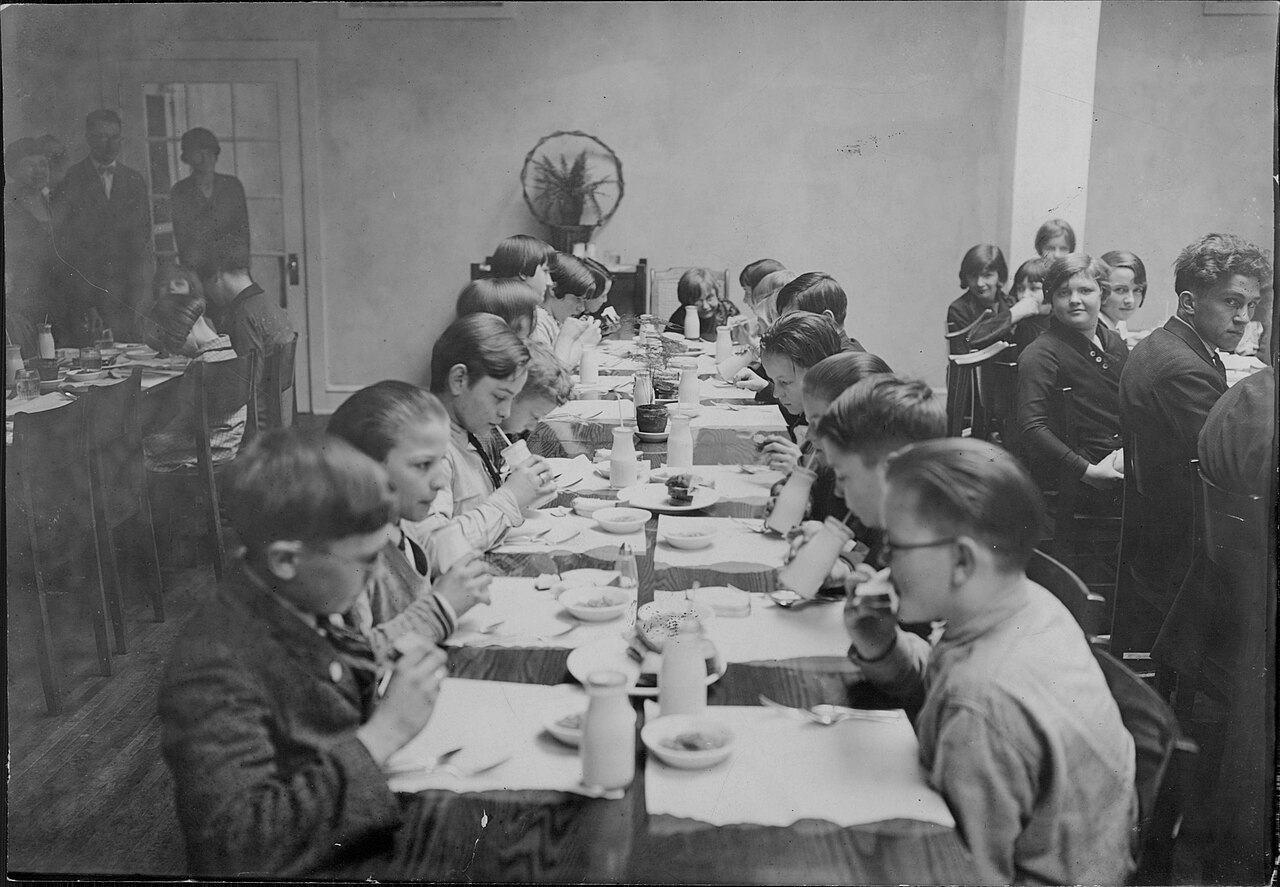
Palacio reveals Summer through characterization (her choices), uses the welcoming lunch table as a quiet symbol of acceptance, and deepens the theme that real friendship is chosen, not given out of pity. Summer sits with Auggie because she wants to, marking a real difference: pity looks down on a person, while compassion stands beside them as an equal. It is why Auggie can tell at once that Summer’s friendship, unlike some kindness aimed at him, is the genuine thing. Characterization, Symbol, and Theme changes an ordinary event into a signal about character and conflict. The effect in Characterization, Symbol, and Theme makes the detail around genuine part of the design. Reading Set beside characterization, symbol and theme, the act of excluding somebody stops being a plot detail and becomes the novel’s central question.
Visual AidThe table that decides who belongs
Photograph of children at lunch in a school dining room in the early twentieth century. The Knowledge Bank explains that Palacio uses a welcoming lunch table as a quiet symbol of acceptance, which is why Summer sitting down matters so much. This is a real school table, not the one in the novel, and none of these children appear in it. Notice that a table like this decides something before anyone speaks: there is a place, or there is not.
Lunch time at the Michael Dowling School, Minneapolis, Minnesota; Digital Public Library of America. Source: Wikimedia Commons, public domain.
📚 Literary Devices in This Part · definitions & examples
Characterization is how an author reveals what a character is like. Summer’s kindness is shown through the choices she makes.A symbol is an object or place that stands for a bigger idea. The welcoming ‘summer table’ can stand for acceptance.Theme is the big idea behind a story. A theme of Part 3 is that real friendship is a choice, not pity.
The questions below are mixed — not grouped by device. Decide which device each one is about.
🧠Knowledge Bank question
1According to the Knowledge Bank, what is the difference between pity and compassion?Pt.3
2A symbol is something that stands for a bigger idea.Pt.3
3Fill in the blanks with the correct words.Pt.3
Word choices:themefriendshiprumorpity- some words will not be used
The big idea behind a story is its
Part 3’s theme is about true
4A welcoming lunch table where anyone is included can act as a — for acceptance.Pt.3
5A theme of this part is that real friendship is a choice, not pity.Pt.3
6Fill in the blanks with the correct words.Pt.3
Word choices:characterizationrevealssettingrumor- some words will not be used
How an author shows a character’s nature is
Characterization slowly
7Summer choosing Auggie as a friend shows the theme that true friendship is based on —Pt.3
8Characterization is how an author shows what a character is like.Pt.3
9Fill in the blanks with the correct words.Pt.3
Word choices:symbolidearumortable- some words will not be used
Something that stands for a bigger meaning is a
A symbol stands for a larger
10Summer’s kindness is shown almost entirely through small CHOICES — sitting down, staying, leaving a party, one careful clue. What does this teach us about characterization?Part 3
Part 4
Think Deeper
Four deeper challenges — no single-word recall. Read, weigh the evidence, and reason it through.
🧠Knowledge Bank · Friendship Is a Choice
Ethical Reasoning · Friendship Is a Choice
Summer’s kindness is never forced. Summer’s part shows a friendship freely chosen. Unlike Jack, who was first asked to befriend Auggie, Summer sits with him simply because she wants to. Palacio separates real kindness from charity or pity: Summer treats Auggie as an ordinary friend, which is exactly what social acceptance requires. Characterization: How an author reveals what a character is like. Later, sensing Auggie is upset with Jack, Summer gives Jack one small clue — ‘Bleeding Scream’ — that helps him understand what went wrong. Social science — how rumors behave: studies find rumors grow shorter, sharper and more dramatic with each retelling, and frightening ones travel fastest — the “plague” is a lab-perfect specimen. Ethics — the three gates: an old teaching — is it true? is it kind? is it necessary? — asks every story to pass three gates before being repeated; Summer’s two-word clue passes all three.
1Claim: “Summer’s friendship with Auggie is real, not pity.” — choose the two details that best prove it.Claim & Evidence
2Sort each action. Tap each item to sort it — tap again to switch sides. You can keep tapping to change your answer.Sort into two
◄ Choosing kindnessGoing along with cruelty ►
3Match each cause to its result. For each cause, pick its result.Cause & Effect
Summer sits with Auggie on the first day→
Kids invent the ‘plague’ game→
Julian tries to pull Summer away→
Summer stays loyal under pressure→
🧠Knowledge Bank question
4Fill both blanks to complete the reasoning.Build the Argument
The Knowledge Bank argues that Summer's friendship differs from the way Jack's began because , which shows that .
Part 5
Standardized Test · Factual Detail & the EXCEPT Question
Part 3 adds a trickier exam family — the Negative Factual (EXCEPT / NOT) question — on top of Factual Detail, Inference and Vocabulary in Context, in the styles the SAT and TOEFL use. Read the passage (the highlighted words are tested below), then choose the answer best supported by the text.
Read the passage — the highlighted words are tested — then answer. Tap an answer, then tap it again to confirm.
SATWords in Context — a word's meaning in this passage
SATInference — a conclusion the passage implies
SATText Structure & Purpose — how the passage is built, and why
TOEFLFactual Information — a fact stated in the passage
TOEFLNegative Factual — the statement the passage does NOT support
TOEFLInference — what the passage implies
TOEFLVocabulary — a tested word's meaning here
How a Rumor Changes With Telling
A rumor is a story that travels without its source. It moves from mouth to mouth, and every teller changes it a little — a detail dropped here, a flourish added there — exactly like the whispering game. By the tenth telling, the current version may barely resemble the genuine one. Scientists who study rumors find they distort in predictable ways: they grow shorter, sharper, and more dramatic with every retelling, shedding the boring true parts first.
Why do rumors race through a school faster than facts? Research points to fear: alarming or disgusting stories multiply fastest, because frightened people pass them on “just in case,” and a rumor about a person spreads most easily when that person is unfamiliar — the less a crowd actually knows, the more room the story has to grow. A rumor, in other words, lives in the gap where facts should be. The good news: every rumor has the same weakness — it needs each new person to agree to pass it on, so it dies at the first person who declines. Rumor-fighters teach three habits: ask how a teller knows before believing; confirm with someone who was actually there before repeating; and remember that knowing a person directly is the strongest antidote of all. Facts starve fiction — a story about “the strange new kid” cannot survive one real lunch at a table that refuses to exclude him.
Original passage written for Garden Heights — not a quotation from the novel.
1In the passage, “genuine” most nearly means —SAT · Words in Context
2The passage most strongly suggests that the best cure for a rumor about someone is to —SAT · Inference
3According to the passage, what happens to a rumor by the tenth telling?TOEFL · Factual Information
4All of the following are mentioned as reasons rumors spread quickly EXCEPT —TOEFL · Negative Factual
5In the passage, “exclude” most nearly means —SAT · Words in Context
6According to the passage, where does a rumor “live”?TOEFL · Factual Information
7The passage most strongly suggests that the surest way to kill a rumor about a new student is to —TOEFL · Inference
8In the passage, the word “confirm” is closest in meaning to —TOEFL · Vocabulary
9Which of the following is NOT stated in the passage?TOEFL · Negative Factual
10Why does the author end with the image of “one real lunch at the same table”?SAT · Text Structure & Purpose
Part 6 · Optional
Creative Writing
A bonus challenge to practice your English.
About This Section
This writing task is optional and not part of your auto-graded score. Feedback checks length, spelling, and grammar only.
Writing Task — Part 3 “Choosing a Friend”
Write about why Summer chooses to stand by Auggie, OR a time you were a loyal friend when it was hard. Use characterization — show what kind of person Summer is through what she does. Write at least 40 words.
You can start with: “Everyone else found a reason to look away, but Summer pulled out the chair, sat down, and…”
0 / 40 words minimum
🗣 Teach It · Just for Fun (optional)
No right or wrong — close the screen and tell someone nearby what happened in this part. Can’t find anyone? Tell yourself out loud. The moment you teach it, you truly understand it.
Part 3 Complete!
You finished Part Three (Summer) of Wonder.
Here are your auto-graded results:
-
points out of 100
Teach it to someone
The best last step is to teach it. In your own words, explain what happened — retell a favorite scene, teach a character’s big choice, or sum up the main idea for a parent, friend, or classmate. When you can teach it clearly, you truly own it.
SAT® is a registered trademark of College Board, which is not affiliated with, and does not endorse, these materials. TOEFL® is a registered trademark of ETS. These materials are not endorsed or approved by ETS. Garden Heights is an independent provider of test-style reading practice.