New here? Just sign up with Google — your account includes Matilda, our gift book, forever.
📚
Garden Heights Academy
Members sign in to continue.
Wonder · Garden Heights Academy
Part 6
for Wonder · Part 6 · Narrated by August
a novel by R.J. Palacio
30 min6 Parts
This workbook is built on a solid pedagogical foundation, effectively integrating content and language learning based on the CLIL framework (Content and Language Integrated Learning), elevated by our unique 5th C — Connection — and an integrated Standardized Test section that weaves every SAT & TOEFL question type right into the novel, so learners build real test skills easily, naturally, and with fun.
💭 Before You Read · Just for Fun
No right or wrong answers — just think or chat about it: Have you ever said goodbye to a pet or something you loved — what helped, even a little? What small ritual does your family repeat every single day without noticing? And how do you know when you have truly grown — is there a moment, or does it sneak up on you?
What Happens in Part 6
The story returns to August. He and Jack are true friends again, and they earn praise together at the science fair. But sorrow comes when the family’s beloved dog, Daisy, becomes very ill and must be put to sleep, and Auggie grieves deeply. At the spring play, Auggie watches his sister Via shine on stage after Miranda quietly gives up her role. Growing in confidence, Auggie even cuts off the little Padawan braid he has worn for years.
What We Will Learn
Literary Element
What It Means
Mood
The feeling a story gives the reader, such as sorrow or hope
Symbol
An object or act that stands for a bigger idea
Theme
The big idea behind a story, such as loss and growing up
Chapter Summary
In This Part
Key Events
Friends Again
Auggie and Jack are close once more and do well at the science fair
Losing Daisy
The family’s old dog Daisy becomes ill and is put to sleep; Auggie grieves
The Play
Auggie watches Via shine on stage after Miranda steps aside
Growing Up
Auggie cuts off his Star Wars Padawan braid, a sign of new confidence
Copyright Notice
Independent study guide by Garden Heights Academy. Not affiliated with or endorsed by R.J. Palacio or Alfred A. Knopf. No text from the novel is reproduced. Students should read the original book.
Part 1
Vocabulary
Study 10 key words from Part Six (August), then answer each question.
🧠Knowledge Bank · Saying Goodbye to a Pet
Lexicology · Saying Goodbye to a Pet
In Part 6 the family’s old dog, Daisy, dies, and everyone grieves. For many children, losing a beloved pet is their first real experience of death, and feeling deep sadness over an animal is completely natural and healthy. Palacio places this ordinary sorrow beside the family’s joys to show that growing up means learning to hold happiness and grief together. The shift from cherish to ache mirrors the part’s movement from one problem toward another. Each bond term earns its place by distinguishing cherish within Saying Goodbye to a Pet. Saying Goodbye to a Pet becomes clearer when bond, cherish, and ache are treated as related but nonidentical terms. Ache is the last shade here and the most useful, because it names a grief that is quiet, ordinary and entirely real.
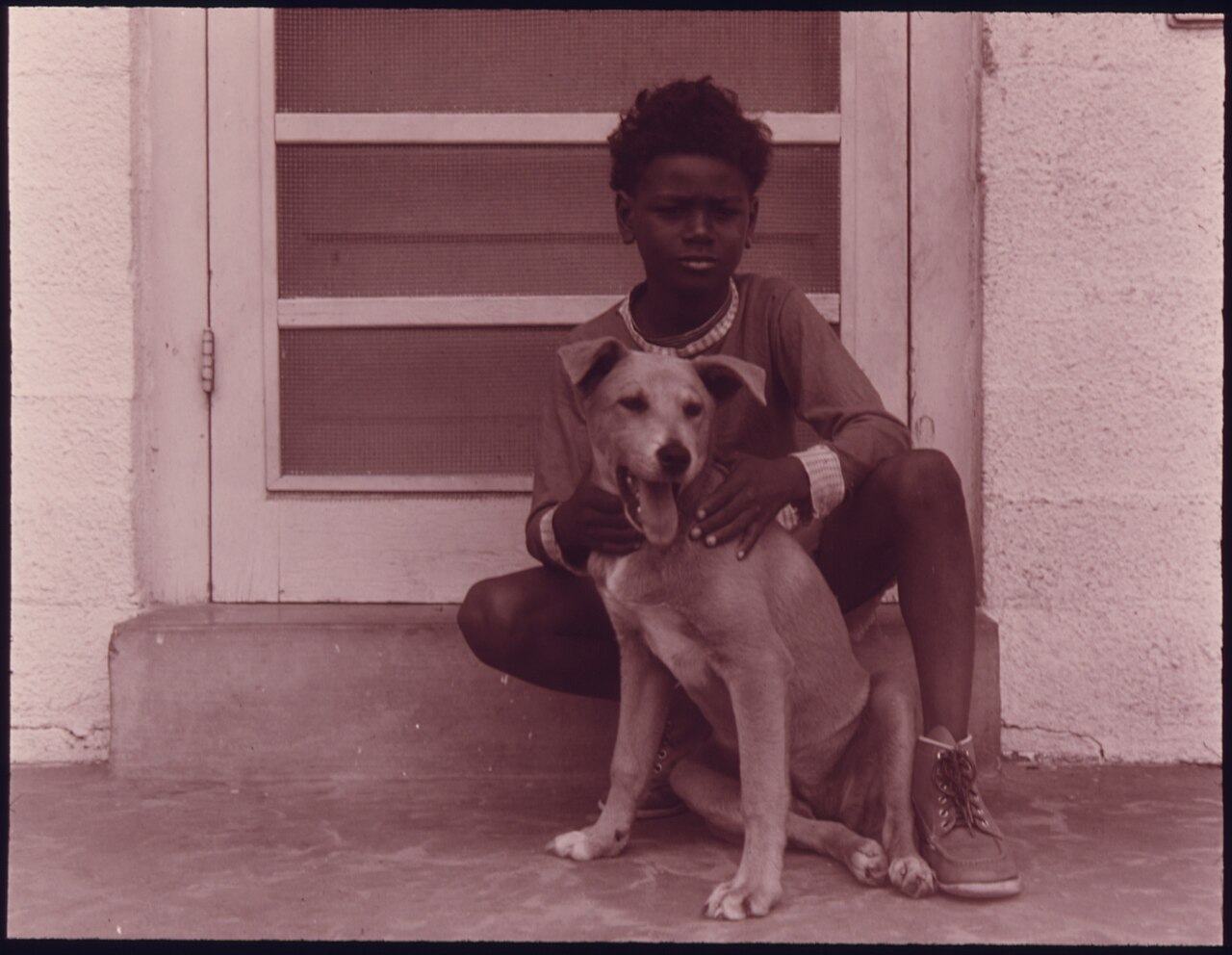
Visual AidThe bond that makes the loss hurt
Photograph of a boy and his dog on a doorstep in Galveston, Texas, taken for a United States government survey in the 1970s. The Knowledge Bank explains that grief over a pet is real, and that warm contact with an animal releases the same bonding chemistry as human affection. This picture shows the bond rather than the loss, because the bond is what makes the loss hurt. It is not Daisy, and no scene of the novel happens here. Notice how the dog leans; that weight is the thing a family misses.
Boy with his dog, Galveston, Texas, 1970s; U.S. National Archives (DOCUMERICA). Source: Wikimedia Commons, public domain.
ⓘ Vocabulary words are selected to help you understand and complete this workbook. Some may not appear verbatim in the novel.
mournv.Pt.6
To feel and show deep sadness for someone or something lost
“The whole family mourns Daisy.”
comfortv.Pt.6
To ease someone’s sadness
“Auggie’s mom tries to comfort him.”
confidencen.Pt.6
Belief in oneself
“Auggie ends the part with more confidence.”
bittersweetadj.Pt.6
Both happy and sad at the same time
“The play is a bittersweet, joyful-yet-tender night.”
gradualadj.Pt.6
Happening slowly, little by little
“Auggie’s growing confidence is gradual.”
bondn.Pt.6
A close connection between people
“The bond between Auggie and Jack is strong again.”
cherishv.Pt.6
To love and value dearly
“Auggie will always cherish his memories of Daisy.”
achen.Pt.6
A dull, lasting pain — here, of sadness
“Losing Daisy leaves an ache in Auggie’s heart.”
transformv.Pt.6
To change in a big way
“The year slowly transforms Auggie.”
milestonen.Pt.6
An important moment or step in life
“Cutting his braid is a small milestone.”
🧠Knowledge Bank question
1According to the Knowledge Bank, the shift from cherish to ache marks something about growing up. What is it?Pt.6
2To “comfort” someone means to ease their sadness.Pt.6
3Belief in oneself is called —Pt.6
4Fill in each blank with the correct word.Pt.6
Word choices:bittersweetachegradualbond- some words will not be used
Both happy and sad at once means
Losing Daisy leaves a dull, lasting
5Something “gradual” happens all at once, in an instant.Pt.6
6A close connection between people is a —Pt.6
7To love and value something dearly is to — it.Pt.6
8A “milestone” is an important moment or step in life.Pt.6
9Fill in each blank with the correct word.Pt.6
Word choices:transformmournmilestonecomfort- some words will not be used
To change in a big way is to
The family gathers to
10Over the year, Auggie slowly changes in a big way. He begins to —Pt.6
Part 2
Comprehension
How well do you understand Part Six (August)?
🧠Knowledge Bank · Tracking Feelings
Narrative Logic · Tracking Feelings
Part 6 swings between happy and sad moments. Friends Again: Auggie and Jack are close once more and do well at the science fair. Losing Daisy: The family’s old dog Daisy becomes ill and is put to sleep; Auggie grieves. The Play: Auggie watches Via shine on stage after Miranda steps aside. Growing Up: Auggie cuts off his Star Wars Padawan braid, a sign of new confidence. The story returns to August. He and Jack are true friends again, and they earn praise together at the science fair. But sorrow comes when the family’s beloved dog, Daisy, becomes very ill and must be put to sleep, and Auggie grieves deeply. At the spring play, Auggie watches his sister Via shine on stage after Miranda quietly gives up her role. Her kindness is invisible to almost everyone.
🧠Knowledge Bank question
1According to the Knowledge Bank, how does Part 6 move between its events?Pt.6
2Auggie and Jack are friends again in Part 6.Pt.6
3Where do Auggie and Jack do well together?Pt.6
4What sad event happens to the family pet?Pt.6
5Put these events from Part 6 in the correct order. Write 1–4 (1 = first).Pt.6
Daisy becomes ill and the family says goodbye.
Auggie watches Via shine on stage in the play.
They succeed together at the science fair.
Auggie and Jack are close friends once more.
6Auggie grieves the loss of Daisy.Pt.6
7At the school play, who does Auggie watch shine on stage?Pt.6
8Why does Via get a bigger part in the play?Pt.6
9Auggie cuts off his Padawan braid as a sign of growing up.Pt.6
10What does cutting his braid suggest about Auggie?Pt.6
Part 3
Literary Elements
Understanding HOW and WHY R.J. Palacio writes Part Six (August) the way she does.
🧠Knowledge Bank · Mood, Symbol, and Theme
Literary Technique · Mood, Symbol, and Theme
Palacio shifts the mood from joy to sorrow, uses the cut Padawanbraid as a symbol of growing up, and weaves in themes of loss, love, and change. When the family dog Daisy dies, the grief is real science: warm contact with a beloved pet releases oxytocin, a bonding chemical, in both human and animal. Losing that bond is true bereavement, and the comfort of connection is part of what carries Auggie through his hardest stretch. Mood, Symbol, and Theme lets the surface action and the deeper implication remain productively different. The effect in Mood, Symbol, and Theme makes the detail around bond part of the design. Reading cherish beside Mood, Symbol, and Theme connects the episode’s concrete detail with a distinct emotional response. Mood is what a reader feels before they can explain why.
Visual AidPart 6 swings — on purpose
Chart for the Knowledge Bank on mood. The vertical axis runs from sorrow at the bottom to joy at the top, and the four marked moments are placed in the order the part tells them. The chart has no numbers, because a book gives none; the heights show direction only, not measured feeling. It does not claim the sad moments and the happy ones weigh the same. Notice that the line never settles — that refusal to settle is the mood the Knowledge Bank describes.
Moments and their order taken from the Knowledge Bank. Drawn for Garden Heights Academy.
📚 Literary Devices in This Part · definitions & examples
Mood is the feeling a story gives the reader. When Daisy dies, the mood becomes heavy and sorrowful.A symbol is an object or act that stands for a bigger idea. Auggie cutting off his Padawan braid is a symbol of growing up.Theme is the big idea behind a story. Themes of Part 6 include loss, love, and growing up.
The questions below are mixed — not grouped by device. Decide which device each one is about.
🧠Knowledge Bank question
1According to the Knowledge Bank, what does science say about the bond with a beloved pet?Pt.6
2A symbol is an object or act that stands for a bigger idea.Pt.6
3Fill in the blanks with the correct words.Pt.6
Word choices:themelosssymbolmood- some words will not be used
The big idea behind a story is its
A theme of Part 6 is grief and
4Auggie cutting off his Padawan braid is a symbol of —Pt.6
5A theme can explore loss and growing up.Pt.6
6Fill in the blanks with the correct words.Pt.6
Word choices:moodfeelingsettingsymbol- some words will not be used
The feeling a story gives the reader is its
Daisy’s death gives the part a sorrowful
7Loss, love, and growing up are all — of this part.Pt.6
8Mood is the feeling a story gives the reader.Pt.6
9Fill in the blanks with the correct words.Pt.6
Word choices:symbolchangemoodsetting- some words will not be used
An act that stands for a bigger idea is a
Cutting the braid is a symbol of
10Part 6 holds Daisy’s death AND the science-fair triumph, the play’s joy AND the braid falling. What is Palacio doing with MOOD here?Part 6
Part 4
Think Deeper
Four deeper challenges — no single-word recall. Read, weigh the evidence, and reason it through.
🧠Knowledge Bank · Joy and Sorrow Together
Ethical Reasoning · Joy and Sorrow Together
Part 6 mixes happiness with grief. Part 6 mixes happiness with real sorrow. Auggie enjoys friendship and success, but also faces the loss of his dog, Daisy. Palacio gives Auggie ordinary childhood grief, not only medical struggle, so readers see that his life is full: friendship, family, love, loss, and growing confidence. Mood: The feeling a story gives the reader, such as sorrow or hope. Growing in confidence, Auggie even cuts off the little Padawan braid he has worn for years. Anthropology — rites of passage: cultures worldwide mark growing up with a physical token released or changed — first haircuts, ceremonies, worn things set aside; Auggie’s braid-cutting is a one-boy rite of passage. Ethics — the kindest hard choice: ending a suffering animal’s pain is one of the hardest kindnesses a family performs; a careful discussion: why can the most loving choice also be the one that hurts most?
1Claim: “This year changes and matures August.” — choose the two details that best prove it.Claim & Evidence
2Joy or sorrow in this part? Tap each item to sort it — tap again to switch sides. You can keep tapping to change your answer.Sort into two
◄ JoySorrow ►
3Match each cause to its result. For each cause, pick its result.Cause & Effect
Auggie and Jack repair things→
Daisy grows very ill→
Auggie loses his beloved dog→
The seasons turn toward spring→
🧠Knowledge Bank question
4Fill both blanks to complete the reasoning.Build the Argument
The Knowledge Bank argues that Palacio gives Auggie an ordinary loss like Daisy because , which shows that .
Part 5
Standardized Test · Reference & Sentence Simplification
Part 6 introduces two TOEFL specialties — Reference (what a pronoun points back to) and Sentence Simplification (keeping a long sentence’s core meaning) — alongside Vocabulary in Context, Factual Detail and Inference, in the styles the SAT and TOEFL use. Read the passage (the highlighted words are tested below), then choose the answer best supported by the text.
Read the passage — the highlighted words are tested — then answer. Tap an answer, then tap it again to confirm.
SATWords in Context — a word's meaning in this passage
SATInference — a conclusion the passage implies
TOEFLFactual Information — a fact stated in the passage
TOEFLReference — what a pronoun refers to
TOEFLSentence Simplification — the shorter sentence that keeps the meaning
TOEFLVocabulary — a tested word's meaning here
TOEFLInference — what the passage implies
TOEFLProse Summary — the three sentences that sum it up
Grieving the Loss of a Pet
Dogs have walked beside humans for thousands of years, and in that time they have become something no other animal quite is: a companion woven into the fabric of a family’s day. A dog shares the morning greeting, the after-school welcome, the quiet presence a family comes to cherish. Scientists have measured what dog-lovers always knew: friendly contact with a beloved animal releases oxytocin — the same bonding chemistry as human affection. Many dogs memorize the family’s routine so completely that they wait at the door minutes before it opens; it has become the clock they live by.
That daily closeness is exactly why the loss cuts so deep. Psychologists now affirm what grieving owners feel: mourning a pet is genuine grief — and it has a particular shape. Because a pet shares every ordinary hour rather than special occasions only, its absence is discovered again and again throughout the day, in a hundred small moments where its presence used to be, each a fresh ache — the empty basket, the walk that no longer needs taking. Healing follows the same paths as any grief. Families find comfort in small rituals — a photograph, a favorite spot marked, stories retold around the table — and children in particular benefit from being allowed to grieve openly rather than being told “it was only a pet.” In time, what remains is not the absence but the practice: a child who has loved and cared for an animal has rehearsed a kind of love that nothing — not even the loss — takes away.
Original passage written for Garden Heights — not a quotation from the novel.
1In the passage, “cherish” most nearly means —SAT · Words in Context
2The passage most strongly suggests that a child who has cared for a pet gains —SAT · Inference
3According to the passage, what does friendly contact with a beloved animal release?TOEFL · Factual Information
4In paragraph 1, the word “it” in “it has become the clock they live by” refers to —TOEFL · Reference
5In the passage, “ache” most nearly means —SAT · Words in Context
6Which sentence best keeps the meaning of: “Because a pet shares every ordinary hour rather than special occasions only, its absence is discovered again and again throughout the day, in a hundred small moments where its presence used to be”?TOEFL · Sentence Simplification
7According to the passage, what do psychologists now affirm?TOEFL · Factual Information
8In the passage, the word “rituals” is closest in meaning to —TOEFL · Vocabulary
9The passage most strongly suggests that telling a grieving child “it was only a pet” is —TOEFL · Inference
10Prose Summary (TOEFL).The passage explains why losing a family dog hurts so deeply and how families heal. This TOEFL task lists six sentences; choose the THREE that best capture the passage’s main ideas. The other three do not belong — they state minor details or ideas the passage does not present.TOEFL · Prose Summary
Part 6 · Optional
Creative Writing
A bonus challenge to practice your English.
About This Section
This writing task is optional and not part of your auto-graded score. Feedback checks length, spelling, and grammar only.
Writing Task — Part 6 “A Goodbye and a Change”
Write about saying goodbye to someone or something you loved (like Daisy), OR describe a milestone that showed you were growing up. Use mood so the reader feels what you felt. Write at least 40 words.
You can start with: “I didn’t know a heart could feel heavy and grateful at the same time, but that day it did, because…”
0 / 40 words minimum
🗣 Teach It · Just for Fun (optional)
No right or wrong — close the screen and tell someone nearby what happened in this part. Can’t find anyone? Tell yourself out loud. The moment you teach it, you truly understand it.
Part 6 Complete!
You finished Part Six (August) of Wonder.
Here are your auto-graded results:
-
points out of 100
Teach it to someone
The best last step is to teach it. In your own words, explain what happened — retell a favorite scene, teach a character’s big choice, or sum up the main idea for a parent, friend, or classmate. When you can teach it clearly, you truly own it.
SAT® is a registered trademark of College Board, which is not affiliated with, and does not endorse, these materials. TOEFL® is a registered trademark of ETS. These materials are not endorsed or approved by ETS. Garden Heights is an independent provider of test-style reading practice.