New here? Just sign up with Google — your account includes Matilda, our gift book, forever.
📚
Garden Heights Academy
Members sign in to continue.
Wonder · Garden Heights Academy
Part 7
for Wonder · Part 7 · Narrated by Miranda
a novel by R.J. Palacio
25 min6 Parts
This workbook is built on a solid pedagogical foundation, effectively integrating content and language learning based on the CLIL framework (Content and Language Integrated Learning), elevated by our unique 5th C — Connection — and an integrated Standardized Test section that weaves every SAT & TOEFL question type right into the novel, so learners build real test skills easily, naturally, and with fun.
💭 Before You Read · Just for Fun
No right or wrong answers — just think or chat about it: Have you ever practiced hard for something you never got to show? Would you give up your biggest moment so a friend could have theirs — honestly? And can a person who lied ever become the most honest voice in the room?
What Happens in Part 7
Miranda, Via’s oldest friend, tells her story. Lonely after her parents’ divorce, she spent summer camp telling other kids a made-up tale about a little brother with a facial difference — really Auggie, whom she had always loved like family. Missing the warm Pullman home, and cast as the lead in the school play, Miranda pretends to be sick so that her old friend Via can take the stage and her family can watch her shine. At the play, Miranda and Via begin to mend their friendship.
What We Will Learn
Literary Element
What It Means
Irony
When what happens is the opposite of what we expect
Honest Narrator
A narrator who tells the truth, even about their own faults
Theme
The big idea behind a story, such as empathy and forgiveness
Chapter Summary
In This Part
Key Events
Miranda’s Secret
Lonely at camp, Miranda told a made-up story about Auggie as her own brother
Missing the Pullmans
Miranda realizes how much she misses Via’s warm family
Giving Up the Role
Miranda lets Via take the lead in the play, and they begin to reconnect
Copyright Notice
Independent study guide by Garden Heights Academy. Not affiliated with or endorsed by R.J. Palacio or Alfred A. Knopf. No text from the novel is reproduced. Students should read the original book.
Part 1
Vocabulary
Study 10 key words from Part Seven (Miranda), then answer each question.
🧠Knowledge Bank · Everyone Carries Something
Lexicology · Everyone Carries Something
We learn that Miranda, who seemed to pull away and act out, was lonely at home after her parents’ divorce. Researchers find that big changes like this can quietly affect how a young person behaves at school. Palacio uses Miranda to teach a hard, grown-up idea: people who hurt or disappoint us are often fightingbattles we cannot see, which is why forgiveness matters. Placed in context, selfless identifies a condition while fault names the response it provokes. Each selfless term earns its place by distinguishing mend within Everyone Carries Something. Everyone Carries Something becomes clearer when selfless, mend, and fault are treated as related but nonidentical terms. The word fault adds one final shade to Everyone Carries Something. Selfless is the word this section builds toward, and Wonder is careful to show what it costs.
ⓘ Vocabulary words are selected to help you understand and complete this workbook. Some may not appear verbatim in the novel.
lonelyadj.Pt.7
Sad from being without friends or company
“After the divorce, Miranda felt very lonely.”
envyn.Pt.7
A wish to have what someone else has
“Miranda feels envy for Via’s close family.”
confessv.Pt.7
To admit something, often a fault
“Miranda is honest enough to confess what she did.”
sincereadj.Pt.7
Honest and truly meant
“Her wish to make things right is sincere.”
generousadj.Pt.7
Willing to give or share
“Giving up her role is a generous act.”
longingn.Pt.7
A strong wish for something
“Miranda feels a longing for the Pullmans’ warmth.”
selflessadj.Pt.7
Caring more for others than for yourself
“Her selfless choice lets Via shine.”
mendv.Pt.7
To repair, including a friendship
“The two girls slowly mend their friendship.”
faultn.Pt.7
A mistake or weakness
“Miranda admits her own fault.”
humbleadj.Pt.7
Not proud; modest
“Miranda is humble enough to step aside.”
🧠Knowledge Bank question
1According to the Knowledge Bank, what hard idea does Palacio teach through Miranda's lonely year?Pt.7
2“Envy” is a wish to have what someone else has.Pt.7
3To admit something, often a fault, is to —Pt.7
4Fill in each blank with the correct word.Pt.7
Word choices:selflesslongingenvyhumble- some words will not be used
Caring more for others than yourself is
A strong wish for something is a
5Someone “sincere” says things they do not really mean.Pt.7
6To repair a broken friendship is to — it.Pt.7
7Giving up her role so Via can shine is a kind, — act.Pt.7
8Someone “humble” is modest and not too proud.Pt.7
9Fill in each blank with the correct word.Pt.7
Word choices:faultconfessmendgenerous- some words will not be used
A mistake or weakness is a
Miranda is honest enough to
10A wish to have what someone else has is —Pt.7
Part 2
Comprehension
How well do you understand Part Seven (Miranda)?
🧠Knowledge Bank · Understanding Why People Act
Narrative Logic · Understanding Why People Act
In Part 7, look for the reasons behind Miranda’s actions. Understanding her loneliness helps explain — though not excuse — the made-up story she told. Miranda’s Secret: Lonely at camp, Miranda told a made-up story about Auggie as her own brother. Missing the Pullmans: Miranda realizes how much she misses Via’s warm family. Giving Up the Role: Miranda lets Via take the lead in the play, and they begin to reconnect. Miranda, Via’s oldest friend, tells her story. Lonely after her parents’ divorce, she spent summer camp telling other kids a made-up tale about a little brother with a facial difference — really Auggie, whom she had always loved like family. Missing the warm Pullman home, and cast as the lead in the school play, Miranda pretends to be sick so that her old friend Via can take the stage and her family can watch her shine.
Visual AidWhat is seen, and what is under it
Diagram for the Knowledge Bank on understanding why people act. It stacks what Miranda’s classmates could see above the thing none of them could, and draws the dividing line as the limit of what a school sees. It does not claim the hidden reason cancels the harm. Notice that both bands are true at the same time, and that only the reader is given both.
Two levels described in the Knowledge Bank. Drawn for Garden Heights Academy.
🧠Knowledge Bank question
1The Knowledge Bank explains what understanding Miranda's loneliness does for the made-up story she told.Pt.7
2Miranda is one of Via’s oldest friends.Pt.7
3What made-up story did Miranda tell at summer camp?Pt.7
4Why might Miranda have told that story?Pt.7
5Put these events from Part 7 in the correct order. Write 1–4 (1 = first).Pt.7
At camp she tells a made-up story about Auggie as her brother.
Miranda gives up the lead so Via can shine.
Miranda’s parents divorce and she feels lonely.
Miranda realizes how much she misses the Pullmans.
6Miranda gives up her lead role so Via can take the stage.Pt.7
7What does Miranda pretend in order to let Via perform?Pt.7
8Miranda still cares about Via and the Pullman family.Pt.7
9What happens between Miranda and Via at the play?Pt.7
10What does Miranda’s choice show about her?Pt.7
Part 3
Literary Elements
Understanding HOW and WHY R.J. Palacio writes Part Seven (Miranda) the way she does.
🧠Knowledge Bank · Irony, Honesty, and Theme
Literary Technique · Irony, Honesty, and Theme
Palacio uses irony (Miranda envies the family she pushed away), an honestnarrator who admits her faults, and a theme of empathy and forgiveness. Ethics — anonymous giving: many traditions rank the hidden gift highest precisely because it cannot be repaid — a ready discussion: does a kindness lose value the moment it is discovered? Honest Narrator: A narrator who tells the truth, even about their own faults. Miranda invents a more exciting life at camp because loneliness pushed her to it — researchers find children’s made-up identities usually grow from a hunger to belong, not a love of lying. Her honest confession, and her gift of the play to Via, show the healthier road back to real connection. The placement of Irony, Honesty, and Theme guides interpretation while leaving room for readers to infer.
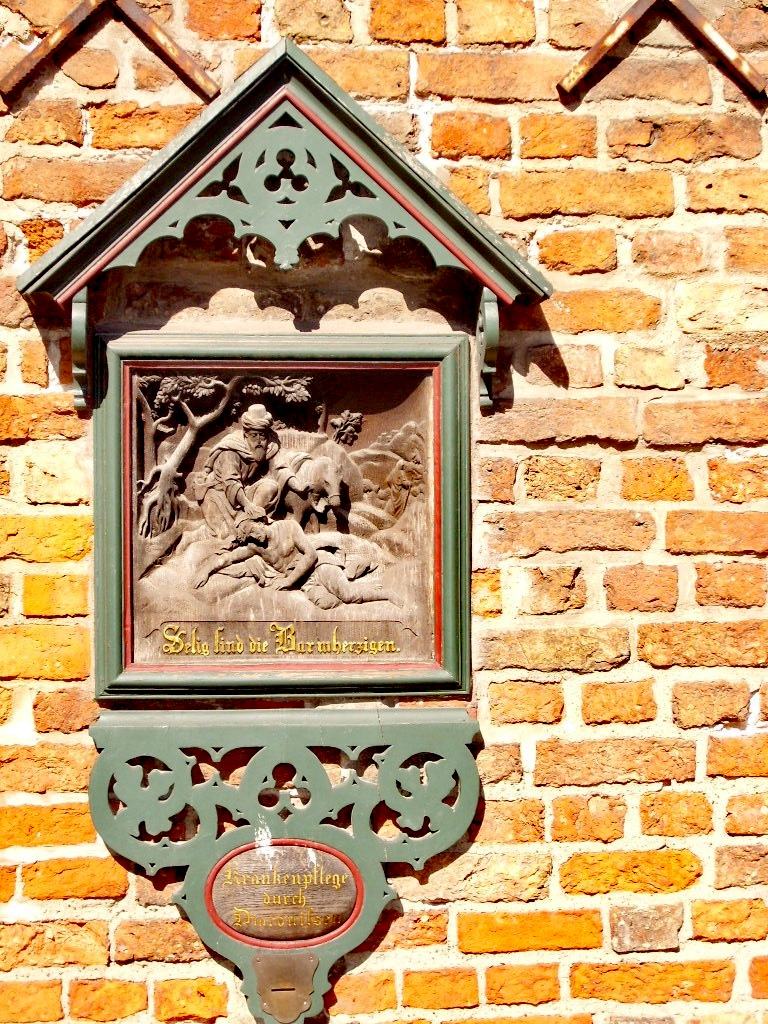
Visual AidA gift with no name on it
Photograph of an alms box on a church wall in Lübeck, Germany. A box like this takes a gift without recording who gave it. The Knowledge Bank explains that many traditions rank the hidden gift highest precisely because it cannot be repaid, which is the shape of what Miranda does for Via. It has no link to the novel and marks no particular donor. Notice that an alms box has no way to say thank you — and that this is the feature, not a fault.
Alms box, St. Jakobi pastorate, Lübeck, Germany. Source: Wikimedia Commons, public domain.
📚 Literary Devices in This Part · definitions & examples
Irony is when things turn out the opposite of what we expect. Miranda envies and misses the very family she had drifted away from.An honest narrator tells the truth, even about their own faults. Miranda openly admits the made-up story she told.Theme is the big idea behind a story. A theme of Part 7 is empathy and forgiveness — giving people a second chance.
The questions below are mixed — not grouped by device. Decide which device each one is about.
🧠Knowledge Bank question
1According to the Knowledge Bank, why do many traditions rank a hidden gift the highest?Pt.7
2An honest narrator tells the truth, even about their own mistakes.Pt.7
3Fill in the blanks with the correct words.Pt.7
Word choices:themeempathyironysetting- some words will not be used
The big idea behind a story is its
Part 7’s theme includes forgiveness and
4Miranda openly admitting her own faults makes her an —Pt.7
5A theme of this part is empathy and second chances.Pt.7
6Fill in the blanks with the correct words.Pt.7
Word choices:ironyoppositesettingrhyme- some words will not be used
A surprising twist where the opposite happens is
Irony gives us the
7Miranda’s change shows the theme of —Pt.7
8Irony is when things turn out opposite to what we would expect.Pt.7
9Fill in the blanks with the correct words.Pt.7
Word choices:honesttruthsettingmetaphor- some words will not be used
A narrator who admits their faults is
An honest narrator tells the
10Miranda lied about her whole life at camp — yet her section holds the book’s fullest confession. Why does Palacio give the HONEST NARRATOR’s role to the liar?Part 7
Part 4
Think Deeper
Four deeper challenges — no single-word recall. Read, weigh the evidence, and reason it through.
🧠Knowledge Bank · Why Forgive Miranda
Ethical Reasoning · Why Forgive Miranda
Miranda did something hurtful, yet the book asks us to understand her. Palacio’s deeper theme is not easy niceness; it is matureempathy, the ability to see pain behind behavior while still naming what was wrong. Miranda once drifted from Via and even borrowed her family’s story to seem interesting at camp. Yet Palacio gives Miranda her own narration so we understand her loneliness after family change and divorce — and watch her make a generous, selfless choice. The book asks us to have empathy without pretending harm never happened. Irony: When what happens is the opposite of what we expect. At the play, Miranda and Via begin to mend their friendship. Theater — the understudy: professional productions keep fully rehearsed understudies who may never perform; “the show must go on” is a real working law — and Miranda’s feigned illness runs the machinery in reverse, on purpose.
1Claim: “Miranda invents a story about Auggie because she misses his warm family.” — choose the two details that best prove it.Claim & Evidence
2Does it push the friends apart or bring them back? Tap each item to sort it — tap again to switch sides. You can keep tapping to change your answer.Sort into two
◄ Pulls them apartBrings them together ►
3Match each cause to its result. For each cause, pick its result.Cause & Effect
Miranda’s parents divorce→
She longs for Auggie’s warm family→
She and Via drift over the summer→
She hands her stage role to Via→
🧠Knowledge Bank question
4Fill both blanks to complete the reasoning.Build the Argument
The Knowledge Bank argues that the book's theme is not easy niceness because , which shows that .
Part 5
Standardized Test · Cohesion & Insert Text
Part 7 practices Cohesion & Transitions and a trickier exam specialty, Insert Text (placing a sentence where it best fits), plus Command of Evidence, Inference and Vocabulary in Context, in the styles the SAT and TOEFL use. Read the passage (the highlighted words are tested below), then choose the answer best supported by the text.
Read the passage — the highlighted words are tested — then answer. Tap an answer, then tap it again to confirm.
SATWords in Context — a word's meaning in this passage
SATInference — a conclusion the passage implies
SATCommand of Evidence — the detail that best supports a claim
SATCentral Ideas — the passage's main point
TOEFLFactual Information — a fact stated in the passage
TOEFLInsert Text — where a sentence best fits
TOEFLInference — what the passage implies
TOEFLVocabulary — a tested word's meaning here
The Understudy Who Waits Offstage
Every professional theater production carries an invisible cast. Behind each lead role stands an understudy — an actor who wins her place at the same audition, attends every rehearsal, and memorizes every line, position, and song of a role she may never once perform. She is the production’s insurance: paid to be standby perfection, and to accept that the audience may never learn her name, whatever her longing for the stage. When the call comes — a lead too ill to go on — the machinery is swift: the understudy steps into the role at an hour’s notice, because the theater’s oldest law is that the show must go on. Her readiness must be so complete that the evening proceeds seamlessly: same songs, same steps, same laughter in the same places. By curtain call, many in the audience never realize they watched the “other” actress; the whole company closes around the substitution like water.
Why accept such a role? Actors answer: love of the craft, and the chance — someday — of a night that changes everything. But theater history also holds quieter stories, told backstage with respect: leads who, for reasons of their own, stepped ASIDE — a feigned illness, a sudden “indisposition” — so that someone else could have the night of her life; the word for that is selfless. The theater has a name for applause you engineer for another person: they call it the oldest gift in the building.
Original passage written for Garden Heights — not a quotation from the novel.
1In the passage, “longing” most nearly means —SAT · Words in Context
2The passage most strongly suggests that a lead who fakes illness so an understudy can perform is being —SAT · Inference
3According to the passage, what does an understudy do during the production?TOEFL · Factual Information
4In the passage, “selfless” most nearly means —SAT · Words in Context
5Insert Text. Look at the four spots in the box below. Where would this sentence best fit? Sentence: “There is no time for a full rehearsal — only for readiness built weeks earlier.”TOEFL · Insert Text
[1] The call can come as little as an hour before curtain. [2] The understudy dresses in the lead’s costume while running her lines one final time. [3] The stage manager quietly informs the rest of the cast of the change. [4] By the time the curtain rises, the company performs as if nothing unusual had happened at all.
6According to the passage, what is the theater’s “oldest law”?TOEFL · Factual Information
7Which sentence from the passage best supports the idea that an understudy’s work may go completely unrecognized?SAT · Command of Evidence
8The passage most strongly suggests that a lead who feigns illness so another can perform is —TOEFL · Inference
9In the passage, the word “readiness” is closest in meaning to —TOEFL · Vocabulary
10Which statement best expresses the central idea of the passage?SAT · Central Ideas
Part 6 · Optional
Creative Writing
A bonus challenge to practice your English.
About This Section
This writing task is optional and not part of your auto-graded score. Feedback checks length, spelling, and grammar only.
Writing Task — Part 7 “An Honest Apology”
Write Miranda’s honest apology to Via, OR write about a time you forgave a friend. Be an honest narrator — tell the truth, even about mistakes. Write at least 40 words.
You can start with: “I know I have no right to ask, but there are some things I need to tell you honestly, Via, because…”
0 / 40 words minimum
🗣 Teach It · Just for Fun (optional)
No right or wrong — close the screen and tell someone nearby what happened in this part. Can’t find anyone? Tell yourself out loud. The moment you teach it, you truly understand it.
Part 7 Complete!
You finished Part Seven (Miranda) of Wonder.
Here are your auto-graded results:
-
points out of 100
Teach it to someone
The best last step is to teach it. In your own words, explain what happened — retell a favorite scene, teach a character’s big choice, or sum up the main idea for a parent, friend, or classmate. When you can teach it clearly, you truly own it.
SAT® is a registered trademark of College Board, which is not affiliated with, and does not endorse, these materials. TOEFL® is a registered trademark of ETS. These materials are not endorsed or approved by ETS. Garden Heights is an independent provider of test-style reading practice.