New here? Just sign up with Google — your account includes Matilda, our gift book, forever.
The Wanderer · Garden Heights
Part 2
for The Wanderer · Part 2 · Chapters 15–22
8 Parts40 min
What Happens in Part 2
The Wanderer works her way north to Grand Manan, an island in a stretch of sea famous for having some of the highest tides in the world — water that can rise and fall dozens of feet in a single day. The crew learns the hard way to respect those tides: they run the boat aground in the shallows near Wood Island, and can do nothing but wait, tilted and stuck, until the sea returns to lift them free. Thick fog rolls in and out, hiding the shore. In the quiet of the island days, Sophie keeps telling Bompie’s stories — this time a tale of a river baptism in which young Bompie is dunked underwater and comes up sputtering — and again the family marvels that she knows it at all. Something else is stirring in Sophie: fleeting images of a ‘little kid,’ and a strange, wordless feeling that she has been near deep water like this before. Brian and Cody bicker; Dock grows quiet whenever a certain name comes up. The island stretch is a pause before the real ocean, and it leaves Sophie both steadier and more haunted.
Setting as a force, the water motif, and a mystery deepening
Cross-Curricular
Tides and the sea — how the moon pulls the ocean up and down
Chapter Summary
Ch.
What happens
Chapters 15–18
Grand Manan and the Tides — the crew reaches the island, runs aground in shallow water, and waits for the huge tide to float them free while fog drifts over the shore.
Chapters 19–22
The Baptism Story — Sophie tells a Bompie tale of a river baptism, images of a ‘little kid’ flicker in her mind, and Dock falls quiet at the mention of a name.
Part 1
Vocabulary
Study 10 key words from Chapters 15–22, then answer each question.
🧠Knowledge Bank · Words of Tide and Island
Lexicology · Words of Tide and Island
Part 2’s words are ruled by water: a tide and its current that leave the boat aground, a fog that hides the shore, and a river baptism in one of Bompie’s stories. The high tides that catch the Wanderer at Grand Manan are not magic but gravity. The moon’s pull tugs the ocean toward it, heaping the water into a slow bulge; as the Earth turns, that bulge sweeps around the planet, so most coasts see the sea rise to a high tide and sink to a low tide about twice a day. The sun pulls too, and when sun and moon line up, the tides grow especially large. In most places the change is a few feet, but in narrow, funnel-shaped bays — like the Bay of Fundy near Grand Manan — the incoming water is squeezed until it climbs dozens of feet, the highest tides on Earth. Creech keeps the numbers real, which is why the boat’s helplessness feels earned rather than convenient.
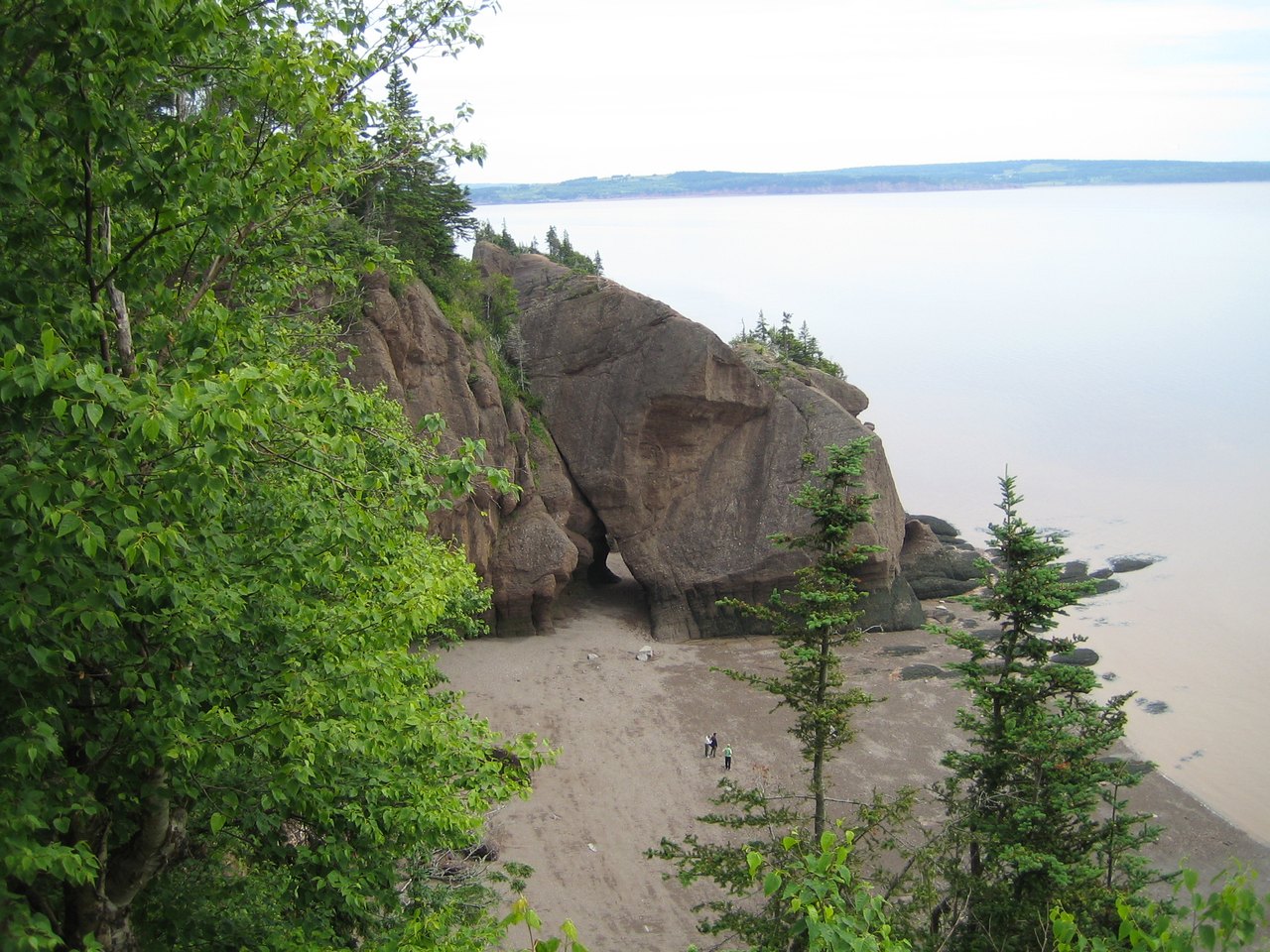
Visual AidWhen the sea drains away
The Bay of Fundy at low tide, near where the Wanderer runs aground. The Knowledge Bank explains that the moon heaps the ocean into a slow bulge and that a long, narrowing bay funnels the incoming water until it has nowhere to go but up. Look at how far out the water has gone. Everything you can see was under the sea a few hours ago and will be again, which is exactly why a boat that floated in at high water can be sitting on mud by morning.
Low tide in the Bay of Fundy. Source: Wikimedia Commons, public domain.
tiden.Ch.15
The daily rise and fall of the sea
“The tide lifted the stuck boat at last.”
currentn.Ch.16
A steady flow of water in the sea
“A strong current pulled them sideways.”
agroundadj.Ch.16
Stuck on the bottom in shallow water
“The Wanderer ran aground on the mud.”
fogn.Ch.15
Thick mist that hides the view
“Fog wrapped the island in white.”
baptismn.Ch.21
A ceremony of dipping someone in water
“The baptism dunked Bompie in the river.”
traditionn.Ch.17
A custom passed down over time
“Telling stories became their tradition.”
anchorn.Ch.16
A heavy hook that holds a boat in place
“They dropped the anchor to wait.”
harborn.Ch.15
A sheltered place where boats rest
“The harbor kept the boat calm.”
strandedadj.Ch.16
Left stuck, unable to move on
“They were stranded until the tide rose.”
hauntedadj.Ch.20
Troubled by something hard to forget
“Sophie felt haunted by a hidden memory.”
ⓘ The vocabulary words in this list are selected to help you understand and complete this workbook. Some may not appear verbatim in the original novel.
🧠Knowledge Bank question
1According to the Knowledge Bank, what causes the huge tides at Grand Manan?Ch.15
2Thick mist that hides the view is ___.Ch.15
3A boat that is ‘aground’ is floating in deep water.Ch.16
4A steady flow of water in the sea is a ___.Ch.16
5Fill in each blank with the correct word.Ch.16
Word choices:anchorstrandedbaptismharbor- some words will not be used
They dropped the to hold the boat.
Until the tide rose they were .
6A ‘baptism’ is a ceremony that dips someone in ___.Ch.21
7A ‘tradition’ is a custom passed down over time.Ch.17
8A sheltered place where boats rest is a ___.Ch.15
9Fill in each blank with the correct word.Ch.20
Word choices:hauntedfogtidecurrent- some words will not be used
A rolling hid the shore from view.
Sophie felt strangely by a memory.
10An ‘anchor’ is used to hold a boat in one place.Ch.16
Part 2
Comprehension
Show you understood what happens in Chapters 15–22.
🧠Knowledge Bank · Held by the Island
Narrative Logic · Held by the Island
The narrative traces the pause at Grand Manan: the huge tides that strand the boat, the fog that hides the shore, a baptism story from Bompie’s past, and the first flickers of a ‘little kid’ in Sophie’s mind. Chapters 15–18: Grand Manan and the Tides — the crew reaches the island, runs aground in shallow water, and waits for the huge tide to float them free while fog drifts over the shore. Chapters 19–22: The Baptism Story — Sophie tells a Bompie tale of a river baptism, images of a ‘little kid’ flicker in her mind, and Dock falls quiet at the mention of a name. The Wanderer works her way north to Grand Manan, an island in a stretch of sea famous for having some of the highest tides in the world — water that can rise and fall dozens of feet in a single day. Everything that happens in these chapters happens because the sea decided to hold them still.
Visual AidThe sea going up and down
Scale drawing for the Knowledge Bank on the grounding. The three bars are tidal ranges at one scale, with a house drawn beside them so the heights mean something. Bar 2 is where the Wanderer sits down on the bottom. Notice that the same ocean produces bar 1 and bar 3; what changes is the shape of the bay, which is why a crew can be held in place by arithmetic they cannot argue with.
Tidal range at Grand Manan and at the head of the Bay of Fundy, drawn to scale. Drawn for Garden Heights Academy.
🧠Knowledge Bank question
1The Knowledge Bank explains that the crew must wait at the island because ___.Ch.15
2The crew gets into trouble when the boat runs ___.Ch.16
3When the boat is stuck, the crew can free it instantly whenever they choose.Ch.16
4What often hides the shore from the crew here?Ch.15
5Write the numbers 1–5 in the boxes to show the correct order of events. Number 1 = what happens first.Chapters 15–22
Sophie tells the baptism story about Bompie.
The crew misjudges the tide and runs aground.
Images of a ‘little kid’ flicker in Sophie’s mind.
They wait, stuck, for the water to rise.
The Wanderer reaches Grand Manan island.
6Sophie stops telling Bompie’s stories during the island days.Ch.21
7In the Bompie story Sophie tells, young Bompie is ___.Ch.21
8During the quiet island days, Sophie begins to ___.Ch.20
9Dock grows quiet whenever a certain name is mentioned.Ch.18
10The island stretch mainly serves as ___ before the open ocean.Ch.22
Part 3
Literary Elements
Understanding HOW and WHY Sharon Creech tells the story across Chapters 15–22.
🧠Knowledge Bank · Setting, Motif and Pace
Literary Technique · Setting, Motif and Pace
Part 2 leans on three tools: a place that shapes the action (setting), a repeated image that gathers meaning (the water motif), and a slower pace that lets feelings surface (pacing). By now a pattern is impossible to miss: water keeps returning. The boat’s name is Wanderer; the tides rule the island; and the Bompie story Sophie tells is a baptism — a boy plunged underwater and hauled back up. This repeated image of falling into water and being rescued is a motif, a detail that recurs until it gathers meaning. Every Bompie tale ends the same way, with water and a rescue, and Sophie is drawn to the sea even as it unsettles her. Creech is building this motif deliberately, brick by brick, so that when its true meaning finally breaks open, the reader will feel the whole book has been pointing here all along.
Visual AidWhat the island does to the book
Diagram for the Knowledge Bank on setting and pace. Card 1 is the book on open water and card 2 is the book aground, and card 3 is what the change buys. Card 4 is the point about who is in charge. Notice that nothing in the plot advances between cards 1 and 3. Creech trades progress for pressure, and the crew, with nothing to do but wait, has nowhere to put its feelings except into words.
Why Creech slows the book down at the island, as described in the Knowledge Bank. Drawn for Garden Heights Academy.
Setting
The island, its tides, and its fog act almost like a character, pinning the boat and pressing on Sophie.
Motif
Falling into water and being rescued keeps returning — the tides, the baptism story, Sophie’s pull to the sea.
Pacing
Creech slows the story on the island so buried feelings, especially Sophie’s, have room to rise.
🧠Knowledge Bank question
1According to the Knowledge Bank, what does Creech gain by slowing the book down here?Ch.15
2Fill in each blank with the correct literary term.Ch.16
Word choices:settingmotifnarratorrhyme- some words will not be used
A place that shapes the action is the .
The repeated image of water is a .
3A motif is a detail that appears only once in a story.Ch.21
4The repeated image of going under water and being saved is a ___.Ch.21
5Creech slows the pace on the island mainly so that ___.Ch.20
6Setting can act almost like a character that presses on the people in a story.Ch.15
7Fill in each blank with the correct literary term.Ch.20
Word choices:pacingmotifrhymesetting- some words will not be used
Slowing the story down is a choice about .
The recurring water image is a .
8The baptism story matters to the book’s design because it ___.Ch.21
9The fog and tide are just scenery with no effect on the plot.Ch.16
10Counting how often water returns helps a reader notice the story’s ___.Ch.21
Part 4
Think Deeper
Four deeper challenges — no single-word recall. Read, weigh the evidence, and reason it out.
🧠Knowledge Bank · Reading the Pause
Ethical Reasoning · Reading the Pause
The episode demonstrates how the island stretch works as more than a backdrop — here the setting acts almost like a character with a will of its own. The tide grabs the boat and pins it; the fog blinds the crew; the island decides when they may leave. Creech slows the whole book down on purpose, trading the rush of open water for a held breath. With nothing to do but wait, Sophie turns inward, and the images of a ‘little kid’ begin to surface. The setting is not just where the story happens; it presses on the characters and squeezes their hidden feelings up toward the light. Watch how often in this book the water arrives first and the confession follows, until it is hard to say whether Sophie is talking or the sea is doing the storytelling.
Imagine the boat tilted over on the mud at low tide, going nowhere. The great bay has simply walked away and left the Wanderer leaning in the shallows, and there is nothing for the crew to do but wait for the water to come striding back. Fog closes around them, soft and white, until the island is only a rumor. In that hush a girl sits on deck and tells a story about a boy long ago who was dipped under a river and hauled up gasping — a story she should have no way of knowing. And behind her eyes, unbidden, a small child appears, standing near water, and a feeling she cannot name rises in her chest like the tide itself. The sea will lift the boat by evening. What it is lifting in Sophie will take much longer.
Original passage written for Garden Heights — not a quotation from the novel.
1Claim: “Part 2 uses the slow island stretch to bring Sophie’s buried past closer to the surface.” — choose the two details that best prove it.Claim & Evidence
2Facts about the island stop, or Signs of Sophie’s hidden past? Tap each detail to sort it — tap again to switch sides. You can keep tapping to change your answer.Sort into two
◄ Facts about the island stopSigns of Sophie’s hidden past ►
3Match each cause to its result. For each cause, pick its result.Cause & Effect
The moon pulls the ocean→
The crew misjudges the tide→
The island forces a slow pause→
Bompie’s baptism story→
🧠Knowledge Bank question
4Fill both blanks to complete the reasoning.Build the Argument
The Knowledge Bank argues that the island stretch is more than a backdrop because , which shows that .
Part 5
Standardized Test
Reading passage · The Tides of the Sea · SAT & TOEFL-style practice
Read the passage — the highlighted words are tested — then answer. Tap an answer, then tap it again to confirm.
SATCentral Ideas — the passage's main point
SATDetail — a fact stated in the passage
SATInference — a conclusion the passage implies
SATWords in Context — a word's meaning in this passage
SATText Connections — how two parts of the text relate
TOEFLFactual Information — a fact stated in the passage
TOEFLProse Summary — the three sentences that sum it up
The Moon's Pull on the Tides
The huge tides that trap the Wanderer at Grand Manan are caused by something far away: the moon. The moon's gravity gently pulls on the Earth's oceans, heaping the water into a slow bulge on the side facing it. As the Earth spins beneath that bulge, most coastlines rise to a high tide and sink to a low tide roughly twice each day. The sun's gravity adds a smaller pull of its own, and when the sun and moon line up, the tides swell larger than usual. In most places the sea only climbs a few feet, so people barely notice; a boat that floated at noon still floats at midnight.
But the shape of the coast can make the tide far more dramatic. In a long, narrowing bay, the incoming water is funneled into a smaller and smaller space until it has nowhere to go but up. The Bay of Fundy, near Grand Manan, is shaped exactly this way, and there the tide can rise and fall dozens of feet, the greatest tidal range on Earth. Such tides also create powerful currents, moving rivers of water that can sweep a boat sideways faster than the wind drives it forward. A sailor who forgets the tide may float in at high water and then find the sea has simply drained away, leaving the boat stranded on mud until the water returns. Reading the tide, the crew learns, is as vital as reading the wind.
Original passage written for Garden Heights — not a quotation from the novel.
1What is the main idea of the passage?SAT · Central Ideas
2How often do most coasts see a high tide and a low tide?SAT · Detail
3Tides grow especially large when the sun and moon are ___.TOEFL · Factual Information
4Why is the Bay of Fundy’s tide so extreme?TOEFL · Factual Information
5The Bay of Fundy has the greatest tidal range ___.SAT · Detail
6According to the passage, strong tides also create ___.TOEFL · Factual Information
7A boat left ‘aground’ must wait until ___.SAT · Inference
8In the passage, stranded most nearly means ___.SAT · Words in Context
9Prose Summary (TOEFL).The passage explains what causes tides and why they are so dramatic at Grand Manan. This TOEFL task lists six sentences; choose the THREE that best capture the passage’s main ideas. The other three do not belong — they state minor details or ideas the passage does not present.TOEFL · Prose Summary
10How does this science connect to the crew’s trouble in Part 2?SAT · Text Connections
Part 6 · Optional
Creative Writing
A bonus challenge to practice your English. Take your time and have fun with it.
About This Section
This writing task is optional and is not part of your auto-graded score. The feedback below checks only the basics — length, spelling, and grammar — not whether your ideas are right or wrong. It is meant for classroom discussion and creative practice, so feel free to use your imagination!
Writing Task — Part 2 “Waiting for the Tide”
The crew can do nothing but wait for the sea to return and free their boat. Write about a time you had to wait for something you could not control — a result, a person, a change — and could only be patient. What was the waiting like, and what did you think about while you waited? 6–10 sentences. End with what finally happened, or what the waiting taught you.
You can start with: “There was nothing I could do but wait...”
0 / 40 words minimum
🗣 Teach It · Just for Fun (optional)
No right or wrong — close the screen and tell someone nearby what happened in this part. Can’t find anyone? Tell yourself out loud. The moment you teach it, you truly understand it.
Part 2 Complete!
You finished Chapters 15–22 of The Wanderer.
Here are your auto-graded results:
-
points out of 100
Teach it to someone
The best last step is to teach it. In your own words, explain what happened — retell a favorite scene, teach a character’s big choice, or sum up the main idea for a parent, friend, or classmate. When you can teach it clearly, you truly own it.
Independent study guide by Garden Heights. Not affiliated with or endorsed by Sharon Creech. Contains original analysis only; no text from the novel is reproduced. Reference text: This workbook follows Sharon Creech’s classic text (the standard Puffin edition sold worldwide). Revised 2023 UK editions change some wording and may not match the vocabulary studied here.
SAT® is a registered trademark of College Board, which is not affiliated with, and does not endorse, these materials. TOEFL® is a registered trademark of ETS. These materials are not endorsed or approved by ETS. Garden Heights is an independent provider of test-style reading practice.