New here? Just sign up with Google — your account includes Matilda, our gift book, forever.
The Wanderer · Garden Heights
Part 3
for The Wanderer · Part 3 · Chapters 23–29
8 Parts40 min
What Happens in Part 3
The waiting ends with a rush: the Wanderer leaves Grand Manan behind and heads out onto the open Atlantic, and suddenly there is nothing around them but water and sky in every direction. Life aboard settles into hard routine. The crew splits the day and night into watches, so someone is always steering and looking out while the others sleep; they cook in the cramped galley, ration the oranges and other provisions, and learn to do everything at a tilt. Sophie, who some doubted, proves quick and useful — she takes to the boat’s radio, learning the codes and the strange spelling alphabet sailors use so their words come through clearly over crackling airwaves. The men talk of insurance and safety, of what to do if something goes wrong so far from help. At night, glowing blips crawl across the radar screen: distant ships out there in the dark, unseen but real. Tempers flare in the tight quarters — Brian and Cody rub each other wrong — but slowly, hour by hour, this odd crew is becoming a true team, and Sophie is finding her place among them.
Characters revealed by work, rising conflict, and Cody’s comic tone
Cross-Curricular
Talking at sea — VHF radio, the spelling alphabet, and radar
Chapter Summary
Ch.
What happens
Chapters 23–26
Out to Open Water — the Wanderer leaves the island and heads into the empty Atlantic; the crew keeps watches, cooks in the galley, and Sophie starts learning the radio and its codes.
Chapters 27–29
Voices in the Dark — the men discuss safety and insurance, the crew practices the spelling alphabet and call signs, and blips of distant ships crawl across the radar at night.
Part 1
Vocabulary
Study 10 key words from Chapters 23–29, then answer each question.
🧠Knowledge Bank · Words of the Open Ocean
Lexicology · Words of the Open Ocean
Part 3’s words put the crew to work: each stands a watch at the wheel, cooks in the galley, learns the radio code, and watches radar blips creep across the screen with the horizon empty all around. Out on the open ocean, beyond the reach of phones, a boat’s main link to the world is its VHF radio. The radio has many channels, and sailors agree to reserve certain ones for certain jobs: Channel 16 is kept clear for hailing other boats and for calls of distress. To make sure a word is not lost in the crackle, sailors spell it out with the phonetic (spelling) alphabet, where each letter has a whole word — Alpha, Bravo, Charlie, Delta, and so on — so that a boat named with the letters C-O-D-Y might be read out as ‘Charlie-Oscar-Delta-Yankee.’ In real trouble, a sailor repeats the word ‘Mayday’ three times, the sea’s oldest cry for help.
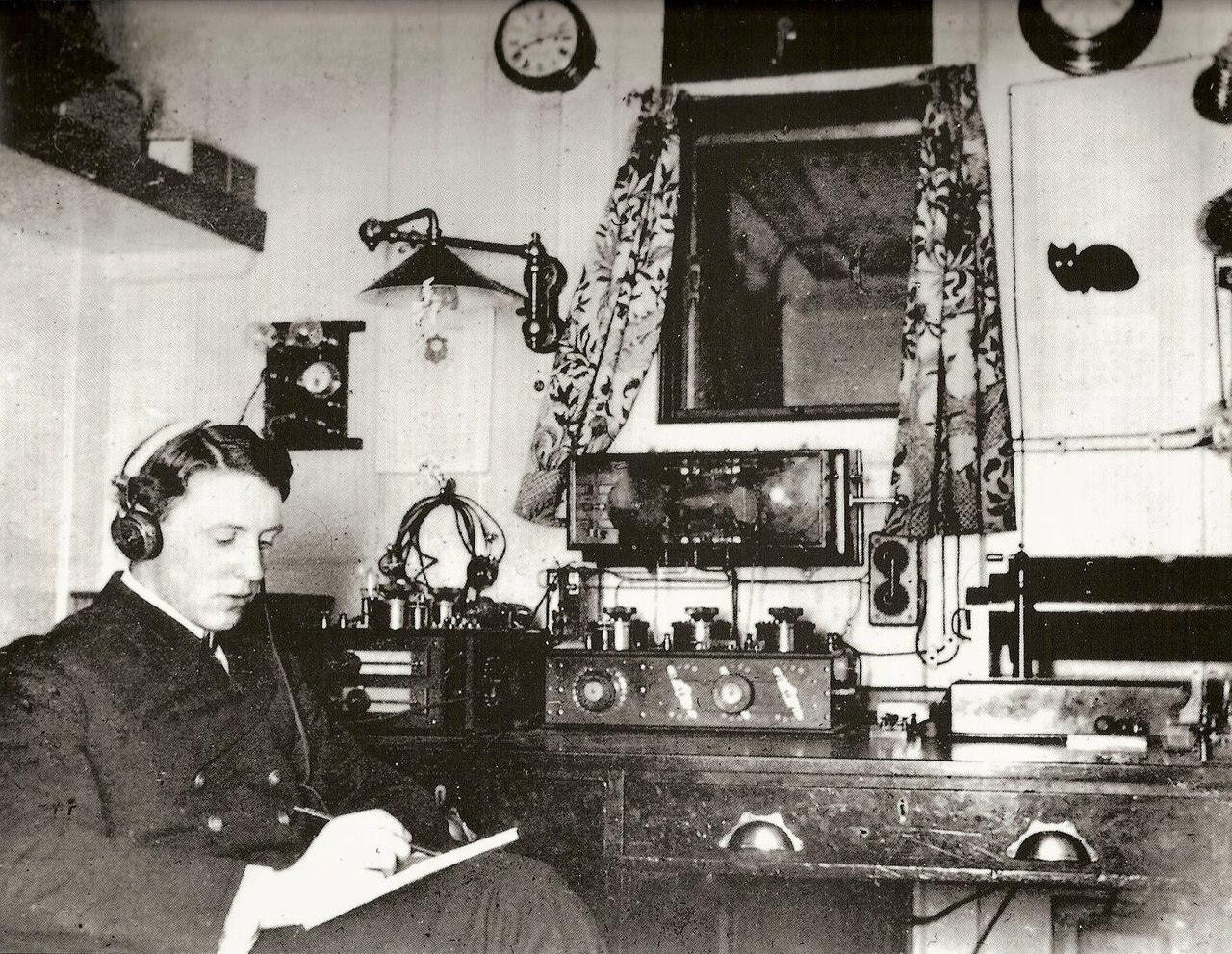
Visual AidA boat's only line to the world
A ship’s radio room, the operator listening through headphones and writing down what he hears. The Knowledge Bank explains that far out at sea a boat is beyond the reach of ordinary phones, so the radio is its one link to anyone else, and that certain channels are kept clear so a call for help always has somewhere to go. Look at the pencil and paper. Half of using a radio is writing down what came through before the static takes it away.
Marconi radio room aboard the Olympic. Source: Wikimedia Commons, public domain.
horizonn.Ch.23
The line where sea meets sky
“Only the empty horizon lay ahead.”
watchn.Ch.25
A turn on duty steering or looking out
“Sophie stood the night watch alone.”
galleyn.Ch.24
The kitchen on a boat
“They cooked oranges and pasta in the galley.”
coden.Ch.26
A system of signals that stand for messages
“She learned the radio code quickly.”
radarn.Ch.29
A device that finds ships by radio echoes
“The radar showed a ship far off.”
hailv.Ch.28
To call to another boat, often by radio
“They tried to hail a passing ship.”
channeln.Ch.28
A radio band set aside for messages
“Channel 16 is kept clear for emergencies.”
distressn.Ch.27
Trouble or danger needing help
“A distress call means real danger.”
transmitv.Ch.26
To send out a signal
“The radio can transmit for many miles.”
vesseln.Ch.29
A ship or boat
“A large vessel passed them in the night.”
ⓘ The vocabulary words in this list are selected to help you understand and complete this workbook. Some may not appear verbatim in the original novel.
🧠Knowledge Bank question
1According to the Knowledge Bank, why do sailors reserve certain radio channels?Ch.23
2A system of signals that stand for messages is a ___.Ch.26
3The ‘galley’ is the kitchen on a boat.Ch.24
4A ‘watch’ on a boat is a ___.Ch.25
5Fill in each blank with the correct word.Ch.28
Word choices:channelhailgalleyhorizon- some words will not be used
They used the radio to a passing ship.
Channel 16 is a kept for emergencies.
6‘Radar’ finds distant ships by using ___.Ch.29
7A call of ‘distress’ means everything is calm and fine.Ch.27
8To ‘transmit’ is to ___ a signal.Ch.26
9Fill in each blank with the correct word.Ch.29
Word choices:radarcodewatchdistress- some words will not be used
At night the screen showed distant ships.
Sophie learned the spelling for the radio.
10To ‘hail’ another boat is to call to it.Ch.28
Part 2
Comprehension
Show you understood what happens in Chapters 23–29.
🧠Knowledge Bank · Under Way on the Atlantic
Narrative Logic · Under Way on the Atlantic
The narrative traces the routine of the open sea: standing watches, cooking in the galley, learning the radio and its codes, watching ships appear as blips, and a doubted girl finding her place in the crew. Chapters 23–26: Out to Open Water — the Wanderer leaves the island and heads into the empty Atlantic; the crew keeps watches, cooks in the galley, and Sophie starts learning the radio and its codes. Chapters 27–29: Voices in the Dark — the men discuss safety and insurance, the crew practices the spelling alphabet and call signs, and blips of distant ships crawl across the radar at night. The waiting ends with a rush: the Wanderer leaves Grand Manan behind and heads out onto the open Atlantic, and suddenly there is nothing around them but water and sky in every direction.
🧠Knowledge Bank question
1The Knowledge Bank explains that the crew's daily routine on the open sea is built around ___.Ch.23
2To make sure someone is always steering, the crew keeps ___.Ch.25
3Everyone on board can sleep all night at the same time.Ch.25
4Sophie surprises the doubters by becoming skilled at ___.Ch.26
5Write the numbers 1–5 in the boxes to show the correct order of events. Number 1 = what happens first.Chapters 23–29
The crew sets up rotating watches, day and night.
The crew practices the spelling alphabet and call signs.
The Wanderer leaves Grand Manan for open water.
Sophie begins learning the radio codes.
Blips of distant ships appear on the radar at night.
6The crew practices a spelling alphabet like Charlie-Oscar-Delta-Yankee.Ch.28
7The glowing blips on the radar screen are ___.Ch.29
8The men’s talk of insurance and safety shows they are thinking about ___.Ch.27
9The tight quarters cause no friction at all among the crew.Ch.28
10By the end of Part 3, the odd crew is slowly becoming ___.Ch.29
Part 3
Literary Elements
Understanding HOW and WHY Sharon Creech tells the story across Chapters 23–29.
🧠Knowledge Bank · Character Shown Through Action
Literary Technique · Character Shown Through Action
Part 3 works with three tools: people revealed by what they do (characterization), a struggle that grows (conflict), and the joking voice that colors Cody’s journal (tone). The two journals do not just tell different facts — they sound different, and that difference is tone. Cody’s entries are quick, funny, and self-mocking; he cracks jokes to keep fear at arm’s length, and his humor lightens the book just when the sea grows heavy. Sophie’s entries are dreamier, full of wonder and half-hidden ache. By setting a light voice beside a haunted one, Creech keeps the story from tipping too far into either comedy or gloom, and she quietly reminds us that the same voyage, in the same boat, on the same day, can read as an adventure to one of them and as a reckoning to another.
Visual AidTwo voices, one night watch
Diagram for the Knowledge Bank on tone. Card 1 is how Sophie writes the fear and card 2 is how Cody writes the same fear, with what each choice does to the reader underneath. Card 3 is the definition the Knowledge Bank is after. Notice that the event in both columns is identical. Only the telling differs, and that difference is the whole of what tone means.
How tone separates the two journals, as described in the Knowledge Bank. Drawn for Garden Heights Academy.
Characterization
The crew’s true natures show through action — Sophie steady on the radio, Cody joking, Brian quoting facts, Dock calm.
Conflict
Two struggles grow at once: the crew against the vast, empty ocean, and the cousins against each other in tight quarters.
Tone
Cody’s light, joking voice sets the mood of his journal against Sophie’s dreamier one.
🧠Knowledge Bank question
1According to the Knowledge Bank, what does Cody's joking voice mostly do?Ch.25
2Fill in each blank with the correct literary term.Ch.28
Word choices:characterizationtonesettingrhyme- some words will not be used
Showing people through their actions is .
Cody’s joking voice sets the .
3Characterization can happen through a character’s actions, not just descriptions.Ch.25
4The struggle of the crew against the huge, empty ocean is a kind of ___.Ch.23
5Cody’s quick, self-mocking journal mainly sets the ___.Ch.28
6There is only one conflict in Part 3, and it is between two people.Ch.28
7Fill in each blank with the correct literary term.Ch.28
Word choices:conflicttonenarratorrhyme- some words will not be used
The tension between Brian and Cody is a .
Cody’s joking voice creates the .
8Creech reveals Sophie’s worth mainly by ___.Ch.26
9Setting a joking voice beside a haunted one keeps the book balanced.Ch.28
10The clearest sign the crew is bonding is that they increasingly ___.Ch.29
Part 4
Think Deeper
Four deeper challenges — no single-word recall. Read, weigh the evidence, and reason it out.
🧠Knowledge Bank · Reading Under Way
Ethical Reasoning · Reading Under Way
This part brings together a rotating watch, a radio code, a screen full of blips, a joking cousin. The episode demonstrates how Creech reveals who these people are through what they DO under way — a technique called characterization by action. On land, talk is cheap; on a small boat crossing an ocean, a person’s true nature shows in how they stand a night watch, handle a rope, or react when things go wrong. Sophie, whom some doubted, turns out to be steady and quick, mastering the radio; Cody hides real worry under jokes; Brian reaches for facts when he is nervous; Dock stays calm and capable. No one has to be described — we simply see them work, and we learn them. The narrative reveals how the ocean strips away pretending.
Picture the boat far from any shore, a single speck under a huge sky, the horizon an unbroken circle of gray-blue water. It is three in the morning and it is Sophie’s watch. The others are asleep below; she alone holds the wheel, feeling the boat lean and surge beneath her. On the radio, a far-off voice crackles and spells its name letter by letter — Charlie, Oscar, Delta — and on the small green screen a blip creeps closer, some cargo ship passing in the dark she will never see. She was the one they doubted, the dreamer, the girl. And here she is, wide awake, steady, keeping her family safe while they sleep. Out here there is no room for pretending. You are simply what you do — and Sophie, it turns out, is a sailor.
Original passage written for Garden Heights — not a quotation from the novel.
1Claim: “Part 3 shows that Sophie belongs on the crew, despite those who doubted her.” — choose the two details that best prove it.Claim & Evidence
2How sailors talk at sea, or How the crew is revealed? Tap each detail to sort it — tap again to switch sides. You can keep tapping to change your answer.Sort into two
◄ How sailors talk at seaHow the crew is revealed ►
3Match each cause to its result. For each cause, pick its result.Cause & Effect
The crew keeps rotating watches→
Sophie takes to the radio→
Cody cracks jokes at sea→
Brian and Cody share tight quarters→
🧠Knowledge Bank question
4Fill both blanks to complete the reasoning.Build the Argument
The Knowledge Bank argues that a small boat reveals character better than land does because , which shows that .
Part 5
Standardized Test
Reading passage · Talking to Other Ships at Sea · SAT & TOEFL-style practice
Read the passage — the highlighted words are tested — then answer. Tap an answer, then tap it again to confirm.
SATCentral Ideas — the passage's main point
SATDetail — a fact stated in the passage
SATInference — a conclusion the passage implies
SATWords in Context — a word's meaning in this passage
SATText Connections — how two parts of the text relate
TOEFLFactual Information — a fact stated in the passage
TOEFLVocabulary — a tested word's meaning here
Radio Distress Calls at Sea
Far out on the ocean, a boat like the Wanderer is beyond the reach of ordinary phones, so its lifeline to the world is the VHF radio. The radio is divided into many channels, and sailors have agreed to keep certain channels for certain uses. The most important is Channel 16, which is left clear so that any boat can hail another or send out a cry for help. Because a spoken word can be swallowed by static and the roar of wind, sailors do not simply say a letter; they use a spelling alphabet in which every letter is a whole word. A becomes Alpha, B becomes Bravo, C becomes Charlie, so that a name spelled C-O-D-Y might be read aloud as Charlie-Oscar-Delta-Yankee, impossible to mishear.
When a boat is in true danger, the crew reaches for the radio and repeats one word three times: Mayday, Mayday, Mayday. It is the sea's oldest code for distress, understood by sailors everywhere, and it tells anyone listening to drop what they are doing and help. A second tool guards the boat against the dark and the fog: radar. The radar sends out invisible radio pulses and listens for the echoes bouncing back off distant ships; it draws each returning echo as a small glowing dot, or blip, on a screen, so the crew can see a vessel miles away even on a night as black as ink. Learning to transmit clearly and to read the radar turns a boatful of relatives into a working crew.
Original passage written for Garden Heights — not a quotation from the novel.
1What is the main idea of the passage?SAT · Central Ideas
2Why is a boat’s VHF radio so important far out at sea?TOEFL · Factual Information
3Channel 16 is kept clear mainly for ___.SAT · Detail
4Why do sailors use a spelling alphabet?SAT · Inference
5The letters C-O-D-Y might be spoken as ___.SAT · Detail
6In real danger, a crew repeats which word three times?TOEFL · Factual Information
7Radar helps a crew by ___.TOEFL · Factual Information
8In the passage, hail most nearly means ___.SAT · Words in Context
9In the passage, code most nearly means ___.TOEFL · Vocabulary
10How does this passage connect to Part 3’s events?SAT · Text Connections
Part 6 · Optional
Creative Writing
A bonus challenge to practice your English. Take your time and have fun with it.
About This Section
This writing task is optional and is not part of your auto-graded score. The feedback below checks only the basics — length, spelling, and grammar — not whether your ideas are right or wrong. It is meant for classroom discussion and creative practice, so feel free to use your imagination!
Writing Task — Part 3 “Proving Them Wrong”
Some of the crew doubted that Sophie belonged, and she quietly proved them wrong by being good at the work. Write about a time someone doubted you, or you doubted yourself, and you showed what you could really do. What was the doubt, what did you do, and how did it change how you or others saw you? 6–10 sentences. End with what you learned about yourself.
You can start with: “They didn’t think I could do it, but...”
0 / 40 words minimum
🗣 Teach It · Just for Fun (optional)
No right or wrong — close the screen and tell someone nearby what happened in this part. Can’t find anyone? Tell yourself out loud. The moment you teach it, you truly understand it.
Part 3 Complete!
You finished Chapters 23–29 of The Wanderer.
Here are your auto-graded results:
-
points out of 100
Teach it to someone
The best last step is to teach it. In your own words, explain what happened — retell a favorite scene, teach a character’s big choice, or sum up the main idea for a parent, friend, or classmate. When you can teach it clearly, you truly own it.
Independent study guide by Garden Heights. Not affiliated with or endorsed by Sharon Creech. Contains original analysis only; no text from the novel is reproduced. Reference text: This workbook follows Sharon Creech’s classic text (the standard Puffin edition sold worldwide). Revised 2023 UK editions change some wording and may not match the vocabulary studied here.
SAT® is a registered trademark of College Board, which is not affiliated with, and does not endorse, these materials. TOEFL® is a registered trademark of ETS. These materials are not endorsed or approved by ETS. Garden Heights is an independent provider of test-style reading practice.