New here? Just sign up with Google — your account includes Matilda, our gift book, forever.
The Wanderer · Garden Heights
Part 4
for The Wanderer · Part 4 · Chapters 30–35
8 Parts40 min
What Happens in Part 4
Deep in the crossing now, the crew lives by the tools of navigation. They measure the boat’s speed in knots, bend over sea charts, watch the compass, and keep track of how far they have come by simple arithmetic — speed times time — the old art of finding your way when there is no land in sight. Between the chores, the crew’s hidden hearts start to show. Uncle Dock, usually so steady, goes soft and sad when the name Rosalie comes up — a woman he once loved and lost — and he guards a small keepsake that clearly means the world to him. Sophie tells another Bompie story, the swimming-hole tale in which young Bompie again ends up underwater, and the family’s puzzlement deepens. Most troubling of all, Sophie’s dreams turn dark: night after night she is chased by nightmares of a ‘little kid’ near water, images she cannot explain and does not want to face. Something long buried is pushing up through her sleep. Dock carries an open grief he can name; Sophie carries a hidden grief she cannot — and the two losses quietly mirror each other as the Wanderer sails on.
A keepsake symbol, parallel griefs, and dreams that foreshadow
Cross-Curricular
Finding your way at sea — charts, compass, knots, and dead reckoning
Chapter Summary
Ch.
What happens
Chapters 30–32
Finding the Way — the crew navigates by chart, compass, and knots; Dock grows sad over a lost love named Rosalie; and Sophie tells the swimming-hole Bompie story.
Chapters 33–35
Nightmares Rising — Sophie is haunted by dreams of a ‘little kid’ near water, Dock keeps a treasured keepsake, and two very different griefs quietly mirror each other.
Part 1
Vocabulary
Study 10 key words from Chapters 30–35, then answer each question.
🧠Knowledge Bank · Words of Finding the Way
Lexicology · Words of Finding the Way
Part 4’s words steer the boat and the heart: a compass and a chart to hold a course, speed measured in knots, and a nightmare of a little kid near water rising from a buried past. With no roads and no landmarks, how does a boat find England across three thousand miles (4,827 km) of water? For centuries the answer was three tools working together. First, the compass, which always points toward magnetic north, lets a sailor hold a steady course in any direction. Second, the chart — a detailed map of the sea — shows depths, dangers, and the grid of imaginary lines (latitude and longitude) that pin any spot on the globe. Third, sailors measure their speed in knots (one knot is one nautical mile per hour) and multiply speed by the hours sailed to learn how far they have traveled.
Visual AidThe needle that never argues
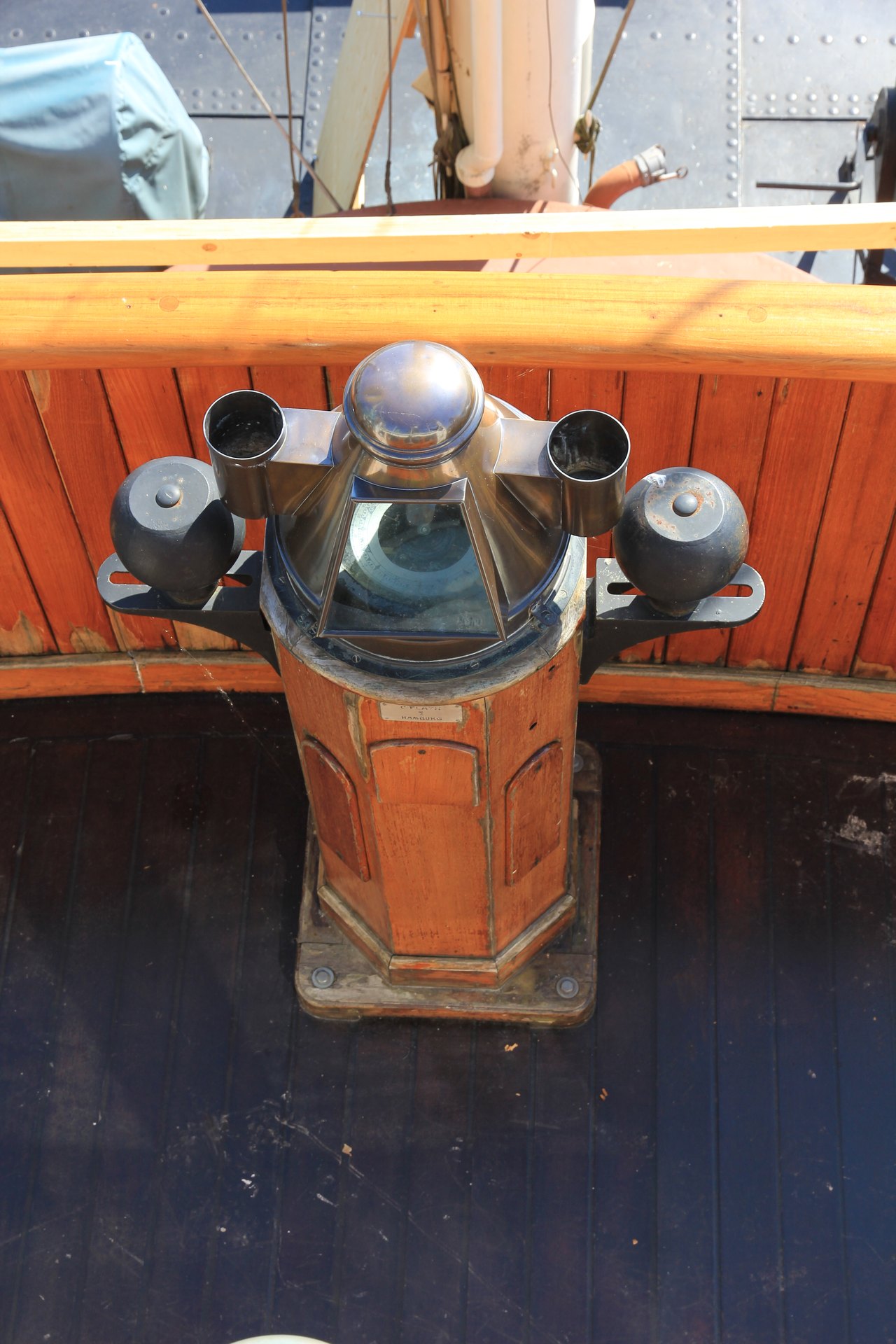
A ship’s compass in its binnacle, the wooden stand that holds it steady on a moving bridge. The Knowledge Bank explains that the needle always swings toward magnetic north, which lets a sailor hold a chosen direction, or course, no matter which way the waves push. Notice the two iron spheres either side. They are there to cancel the pull of the ship’s own steel, so that the needle answers only the Earth.
Ship's bridge compass aboard the icebreaker Tarmo. Source: Wikimedia Commons, public domain.
knotn.Ch.30
A unit of a boat’s speed (one nautical mile per hour)
“The Wanderer made six knots in a good wind.”
chartn.Ch.30
A map of the sea used by sailors
“Dock spread the chart across the table.”
compassn.Ch.30
A tool whose needle always points north
“The compass held them on a true course.”
navigatev.Ch.30
To find and follow a course
“They learned to navigate far from land.”
coursen.Ch.30
The direction a boat is steered
“They kept the course pointed east.”
reckoningn.Ch.30
Figuring a boat’s position from speed and time
“By reckoning, they guessed their spot at sea.”
keepsaken.Ch.31
An object kept in memory of someone
“Dock’s keepsake reminded him of Rosalie.”
longingn.Ch.31
A deep wish for someone or something
“His face filled with longing.”
nightmaren.Ch.34
A frightening dream
“The same nightmare woke Sophie again.”
buriedadj.Ch.34
Hidden deep, out of sight or memory
“A buried memory pushed at her sleep.”
ⓘ The vocabulary words in this list are selected to help you understand and complete this workbook. Some may not appear verbatim in the original novel.
🧠Knowledge Bank question
1According to the Knowledge Bank, what does a compass let a sailor do?Ch.30
2A map of the sea used by sailors is a ___.Ch.30
3A ‘compass’ needle always points north.Ch.30
4To ‘navigate’ is to ___.Ch.30
5Fill in each blank with the correct word.Ch.30
Word choices:reckoningcoursekeepsakechart- some words will not be used
They steered a steady eastward .
By they guessed their position.
6A ‘keepsake’ is an object kept ___.Ch.31
7A ‘nightmare’ is a happy, peaceful dream.Ch.34
8‘Longing’ is a deep ___ for someone or something.Ch.31
9Fill in each blank with the correct word.Ch.34
Word choices:buriednightmareknotcompass- some words will not be used
The same woke Sophie again.
It rose from a memory she could not name.
10To ‘chart’ a course, sailors use a map of the sea.Ch.30
Part 2
Comprehension
Show you understood what happens in Chapters 30–35.
🧠Knowledge Bank · Course and Nightmare
Narrative Logic · Course and Nightmare
The narrative traces the deeper crossing: the crew navigating by chart, compass, and knots; Dock’s sorrow over lost Rosalie; another underwater Bompie story; and Sophie’s nightmares of a ‘little kid’ near water. Chapters 30–32: Finding the Way — the crew navigates by chart, compass, and knots; Dock grows sad over a lost love named Rosalie; and Sophie tells the swimming-hole Bompie story. Chapters 33–35: Nightmares Rising — Sophie is haunted by dreams of a ‘little kid’ near water, Dock keeps a treasured keepsake, and two very different griefs quietly mirror each other. Deep in the crossing now, the crew lives by the tools of navigation. Between the chores, the crew’s hidden hearts start to show. Uncle Dock, usually so steady, goes soft and sad when the name Rosalie comes up — a woman he once loved and lost — and he guards a small keepsake that clearly means the world to him. Two griefs are aboard this boat, and only one of them has a name.
Visual AidFinding a boat with arithmetic
Diagram for the Knowledge Bank on navigation. The four cards are one round of dead reckoning — heading, speed, hours, new position — and the dashed arrow is the part that matters: it runs straight back to the beginning and starts again. Card 5 is what the repetition buys. Notice that not one step needs to see land. That is the whole point, and it is why the method still works when a screen goes dark.
How dead reckoning finds a boat with no landmarks, as described in the Knowledge Bank. Drawn for Garden Heights Academy.
🧠Knowledge Bank question
1The Knowledge Bank explains that dead reckoning works by ___.Ch.30
2To find their way with no land in sight, the crew uses a compass and a ___.Ch.30
3Uncle Dock stays cheerful and untroubled whenever Rosalie is mentioned.Ch.31
4The keepsake Dock guards is tied to ___.Ch.31
5Write the numbers 1–5 in the boxes to show the correct order of events. Number 1 = what happens first.Chapters 30–35
Dock grows sad when Rosalie’s name comes up.
Nightmares of a ‘little kid’ near water begin to haunt Sophie.
Sophie tells the swimming-hole Bompie story.
The crew navigates by chart, compass, and knots.
Dock’s grief and Sophie’s buried grief quietly mirror each other.
6In the swimming-hole story, young Bompie ends up underwater.Ch.32
7Sophie’s nightmares keep showing a ___.Ch.34
8The difference between Dock’s grief and Sophie’s is that Dock’s is ___.Ch.34
9Sophie easily explains and understands her nightmares.Ch.34
10By the end of Part 4, the two griefs on the boat serve to ___.Ch.35
Part 3
Literary Elements
Understanding HOW and WHY Sharon Creech tells the story across Chapters 30–35.
🧠Knowledge Bank · Objects, Echoes and Dreams
Literary Technique · Objects, Echoes and Dreams
Part 4 uses three tools: an object that carries meaning (symbol), two characters whose losses echo (parallel characters), and dreams that hint at what is coming (foreshadowing). The narrative reveals how Creech places Dock’s sorrow right beside Sophie’s — a technique of parallel characters, where two people echo each other so we understand both more deeply. Dock’s grief is open: he can name Rosalie, sigh over his keepsake, and let the family see him hurt. Sophie’s grief is buried: it has no name yet, and it can only reach her sideways, through nightmares of a ‘little kid’ near water. By setting the two side by side, Creech shows a range of ways the human heart handles loss — some out loud, some hidden so well that even the griever does not know what they mourn.
Symbol
Dock’s keepsake stands for a love lost yet still carried — grief folded into an object.
Parallel characters
Dock’s open grief over Rosalie mirrors Sophie’s buried grief, so we understand both more deeply.
Foreshadowing
Sophie’s nightmares of a ‘little kid’ near water hint at the buried truth about to surface.
🧠Knowledge Bank question
1According to the Knowledge Bank, why does Creech keep returning to Bompie's stories?Ch.31
2Fill in each blank with the correct literary term.Ch.31
Word choices:symbolparallelsettingrhyme- some words will not be used
Dock’s keepsake of lost love is a .
Dock’s grief mirroring Sophie’s is a .
3A symbol is an object that also stands for a larger idea or feeling.Ch.31
6Parallel characters echo each other so the reader understands both more deeply.Ch.34
7Fill in each blank with the correct literary term.Ch.34
Word choices:foreshadowingsymbolnarratorrhyme- some words will not be used
Dreams hinting at a coming truth are .
The keepsake that holds Dock’s longing is a .
8The key difference the parallel highlights is that Dock’s grief is named while Sophie’s is ___.Ch.34
9Sophie’s nightmares are just random and mean nothing to the story.Ch.34
10Creech gives gruff Dock a tender secret mainly to show that ___.Ch.31
Part 4
Think Deeper
Four deeper challenges — no single-word recall. Read, weigh the evidence, and reason it out.
🧠Knowledge Bank · Reading the Hidden Hearts
Ethical Reasoning · Reading the Hidden Hearts
This part brings together a compass and chart, a treasured keepsake, a swimming-hole story, a nightmare of a little kid. Uncle Dock guards a small keepsake tied to Rosalie, the woman he loved and lost, and that little object works as a symbol of longing — of a love that is over yet still carried everywhere. Creech gives the gruff, capable uncle this tender secret for a reason: it shows that grief does not only belong to Sophie. Everyone on this boat is carrying something. The episode demonstrates how a physical object can hold an entire invisible history — a whole lost future folded into a thing you can hold in one hand. The keepsake reminds us that the people who seem strongest often ache the most quietly, and it prepares us to understand the far deeper loss that Sophie herself has buried.
Below deck, a lantern swings and the chart lies open on the table, its blue expanse crossed with faint lines and numbers. Dock bends over it with the compass, plotting how far six knots for six hours has carried them across the empty ocean — and then his eyes drift, and his thumb finds a small keepsake in his pocket, and for a moment he is somewhere else entirely, with a woman named Rosalie he lost long ago. Across the cabin, Sophie sleeps — and does not rest. Behind her eyelids a little kid stands near dark water, again and again, and she wakes with her heart pounding, unable to say what the dream means or why it will not leave her alone. Two people on one small boat, both carrying a loss. One can name his. The other does not yet know what she has buried.
Original passage written for Garden Heights — not a quotation from the novel.
1Claim: “Part 4 shows that Sophie is carrying a hidden grief she cannot yet name.” — choose the two details that best prove it.Claim & Evidence
2How sailors navigate, or Signs of buried grief? Tap each detail to sort it — tap again to switch sides. You can keep tapping to change your answer.Sort into two
◄ How sailors navigateSigns of buried grief ►
3Match each cause to its result. For each cause, pick its result.Cause & Effect
A compass and chart→
Dock guards a keepsake→
Dock’s grief sits beside Sophie’s→
Nightmares of a little kid→
🧠Knowledge Bank question
4Fill both blanks to complete the reasoning.Build the Argument
The Knowledge Bank argues that good sailors still learn the older tools because , which shows that .
Part 5
Standardized Test
Reading passage · Finding the Way Across the Ocean · SAT & TOEFL-style practice
Read the passage — the highlighted words are tested — then answer. Tap an answer, then tap it again to confirm.
SATCentral Ideas — the passage's main point
SATDetail — a fact stated in the passage
SATInference — a conclusion the passage implies
SATWords in Context — a word's meaning in this passage
TOEFLFactual Information — a fact stated in the passage
TOEFLInsert Text — where a sentence best fits
Old Tools of Ocean Navigation
With no roads and no signs, crossing an ocean means answering one hard question over and over: where are we now? For hundreds of years, sailors answered it with three simple tools. The first is the compass, whose needle always swings toward magnetic north, letting a sailor hold a chosen direction, or course, no matter which way the waves push. The second is the chart, a detailed map of the sea that shows depths, rocks buried just beneath the surface, and the grid of lines, latitude and longitude, that can pin any point on the whole round Earth.
The third tool is arithmetic. Sailors measure their speed in knots, where one knot equals one nautical mile each hour, and then multiply that speed by the number of hours they have sailed to learn how far they have come. By adding up each heading and each distance in turn, a navigator can estimate the boat's position without ever glimpsing land, a patient method called dead reckoning. Modern crews also carry GPS, a small device that listens to satellites and reports the boat's exact spot within seconds. Yet good sailors still learn the older skills, because batteries die and screens fail, while a compass, a chart and careful counting almost never do. Navigation, in the end, is really a kind of bookkeeping.
Original passage written for Garden Heights — not a quotation from the novel.
1What is the main idea of the passage?SAT · Central Ideas
3A chart is best described as ___.TOEFL · Factual Information
4What do latitude and longitude form on a chart?TOEFL · Factual Information
5How fast is one knot?SAT · Detail
6To estimate position without seeing land, sailors add up their ___.TOEFL · Factual Information
7Why do good sailors still learn the older skills?SAT · Inference
8In the passage, buried most nearly means ___.SAT · Words in Context
9What does GPS use to find a boat’s exact spot?SAT · Detail
10Insert Text (TOEFL). Look at the four squares [1]–[4] in the excerpt below. They show where this sentence could be added: “Before satellites existed, this patient bookkeeping was the only way to guess where a boat was.”
For centuries, sailors found their way with a compass and a chart. [1] To learn how far they had gone, they measured speed in knots and multiplied it by the hours sailed. [2] Adding up each heading and distance, they could estimate their position without seeing land, a method called dead reckoning. [3] Today a small GPS device can fix a boat’s exact spot from satellites in seconds. [4]
Where would the sentence fit best?TOEFL · Insert Text
Part 6 · Optional
Creative Writing
A bonus challenge to practice your English. Take your time and have fun with it.
About This Section
This writing task is optional and is not part of your auto-graded score. The feedback below checks only the basics — length, spelling, and grammar — not whether your ideas are right or wrong. It is meant for classroom discussion and creative practice, so feel free to use your imagination!
Writing Task — Part 4 “Something I Carry”
Dock keeps a small keepsake that holds a whole story of love and loss. Write about an object you keep that means far more than it looks — a gift, a photo, something handed down. What is it, where did it come from, and why do you hold on to it? 6–10 sentences. End with what the object reminds you of every time you see it.
You can start with: “It might look like nothing, but to me...”
0 / 40 words minimum
🗣 Teach It · Just for Fun (optional)
No right or wrong — close the screen and tell someone nearby what happened in this part. Can’t find anyone? Tell yourself out loud. The moment you teach it, you truly understand it.
Part 4 Complete!
You finished Chapters 30–35 of The Wanderer.
Here are your auto-graded results:
-
points out of 100
Teach it to someone
The best last step is to teach it. In your own words, explain what happened — retell a favorite scene, teach a character’s big choice, or sum up the main idea for a parent, friend, or classmate. When you can teach it clearly, you truly own it.
Independent study guide by Garden Heights. Not affiliated with or endorsed by Sharon Creech. Contains original analysis only; no text from the novel is reproduced. Reference text: This workbook follows Sharon Creech’s classic text (the standard Puffin edition sold worldwide). Revised 2023 UK editions change some wording and may not match the vocabulary studied here.
SAT® is a registered trademark of College Board, which is not affiliated with, and does not endorse, these materials. TOEFL® is a registered trademark of ETS. These materials are not endorsed or approved by ETS. Garden Heights is an independent provider of test-style reading practice.