New here? Just sign up with Google — your account includes Matilda, our gift book, forever.
The Wanderer · Garden Heights
Part 5
for The Wanderer · Part 5 · Chapters 36–47
8 Parts40 min
What Happens in Part 5
Out in the middle of the North Atlantic, the sea turns against them. What begins as a lively wind stiffens into a gale, and then the gale keeps building. The swells grow into moving hills of water; the boat climbs each one, hangs at the crest, and slides sickeningly into the trough beyond. The rigging howls, the deck heaves, and the crew battens down everything loose. Day and night blur into one long fight to keep the Wanderer pointed the right way and afloat. There is no time to rest; the sailors take turns at the wheel until they are gray with exhaustion, weary to the bone and drenched to the skin. In the middle of the ordeal, human moments still break through — Cody and his father Mo, so often at odds, begin to reach for each other, and Sophie feels how utterly small and alone a person can be against so much water. She tells the darkest Bompie story yet, the one in which he is nearly lost in the ocean itself. Then the wind reaches Force Ten, near the top of the storm scale, and the crew understands that the sea is about to test them as never before.
What We Will Learn
Section
What you will practice
Vocabulary
Storm words: gale, swell, crest, trough, weary…
Literary Elements
Vivid storm imagery, a sea brought to life, and rising action
Cross-Curricular
The Atlantic crossing — the Gulf Stream, weather, and the wind scale
Chapter Summary
Ch.
What happens
Chapters 36–41
The Wind Rises — a gale builds into towering swells; the crew battens down and fights to hold the boat’s course as the sea grows wild.
Chapters 42–47
Weary to the Bone — the crew battles on without rest; Cody and Mo grow closer; Sophie tells the story of Bompie nearly lost at sea; and the wind climbs to Force Ten.
Part 1
Vocabulary
Study 10 key words from Chapters 36–47, then answer each question.
🧠Knowledge Bank · Words of Wind and Waves
Lexicology · Words of Wind and Waves
Part 5’s words raise a storm: a rising gale heaps the sea into swells that lift the boat to each crest and drop it into the trough, until the crew is weary to the bone. The North Atlantic is one of the roughest ocean crossings on Earth, and Part 5 shows why. Warm water from the tropics flows northeast in a great current called the Gulf Stream, and where its warmth meets colder air, storms are born and grow. Prevailing westerly winds tend to push weather — and boats — from west to east across this stretch, which is one reason crews sail toward England this way. To describe how hard the wind blows, sailors use the Beaufort scale, which numbers wind force from 0 (dead calm) up to 12 (hurricane). A crew that can name the force it is in is a crew still thinking, which is exactly what a storm tries to take away.
Visual AidCrest, trough, and the drop between
Diagram for the Knowledge Bank on the words of wind and water. Lines 1 and 2 are the top and the bottom of one wave and the arrow between them is the swell height the Knowledge Bank names. Notice the two small squares: that is the same boat, a few seconds apart. From the crest you can see for miles; from the trough there is nothing to see but water.
The parts of one swell, and the height the Knowledge Bank names. Drawn for Garden Heights Academy.
galen.Ch.37
A very strong wind
“The gale tore at the sails all night.”
swelln.Ch.36
A long, rolling wave
“Each swell lifted the boat like a hill.”
crestn.Ch.41
The top of a wave
“The boat hung at the crest, then fell.”
troughn.Ch.39
The low valley between waves
“It slid into the trough with a groan.”
lurchv.Ch.38
To roll suddenly to one side
“The deck would lurch without warning.”
battenv.Ch.36
To fasten down tightly for a storm
“They battened down every loose thing.”
wearyadj.Ch.43
Very tired
“The crew grew weary at the wheel.”
relentlessadj.Ch.42
Never stopping or easing
“The relentless wind gave no rest.”
endurev.Ch.43
To bear something hard
“They could only endure the storm.”
drenchedadj.Ch.40
Soaked completely through
“Everyone was drenched by the spray.”
ⓘ The vocabulary words in this list are selected to help you understand and complete this workbook. Some may not appear verbatim in the original novel.
🧠Knowledge Bank question
1According to the Knowledge Bank, what makes the North Atlantic so rough?Ch.37
2The low valley between two waves is the ___.Ch.39
3The ‘crest’ of a wave is its very top.Ch.41
4To be ‘weary’ is to be ___.Ch.43
5Fill in each blank with the correct word.Ch.36
Word choices:battenswellendurecrest- some words will not be used
They rushed to down every loose thing.
A long lifted the boat like a hill.
6Something ‘relentless’ ___.Ch.42
7To ‘endure’ a storm is to run away and avoid it.Ch.43
8To ‘lurch’ is to ___.Ch.38
9Fill in each blank with the correct word.Ch.40
Word choices:drenchedtroughgaleweary- some words will not be used
The spray left everyone to the skin.
A screaming tore at the sails.
10To ‘batten’ down is to fasten things tightly before a storm.Ch.36
Part 2
Comprehension
Show you understood what happens in Chapters 36–47.
🧠Knowledge Bank · Into the Storm
Narrative Logic · Into the Storm
The narrative traces the rising danger: a gale that swells into towering seas, a crew fighting sleepless at the wheel, Cody and Mo reaching for each other, the darkest Bompie story, and a wind that climbs to Force Ten. Chapters 36–41: The Wind Rises — a gale builds into towering swells; the crew battens down and fights to hold the boat’s course as the sea grows wild. Chapters 42–47: Weary to the Bone — the crew battles on without rest; Cody and Mo grow closer; Sophie tells the story of Bompie nearly lost at sea; and the wind climbs to Force Ten. Out in the middle of the North Atlantic, the sea turns against them. What begins as a lively wind stiffens into a gale, and then the gale keeps building.
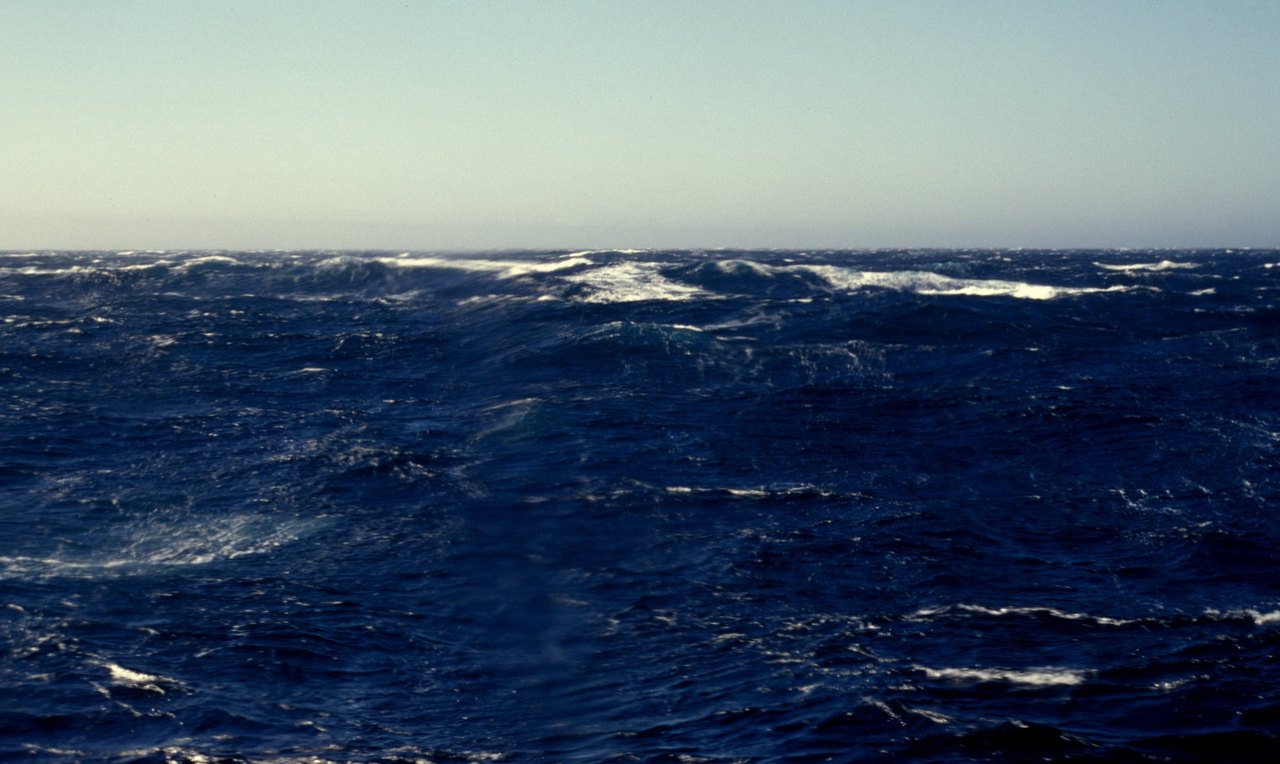
Visual AidWhat a gale looks like from the deck
The open ocean in a strong wind, photographed for the United States weather service. The Knowledge Bank explains that sailors measure wind on the Beaufort scale, from 0 for a dead calm to 12 for a hurricane, and that the Wanderer meets a Force 10. Look at the white streaks lying along the wave tops. Sailors read those streaks to judge the force, because far from land there is no instrument that matters more than what you can see.
Sea state in a strong wind; U.S. National Oceanic and Atmospheric Administration photo library. Source: Wikimedia Commons, public domain.
🧠Knowledge Bank question
1The Knowledge Bank explains that the crew's nights during the gale are spent ___.Ch.37
2As the swells grow, the boat climbs each one and then ___.Ch.41
3During the worst of it, the crew gets plenty of rest and sleep.Ch.42
4Two crew members who grow closer during the storm are ___.Ch.44
5Write the numbers 1–5 in the boxes to show the correct order of events. Number 1 = what happens first.Chapters 36–47
The wind climbs to Force Ten near the top of the storm scale.
The exhausted crew fights sleepless at the wheel.
A lively wind stiffens into a building gale.
Sophie tells of Bompie nearly lost in the ocean.
Towering swells lift and drop the boat.
6In the darkest Bompie story of Part 5, he is nearly lost in the ocean.Ch.46
7In the middle of the storm, Sophie feels ___.Ch.45
8‘Force Ten’ describes ___.Ch.47
9The crew can simply steer around the storm to avoid it.Ch.42
10By the end of Part 5, the crew understands the sea is about to ___.Ch.47
Part 3
Literary Elements
Understanding HOW and WHY Sharon Creech tells the story across Chapters 36–47.
🧠Knowledge Bank · A Sea That Seems Alive
Literary Technique · A Sea That Seems Alive
Part 5 works with three tools: sensory language that puts you in the storm (imagery), a sea given a living will (personification), and danger that steadily climbs (rising action). Again and again the storm chapters give the sea a will of its own — it ‘battles,’ it ‘howls,’ it seems to reach for the boat — a technique called personification, describing a nonliving thing as if it were alive. This is more than decoration. By making the ocean feel like a living opponent, Creech raises the human stakes: the crew is not just enduring weather, they are wrestling something that appears to want them. For Sophie the personified sea is especially charged, because water in this book is bound up with her buried past. When the sea seems to hunt her, we sense that her private fear and the real storm are becoming one and the same.
Visual AidHow hard is the wind blowing
Scale drawing for the Knowledge Bank on the storm. The four numbered points are places on the Beaufort scale, which runs from 0 to 12, and the red one is where this part sits. Card 5 says so plainly. Notice how far Force 10 already is from a full hurricane, and notice that the scale describes what the sea is doing rather than a number on a dial — which is why a sailor can read it by looking.
The Beaufort scale and where this part's storm sits on it, as described in the Knowledge Bank. Drawn for Garden Heights Academy.
Imagery
Sensory storm details — howling rigging, dropping decks, salt spray, gray hills of water — put the reader on the pitching deck.
Personification
The sea is described as if alive — it battles, howls, and reaches — making the weather a living opponent.
Rising action
The steadily building gale toward Force Ten drives the story upward toward its crisis.
🧠Knowledge Bank question
1According to the Knowledge Bank, giving the sea a will of its own is called ___.Ch.38
2Fill in each blank with the correct literary term.Ch.38
Word choices:imagerypersonificationsettingrhyme- some words will not be used
Sensory storm details are .
Giving the sea a will of its own is .
3Imagery appeals to the reader’s senses.Ch.38
4Describing the sea as if it ‘battles’ and ‘howls’ is ___.Ch.42
5The gale that keeps building toward Force Ten is an example of ___.Ch.47
6Personification describes a nonliving thing as if it were alive.Ch.42
7Fill in each blank with the correct literary term.Ch.47
Word choices:rising actionimagerynarratorrhyme- some words will not be used
The steadily climbing storm is .
The sensory storm details are .
8The personified sea matters especially for Sophie because water is tied to her ___.Ch.45
9The storm details carry no emotion, only facts.Ch.38
10Rising action in Part 5 mainly builds toward ___.Ch.47
Part 4
Think Deeper
Four deeper challenges — no single-word recall. Read, weigh the evidence, and reason it out.
🧠Knowledge Bank · Reading the Storm
Ethical Reasoning · Reading the Storm
This part brings together a building gale, hills of gray water, a sea that seems to howl, a wind at Force Ten. Feel how Creech makes the storm real through imagery — language that appeals to the senses. We do not simply read that the weather was bad; we hear the rigging howl, feel the deck drop from under us, taste salt spray, and see gray water rising into hills. Both narrators pour these details onto the page because a storm is not an idea, it is an experience of the whole shaking body. Strong imagery pulls the reader out of a safe chair and onto a pitching deck. The narrative reveals how the sensory details also carry emotion: the same crashing sea that terrifies is, in a strange way, thrilling, and the writing lets us feel both at once.
Imagine the world reduced to water and noise. The wind is no longer a breeze but a living scream in the rigging, and the sea has stopped being a surface and become a range of moving gray mountains. The Wanderer claws up the face of each swell, teeters at the top where the wind tries to tear her sideways, then plunges into the trough with a shudder that runs through every bone aboard. The crew has not truly slept in days; they are drenched, salt-stung, and weary past words, taking the wheel in turns because to stop is to lose. And a thirteen-year-old girl, gripping a rail as the ocean lunges at the boat, feels her oldest, deepest fear and the real storm outside become one single, roaring thing. The needle climbs toward Force Ten. The worst is still ahead.
Original passage written for Garden Heights — not a quotation from the novel.
1Claim: “Part 5 builds steadily toward the story’s crisis rather than resolving it.” — choose the two details that best prove it.Claim & Evidence
2The science of the crossing, or How Creech builds dread? Tap each detail to sort it — tap again to switch sides. You can keep tapping to change your answer.Sort into two
◄ The science of the crossingHow Creech builds dread ►
3Match each cause to its result. For each cause, pick its result.Cause & Effect
Howling rigging and salt spray→
The sea ‘battles’ and reaches→
The wind climbs to Force Ten→
Water is tied to Sophie’s fear→
🧠Knowledge Bank question
4Fill both blanks to complete the reasoning.Build the Argument
The Knowledge Bank argues that the storm feels real because , which shows that .
Part 5
Standardized Test
Reading passage · Crossing the Wild North Atlantic · SAT & TOEFL-style practice
Read the passage — the highlighted words are tested — then answer. Tap an answer, then tap it again to confirm.
SATCentral Ideas — the passage's main point
SATDetail — a fact stated in the passage
SATWords in Context — a word's meaning in this passage
SATText Connections — how two parts of the text relate
TOEFLFactual Information — a fact stated in the passage
TOEFLVocabulary — a tested word's meaning here
Storms of the North Atlantic
The North Atlantic is famous among sailors as one of the hardest oceans to cross, and the reasons are written into the water and the air. A vast current of warm water called the Gulf Stream sweeps up from the tropics and curves northeast across the ocean. Where its warmth meets colder air above, storms are born and quickly grow. The winds in these latitudes usually blow from west to east, which is why a crew bound for England often rides them across, but those same westerly winds also drive one weather system after another straight along the route, giving little rest between them.
To describe how hard the wind is blowing, sailors use the Beaufort scale, which runs from 0, a dead calm, up to 12, a full hurricane. A Force 7 is already a near gale; a Force 10, the strength the Wanderer meets, means shrieking wind and a swell that rises into towering, breaking seas able to roll a boat completely over. Experienced crews try to read the weather before it arrives by watching the sky and the barometer, an instrument that measures air pressure; when the pressure drops quickly, a storm is usually close behind. Far from any coast, a boat cannot outrun such weather or steer around it. The crew can only batten down every hatch, hold on, and endure.
Original passage written for Garden Heights — not a quotation from the novel.
1What is the main idea of the passage?SAT · Central Ideas
2The Gulf Stream is a current of ___ water.SAT · Detail
3Storms in this region tend to form where warm water meets ___.TOEFL · Factual Information
4The westerly winds usually blow from ___.SAT · Detail
5The Beaufort scale measures the ___.TOEFL · Factual Information
6A Force 10 wind brings ___.SAT · Detail
7What warning does a quickly falling barometer give?TOEFL · Factual Information
8In the passage, swell most nearly means ___.SAT · Words in Context
9In the passage, batten down most nearly means ___.TOEFL · Vocabulary
10How does this passage connect to Part 5’s events?SAT · Text Connections
Part 6 · Optional
Creative Writing
A bonus challenge to practice your English. Take your time and have fun with it.
About This Section
This writing task is optional and is not part of your auto-graded score. The feedback below checks only the basics — length, spelling, and grammar — not whether your ideas are right or wrong. It is meant for classroom discussion and creative practice, so feel free to use your imagination!
Writing Task — Part 5 “Holding On”
The crew cannot outrun the storm; they can only prepare, hold on, and endure. Write about a hard time you had to get through when quitting was not an option — a long challenge, a scary day, a task that tested you. What made it hard, and how did you keep going? 6–10 sentences. End with how you felt when it was finally over.
You can start with: “I couldn’t quit, so I just held on...”
0 / 40 words minimum
🗣 Teach It · Just for Fun (optional)
No right or wrong — close the screen and tell someone nearby what happened in this part. Can’t find anyone? Tell yourself out loud. The moment you teach it, you truly understand it.
Part 5 Complete!
You finished Chapters 36–47 of The Wanderer.
Here are your auto-graded results:
-
points out of 100
Teach it to someone
The best last step is to teach it. In your own words, explain what happened — retell a favorite scene, teach a character’s big choice, or sum up the main idea for a parent, friend, or classmate. When you can teach it clearly, you truly own it.
Independent study guide by Garden Heights. Not affiliated with or endorsed by Sharon Creech. Contains original analysis only; no text from the novel is reproduced. Reference text: This workbook follows Sharon Creech’s classic text (the standard Puffin edition sold worldwide). Revised 2023 UK editions change some wording and may not match the vocabulary studied here.
SAT® is a registered trademark of College Board, which is not affiliated with, and does not endorse, these materials. TOEFL® is a registered trademark of ETS. These materials are not endorsed or approved by ETS. Garden Heights is an independent provider of test-style reading practice.