New here? Just sign up with Google — your account includes Matilda, our gift book, forever.
The Wanderer · Garden Heights
Part 6
for The Wanderer · Part 6 · Chapters 48–60
8 Parts40 min
What Happens in Part 6
This is the heart of the storm and the heart of the book. In the black of night, at the peak of the gale, an enormous rogue wave — a wall of water far bigger than the rest — rises out of the dark and smashes the Wanderer, knocking her flat on her side in a terrifying knockdown. For a few endless seconds the boat is nearly lost, half-capsized, everything below decks flung into a soaked and jumbled heap. Somehow she rights herself and survives, battered but afloat, and the exhausted crew begins the long work of patching sails, pumping water, and limping onward. But the giant wave has done something inside Sophie that no repair can undo: it has cracked open a door she kept sealed for years. The buried memory begins to surface in pieces — a ‘little kid,’ deep water, a wave, a loss — pushing and pulling at her until she can no longer look away. She starts, at last, to ask questions about who she really is and what happened to her long ago. The sea has nearly taken the boat — and in doing so, it has finally given Sophie back her own past.
The story’s climax, the wave as symbol, and a sudden realization
Cross-Curricular
Rogue and giant waves — how a monster wave forms at sea
Chapter Summary
Ch.
What happens
Chapters 48–52
The Wave — a giant rogue wave knocks the Wanderer flat in the night; she barely survives, and the crew is left limping with everything jumbled and soaked.
Chapters 53–60
Something Surfaces — the crew repairs and sails on; the near-disaster cracks open Sophie’s buried memory of a little kid and a wave, and she begins asking questions about her past.
Part 1
Vocabulary
Study 10 key words from Chapters 48–60, then answer each question.
🧠Knowledge Bank · Words of the Great Wave
Lexicology · Words of the Great Wave
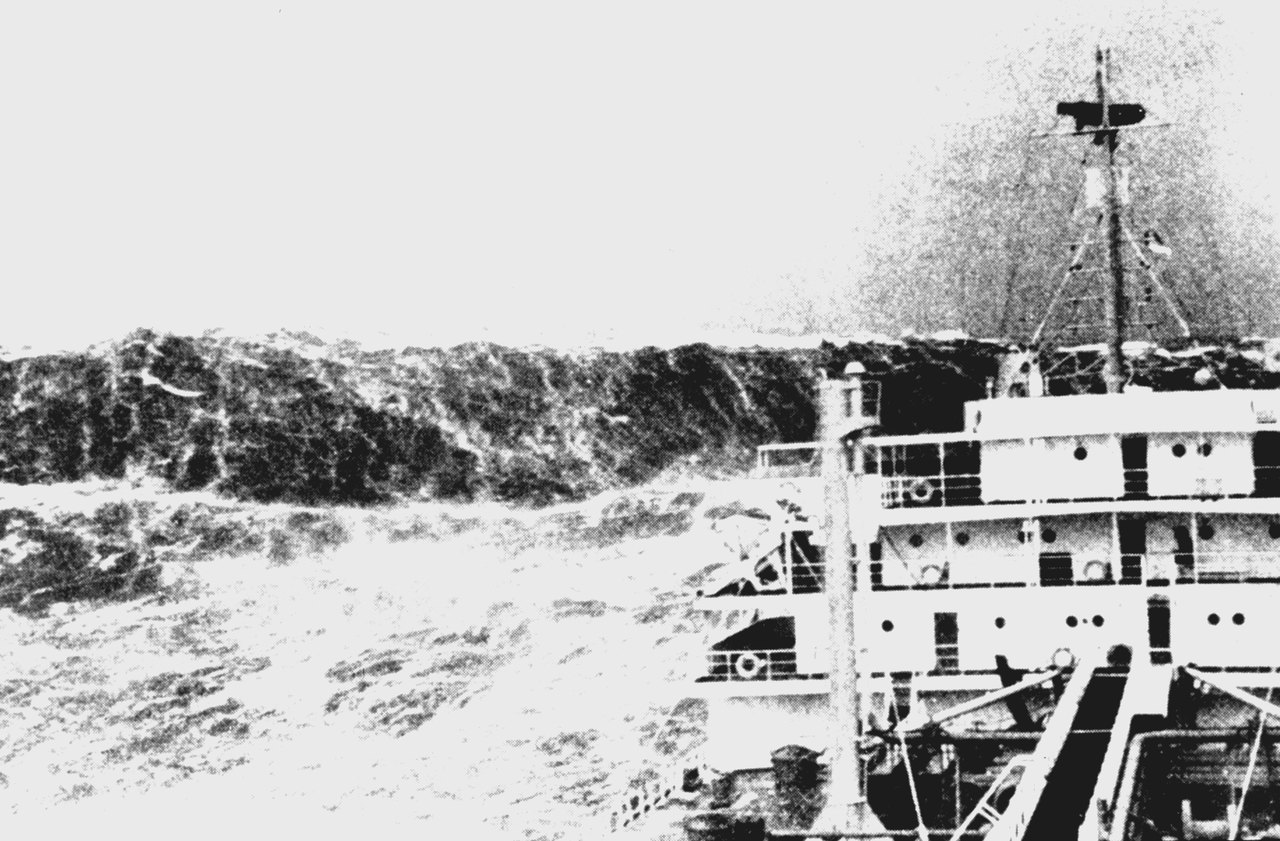
Part 6’s words break over the boat and the heart: a rogue wave and its violent surge cause a knockdown that nearly capsizes the boat — and shakes a buried memory to the surface. The wave that nearly ends the Wanderer is what sailors call a rogue wave — a single wave far taller than the seas around it, appearing almost without warning. For a long time scientists doubted such waves were real, dismissing them as sailors’ tall tales, until instruments and satellites proved they truly happen. A rogue wave can form when several ordinary waves, traveling at slightly different speeds, briefly stack on top of one another, adding their heights together into one towering wall; strong currents flowing against the wind, like the Gulf Stream in a storm, can make them worse.
Visual AidA wall of water arriving
A large wave rearing over a ship, from the United States weather service collection. The Knowledge Bank explains that a rogue wave is a single wave far taller than the seas around it, that sailors who survived them were long disbelieved, and that instruments finally proved them real. Compare the wave with the ship’s own rail. That is how the size of such a wave is judged at sea — against something you already know the height of.
A large wave breaking over a ship; U.S. National Oceanic and Atmospheric Administration photo library. Source: Wikimedia Commons, public domain.
rogueadj.Ch.50
Unexpectedly huge and dangerous
“A rogue wave rose out of the dark.”
surgen.Ch.48
A sudden, powerful rush of water
“A surge slammed across the deck.”
knockdownn.Ch.50
When a wave shoves a boat flat on its side
“The knockdown put the mast in the water.”
capsizev.Ch.49
To turn a boat over
“The wave nearly made the boat capsize.”
salvagev.Ch.54
To save from wreck or loss
“They tried to salvage the soaked gear.”
jumbledadj.Ch.52
Mixed up in confusion
“Below decks lay a jumbled, soaked heap.”
batterv.Ch.51
To strike again and again
“The waves battered the limping boat.”
memoryn.Ch.58
Something remembered from the past
“A hidden memory rose in her mind.”
surfacev.Ch.58
To rise up into view
“The truth began to surface at last.”
confrontv.Ch.60
To face something difficult directly
“Sophie began to confront her past.”
ⓘ The vocabulary words in this list are selected to help you understand and complete this workbook. Some may not appear verbatim in the original novel.
🧠Knowledge Bank question
1According to the Knowledge Bank, what makes a wave a rogue wave?Ch.48
2A ‘rogue’ wave is one that is ___.Ch.50
3To ‘capsize’ a boat is to turn it over.Ch.49
4A ‘knockdown’ is when a wave ___.Ch.50
5Fill in each blank with the correct word.Ch.54
Word choices:salvagejumbledsurgerogue- some words will not be used
Below decks everything lay soaked and .
The crew worked to what they could.
6To ‘surface’ is to ___.Ch.58
7To ‘confront’ a problem is to hide from it.Ch.60
8To ‘batter’ the boat is to ___ it.Ch.51
9Fill in each blank with the correct word.Ch.58
Word choices:memoryconfrontcapsizesurge- some words will not be used
A long-hidden rose in her mind.
At last she began to her past.
10To ‘salvage’ something is to save it from wreck or loss.Ch.54
Part 2
Comprehension
Show you understood what happens in Chapters 48–60.
🧠Knowledge Bank · The Wave and the Truth
Narrative Logic · The Wave and the Truth
The narrative traces the crisis: a giant rogue wave knocks the boat flat in the night; she barely survives and limps on; and the terror shakes Sophie’s buried memory of a little kid and a wave up to the surface. Chapters 48–52: The Wave — a giant rogue wave knocks the Wanderer flat in the night; she barely survives, and the crew is left limping with everything jumbled and soaked. Chapters 53–60: Something Surfaces — the crew repairs and sails on; the near-disaster cracks open Sophie’s buried memory of a little kid and a wave, and she begins asking questions about her past. This is the heart of the storm and the heart of the book. In the black of night, at the peak of the gale, an enormous rogue wave — a wall of water far bigger than the rest — rises out of the dark and smashes the Wanderer, knocking her flat on her side in a terrifying knockdown.
Visual AidWhy she came back up
Diagram for the Knowledge Bank on the knockdown. The three pictures are one event in order, and the teal circle is the ballast at the foot of the keel — the same weight in all three. Card 4 is the point. Notice that nothing here is a rescue: the boat rights herself because the weight that was hanging under her ends up out to one side and high, and falling is the only thing it can do.
How a keel rights a knocked-down boat, as described in the Knowledge Bank. Drawn for Garden Heights Academy.
🧠Knowledge Bank question
1The Knowledge Bank explains that the wave shakes loose ___.Ch.50
2The giant wave knocks the boat ___.Ch.50
3The Wanderer sinks completely and is lost.Ch.51
4After the wave, the crew spends its time ___.Ch.54
5Write the numbers 1–5 in the boxes to show the correct order of events. Number 1 = what happens first.Chapters 48–60
The crew repairs the boat and limps onward.
The boat rights herself and survives, battered.
At the storm’s peak, a giant rogue wave appears in the night.
Sophie’s buried memory begins to surface, and she asks about her past.
The wave knocks the Wanderer flat on her side.
6The near-disaster leaves Sophie exactly as she was before, unchanged.Ch.58
7What begins to surface in Sophie after the wave?Ch.58
8Her memory returns in a ‘push and pull,’ meaning it ___.Ch.58
9By the end of Part 6, Sophie starts asking questions about who she really is.Ch.60
10The deepest change the wave brings is that it ___.Ch.60
Part 3
Literary Elements
Understanding HOW and WHY Sharon Creech tells the story across Chapters 48–60.
🧠Knowledge Bank · The Wave at the Climax
Literary Technique · The Wave at the Climax
Part 6 turns on three tools: the story’s highest point of tension (climax), the wave that stands for buried trauma (symbol), and a sudden life-changing realization (epiphany). After the wave, Sophie moves toward an epiphany — a sudden, life-changing realization. For most of the voyage her past has reached her only sideways, in nightmares and flickers of a ‘little kid.’ Now the terror of nearly drowning shakes the memory loose, and it begins to surface in pieces she can no longer push back down. Notice that Creech does not hand us the whole truth at once; the realization comes in a ‘push and pull,’ advancing and retreating, the way real healing does. Sophie starts asking questions she has never dared ask, about who she is and what happened long ago. The wave does not give Sophie her memory back. It only knocks loose the lid she had been holding down since she was small.
Visual AidOne wave, two meanings
Diagram for the Knowledge Bank on the wave as a symbol. Card 1 is what the wave is on the surface and card 2 is what it is underneath, and card 3 is the thing that makes it a symbol rather than just weather: it is both at once. Notice that the dashed line down the middle is not a wall. The two readings are the same object, which is why the crisis outside the boat is what forces the one inside it.
The wave read two ways at once, as described in the Knowledge Bank. Drawn for Garden Heights Academy.
Climax
The rogue-wave knockdown is the story’s peak of danger — the moment the whole voyage has been building toward.
Symbol
The giant wave stands for Sophie’s buried trauma, so surviving it and facing her past happen at once.
Epiphany
A sudden, life-changing realization — Sophie’s sealed memory breaks loose and she begins to see the truth of her life.
🧠Knowledge Bank question
1According to the Knowledge Bank, an epiphany is ___.Ch.50
2Fill in each blank with the correct literary term.Ch.50
Word choices:climaxsymbolsettingrhyme- some words will not be used
The peak of the story’s tension is the .
The wave that stands for buried trauma is a .
3The climax is the moment of highest tension in a story.Ch.50
4The giant wave mainly stands for Sophie’s ___.Ch.58
5Sophie’s sudden, life-changing realization about her past is an ___.Ch.60
6A symbol can let one image carry both an outer event and an inner truth.Ch.58
7Fill in each blank with the correct literary term.Ch.60
Word choices:epiphanyclimaxnarratorrhyme- some words will not be used
A sudden life-changing realization is an .
The peak of the story’s danger is the .
8Creech places the plot’s climax and Sophie’s inner crisis in the same chapters so that ___.Ch.58
9Sophie’s realization arrives all at once, complete and easy.Ch.58
10An epiphany changes a character because it ___.Ch.60
Part 4
Think Deeper
Four deeper challenges — no single-word recall. Read, weigh the evidence, and reason it out.
🧠Knowledge Bank · Reading the Crisis
Ethical Reasoning · Reading the Crisis
This part brings together a rogue wave, a knockdown in the dark, a memory pushing up, a girl asking who she is. The giant wave is the book’s single most important symbol. On the surface it is a real wall of water that nearly sinks the boat. Underneath, it is the very thing Sophie has spent years burying: a wave, deep water, a loss she was too young and too hurt to face. Creech has been building toward this moment through every earlier mention of water — the boat’s name, the tides, all of Bompie’s falling-into-water stories — so that when the real wave finally strikes, it also strikes Sophie’s locked memory and breaks it open. Outer storm and inner storm become one. This is why the crisis of the plot (surviving the wave) and the crisis of Sophie’s heart (facing her past) happen in the very same chapters.
It comes in the dark, without warning. One moment the Wanderer is fighting the same gray mountains she has fought for days; the next, a wall of water taller than all the rest rears out of the night and falls on her like a collapsing building. The boat is slammed onto her side, mast in the sea, the world upside down, everything below decks torn loose and flung into a soaked and jumbled heap. For a few endless seconds it seems she will not come back — and then her heavy keel swings her upright, streaming water, alive. But something else has broken loose in the dark. Deep in Sophie, a door she bolted years ago has burst open, and up through it rises a little kid, and deep water, and a wave, and a loss she was never able to name. The sea nearly took the boat. Instead, it gave her back the truth.
Original passage written for Garden Heights — not a quotation from the novel.
1Claim: “Part 6 makes the giant wave the crisis of both the voyage and Sophie’s inner life.” — choose the two details that best prove it.Claim & Evidence
2The science of the wave, or The meaning of the wave? Tap each detail to sort it — tap again to switch sides. You can keep tapping to change your answer.Sort into two
◄ The science of the waveThe meaning of the wave ►
3Match each cause to its result. For each cause, pick its result.Cause & Effect
Several waves briefly stack up→
The wave hits the boat side-on→
The near-drowning terrifies Sophie→
The memory pushes and pulls→
🧠Knowledge Bank question
4Fill both blanks to complete the reasoning.Build the Argument
The Knowledge Bank argues that the wave is the book's most important symbol because , which shows that .
Part 5
Standardized Test
Reading passage · Giant Waves at Sea · SAT & TOEFL-style practice
Read the passage — the highlighted words are tested — then answer. Tap an answer, then tap it again to confirm.
SATCentral Ideas — the passage's main point
SATDetail — a fact stated in the passage
SATWords in Context — a word's meaning in this passage
SATText Connections — how two parts of the text relate
TOEFLFactual Information — a fact stated in the passage
TOEFLProse Summary — the three sentences that sum it up
The Danger of a Rogue Wave
The wall of water that nearly ends the Wanderer is what sailors call a rogue wave: a single wave far taller than the seas around it, rising almost without warning. For centuries, sailors who survived such waves were often not believed. Scientists assumed the ocean's waves stayed within a fairly even range, and treated stories of monster waves as exaggeration. Only in recent decades, when instruments on ships, oil platforms and satellites finally measured them, did the world accept that rogue waves are real and more common than anyone had thought.
How can one wave grow so much larger than its neighbors? Ocean waves travel at slightly different speeds, and now and then several of them line up and briefly stack on top of one another, adding their heights into a single towering crest before pulling apart again. A strong current flowing against the wind can squeeze and steepen the seas, making such waves even more dangerous. When a giant wave strikes a small boat from the side, the surge can cause a knockdown, laying the boat flat with its mast in the water, or even capsize it, rolling it completely over. A well-built sailboat is designed to fight back: its heavy keel acts like a pendulum and swings the boat upright again, though surviving also depends on preparation, hatches shut and crew clipped on.
Original passage written for Garden Heights — not a quotation from the novel.
1What is the main idea of the passage?SAT · Central Ideas
2A rogue wave is best described as ___.TOEFL · Factual Information
3For a long time, scientists treated stories of monster waves as ___.SAT · Detail
4One way a rogue wave forms is when several waves ___.TOEFL · Factual Information
5What can make such waves even more dangerous?SAT · Detail
6A ‘knockdown’ lays a boat ___.TOEFL · Factual Information
7What helps a well-built sailboat right itself again?SAT · Detail
8In the passage, surge most nearly means ___.SAT · Words in Context
9Prose Summary (TOEFL).The passage explains what rogue waves are, how they form, and how a boat can survive one. This TOEFL task lists six sentences; choose the THREE that best capture the passage’s main ideas. The other three do not belong — they state minor details or ideas the passage does not present.TOEFL · Prose Summary
10How does this passage connect to Part 6’s events?SAT · Text Connections
Part 6 · Optional
Creative Writing
A bonus challenge to practice your English. Take your time and have fun with it.
About This Section
This writing task is optional and is not part of your auto-graded score. The feedback below checks only the basics — length, spelling, and grammar — not whether your ideas are right or wrong. It is meant for classroom discussion and creative practice, so feel free to use your imagination!
Writing Task — Part 6 “When Something Broke Open”
The great wave shakes loose a memory Sophie had buried for years. Write about a time a strong experience brought back a memory or feeling you had pushed away — or a moment when you finally faced something you had been avoiding. What brought it up, and what did you realize? 6–10 sentences. End with how facing it changed you.
You can start with: “I had pushed it down for a long time, until...”
0 / 40 words minimum
🗣 Teach It · Just for Fun (optional)
No right or wrong — close the screen and tell someone nearby what happened in this part. Can’t find anyone? Tell yourself out loud. The moment you teach it, you truly understand it.
Part 6 Complete!
You finished Chapters 48–60 of The Wanderer.
Here are your auto-graded results:
-
points out of 100
Teach it to someone
The best last step is to teach it. In your own words, explain what happened — retell a favorite scene, teach a character’s big choice, or sum up the main idea for a parent, friend, or classmate. When you can teach it clearly, you truly own it.
Independent study guide by Garden Heights. Not affiliated with or endorsed by Sharon Creech. Contains original analysis only; no text from the novel is reproduced. Reference text: This workbook follows Sharon Creech’s classic text (the standard Puffin edition sold worldwide). Revised 2023 UK editions change some wording and may not match the vocabulary studied here.
SAT® is a registered trademark of College Board, which is not affiliated with, and does not endorse, these materials. TOEFL® is a registered trademark of ETS. These materials are not endorsed or approved by ETS. Garden Heights is an independent provider of test-style reading practice.