New here? Just sign up with Google — your account includes Matilda, our gift book, forever.
The Wanderer · Garden Heights
Part 7
for The Wanderer · Part 7 · Chapters 61–70
8 Parts40 min
What Happens in Part 7
After days when the whole world was nothing but heaving water, a cry goes up on deck: land. The battered Wanderer has made landfall on the coast of Ireland, and the relief that floods the exhausted crew is almost too big to hold — they have crossed the wild Atlantic and lived. They put into a snug haven, tie up, and step onto solid ground that seems to rock and tilt beneath their sea-legs; they crowd into a warm Irish pub, eat real food, and let the terror of the storm drain slowly out of them. The boat, weathered and leaking, is patched and made ready for the last short leg to England. But for Sophie there is no simple rest. The memory the great wave shook loose keeps rising in fragments — the little kid, the deep water, a loss — and she begins, cautiously, to speak of it, and to ask the questions she has avoided her whole life. The crew, her found family, gathers around her with a tenderness that says she is safe now. Reaching land is not the end of Sophie’s voyage; it is where the harder, inward journey toward the truth truly begins.
Falling action, the safe harbor as symbol, and the theme of healing
Cross-Curricular
How the mind buries a painful memory — and slowly heals
Chapter Summary
Ch.
What happens
Chapters 61–65
Land Ho — the crew spots Ireland and makes landfall; flooded with relief, they rest in a safe haven, warm up in an Irish pub, and patch the weathered boat.
Chapters 66–70
The Truth Rising — Sophie’s buried memory surfaces in fragments; she begins to speak of the little kid and the water, and her found family gathers around her.
Part 1
Vocabulary
Study 10 key words from Chapters 61–70, then answer each question.
🧠Knowledge Bank · Words of Landfall and Healing
Lexicology · Words of Landfall and Healing
Part 7’s words bring the crew ashore and turn inward: a joyful landfall and flood of relief in a safe haven, and a long- repressed memory of grief rising in fragments. Why did Sophie forget something as huge as losing her first family? The mind has ways of protecting a person from pain too great to face, especially a very young child. When an experience is overwhelming — what we call trauma — the brain may wall the memory off, pushing it down out of everyday awareness in a process sometimes called repression. The person may truly not remember what happened, yet the buried feeling does not simply vanish; it leaks out sideways in nightmares, sudden fears, or a strange, unexplained pull toward the very thing that is linked to the wound — which is why, for Sophie, everything comes back to water.
Visual AidA buried memory does not sit still
Diagram for the Knowledge Bank on repression. Card 1 is the walled-off memory and cards 2 to 5 are the ways the Knowledge Bank says the hidden feeling leaks out sideways. Card 6 is the condition it finally comes up under. Notice that every arrow is dotted and none of them is chosen. Sophie is not deciding to dream about water; that is what a buried thing does while it waits.
How a buried memory leaks out sideways, as described in the Knowledge Bank. Drawn for Garden Heights Academy.
landfalln.Ch.61
The first sight of land after a sea voyage
“Their landfall on Ireland brought cheers.”
reliefn.Ch.62
The good feeling when trouble ends
“Relief washed over the weary crew.”
havenn.Ch.62
A safe, sheltered place
“The harbor was a welcome haven.”
repressv.Ch.65
To push a feeling or memory down out of mind
“Sophie had learned to repress the memory.”
trauman.Ch.66
A deep emotional wound
“The old trauma had shaped her fears.”
weatheredadj.Ch.63
Worn by storms; having come through hardship
“The weathered boat needed repairs.”
griefn.Ch.66
Deep sorrow, especially after a loss
“A hidden grief lay under her calm.”
fragmentn.Ch.65
A small broken piece
“The memory returned in fragments.”
healv.Ch.66
To become whole or well again
“Telling the story helped her heal.”
gratituden.Ch.64
The feeling of being thankful
“The crew felt deep gratitude to be alive.”
ⓘ The vocabulary words in this list are selected to help you understand and complete this workbook. Some may not appear verbatim in the original novel.
🧠Knowledge Bank question
1According to the Knowledge Bank, why can a very young child bury a memory most easily?Ch.61
2Deep sorrow, especially after a loss, is ___.Ch.66
3A ‘haven’ is a dangerous, exposed place.Ch.62
4To ‘repress’ a memory is to ___.Ch.65
5Fill in each blank with the correct word.Ch.62
Word choices:reliefhaventraumalandfall- some words will not be used
Reaching port, the crew felt a flood of .
The snug harbor was a welcome .
6A ‘trauma’ is a deep ___ wound.Ch.66
7To ‘heal’ is to become whole or well again.Ch.66
8A ‘fragment’ is a small ___.Ch.65
9Fill in each blank with the correct word.Ch.66
Word choices:repressgratitudeweatheredfragment- some words will not be used
For years she had tried to the pain.
The crew felt deep to be alive.
10‘Weathered’ can describe something worn by storms.Ch.63
Part 2
Comprehension
Show you understood what happens in Chapters 61–70.
🧠Knowledge Bank · Safe Ashore, Facing the Past
Narrative Logic · Safe Ashore, Facing the Past
The narrative traces the turn toward home: the joyful landfall in Ireland, the relief and rest in a safe harbor, the patched boat, and Sophie’s buried memory surfacing as her found family draws close. Chapters 61–65: Land Ho — the crew spots Ireland and makes landfall; flooded with relief, they rest in a safe haven, warm up in an Irish pub, and patch the weathered boat. Chapters 66–70: The Truth Rising — Sophie’s buried memory surfaces in fragments; she begins to speak of the little kid and the water, and her found family gathers around her. After days when the whole world was nothing but heaving water, a cry goes up on deck: land. The battered Wanderer has made landfall on the coast of Ireland, and the relief that floods the exhausted crew is almost too big to hold — they have crossed the wild Atlantic and lived.
Visual AidWhat a harbor is for
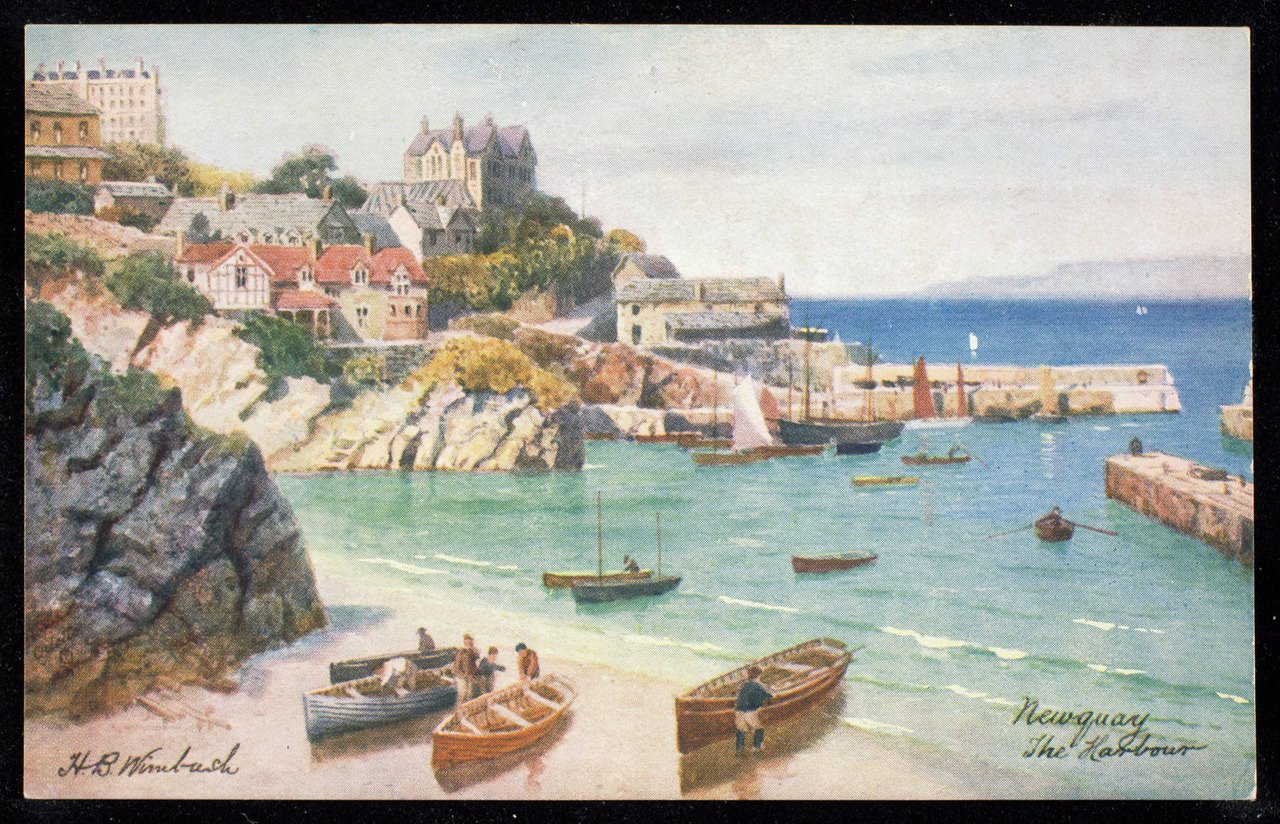
A painted view of a small harbor, its stone arm curving out to hold the water still. The Knowledge Bank explains that reaching a sheltered harbor after the storm is a real event and also a symbol: all voyage long the open sea has meant danger and exhaustion, and the quiet haven means safety, warmth and rest. Look at what the wall is doing. It does not stop the sea; it only breaks it, which is all anyone needs to sleep.
A small Cornish harbor at Newquay; painted view, National Library of Wales collection. Source: Wikimedia Commons, public domain.
🧠Knowledge Bank question
1The Knowledge Bank explains that Sophie's memory surfaces once she is ___.Ch.61
2The first land they reach is the coast of ___.Ch.61
3The crew feels no relief at all when they reach land.Ch.62
4On solid ground, the crew warms up and celebrates in ___.Ch.62
5Write the numbers 1–5 in the boxes to show the correct order of events. Number 1 = what happens first.Chapters 61–70
They make landfall and tie up in a safe harbor.
Sophie’s buried memory surfaces and she begins to speak of it.
They rest and warm up in an Irish pub.
The weathered boat is patched for the last leg.
The crew spots the coast of Ireland and cheers.
6Reaching land instantly solves all of Sophie’s inner struggles.Ch.66
7Sophie’s memory returns to her ___.Ch.65
8As her memory surfaces, Sophie begins to ___.Ch.66
9When Sophie’s pain breaks open, the crew turns away from her.Ch.66
10For Sophie, reaching land is best described as ___.Ch.70
Part 3
Literary Elements
Understanding HOW and WHY Sharon Creech tells the story across Chapters 61–70.
🧠Knowledge Bank · After the Crisis
Literary Technique · After the Crisis
Part 7 works with three tools: the easing tension after the crisis (falling action), the safe harbor that pictures safety (symbol), and the book’s deepest idea coming clear (theme). The episode emphasizes the crew gather around Sophie as her memory surfaces — this is the book’s great theme of found family coming into full light. Sophie lost her first family to the water; she is an orphan who was chosen, adopted into this loud, imperfect, seagoing clan. Through the whole voyage they have tested and teased and worried over her, and now, when her oldest pain breaks open, they do not turn away — they draw close. The theme is quietly radical: family is not only who you are born to but who stays, who chooses you, who holds on. Notice that nobody aboard asks her to explain herself first. They close in around her, and that order — comfort before questions — is the book’s real argument.
Falling action
After the climactic wave, the tension eases — landfall, rest, and repair — as the story moves toward its resolution.
Symbol
The safe harbor after the storm mirrors the inner safety Sophie needs before she can face her past.
Theme
Found family: an orphan who was chosen, held close by the very people who sailed an ocean with her.
🧠Knowledge Bank question
1According to the Knowledge Bank, what does the safe harbor stand for?Ch.62
2Fill in each blank with the correct literary term.Ch.62
Word choices:falling actionsymbolsettingrhyme- some words will not be used
The easing of tension after the climax is .
The safe harbor that pictures safety is a .
3Falling action comes after the climax of a story.Ch.62
4The sheltered harbor mainly stands for the ___ Sophie needs to face her past.Ch.66
5The book’s deepest idea, shining out as the crew gathers around Sophie, is ___.Ch.66
6A theme is the deeper idea or message a story explores.Ch.66
7Fill in each blank with the correct literary term.Ch.66
Word choices:themefalling actionnarratorrhyme- some words will not be used
The idea of found family is a .
The easing tension after the wave is .
8Creech has Sophie face her past in the harbor because ___.Ch.66
9The outer geography (storm, then harbor) mirrors Sophie’s inner journey (crisis, then healing).Ch.66
10The found-family theme is ‘quietly radical’ because it says family is ___.Ch.66
Part 4
Think Deeper
Four deeper challenges — no single-word recall. Read, weigh the evidence, and reason it out.
🧠Knowledge Bank · Reading the Landfall
Ethical Reasoning · Reading the Landfall
This part brings together a cry of ‘land,’ a safe harbor, a memory rising in pieces, a family drawing close. Reaching a sheltered harbor after the storm is a real event — and also a symbol. All voyage long, the open sea has meant danger, exhaustion, and, for Sophie, buried terror; the quiet haven means safety, warmth, and rest. Creech places Sophie’s first real facing of her past right here, in the harbor, on purpose. A person can only look at a deep wound when they feel safe enough to do it, and the sheltered port becomes an outward picture of the inner safety Sophie has found among her family. The narrative reveals how the book’s outer geography keeps mirroring its inner one: storm and crisis together, harbor and healing together.
After days when the sky and the sea were the same churning gray, someone shouts and points, and there it is: a low green line on the horizon that is not a wave and does not move. Land. Ireland. The battered Wanderer limps into a quiet harbor, and the crew steps onto ground that seems to sway beneath their sea-legs, half-laughing, half-crying, alive. In a warm pub that night the storm slowly loosens its grip on them. But a thirteen-year-old girl sits a little apart, because the same wave that spared the boat has opened something in her, and the pieces keep coming — a little kid, dark water, a grief with no words. And around her, quietly, the family that chose her draws in close, and does not look away. She has reached the land. Now she has to reach the truth.
Original passage written for Garden Heights — not a quotation from the novel.
1Claim: “Part 7 shows that reaching safe land lets Sophie finally begin to face her buried past.” — choose the two details that best prove it.Claim & Evidence
2How the mind handles trauma, or Sophie’s healing in Part 7? Tap each detail to sort it — tap again to switch sides. You can keep tapping to change your answer.Sort into two
◄ How the mind handles traumaSophie’s healing in Part 7 ►
3Match each cause to its result. For each cause, pick its result.Cause & Effect
The storm finally ends→
They reach a sheltered harbor→
The buried memory surfaces→
The family gathers around her→
🧠Knowledge Bank question
4Fill both blanks to complete the reasoning.Build the Argument
The Knowledge Bank argues that telling the story aloud helps because , which shows that .
Part 5
Standardized Test
Reading passage · How the Mind Buries and Heals · SAT & TOEFL-style practice
Read the passage — the highlighted words are tested — then answer. Tap an answer, then tap it again to confirm.
SATCentral Ideas — the passage's main point
SATDetail — a fact stated in the passage
SATWords in Context — a word's meaning in this passage
SATText Connections — how two parts of the text relate
TOEFLFactual Information — a fact stated in the passage
How the Mind Buries Trauma
How could Sophie forget something as enormous as the loss of her first family? The answer lies in one of the mind's oldest forms of self-protection. When an experience is too painful to face, what psychologists call trauma, the brain can wall the memory off and push it down below everyday awareness. This is sometimes called repression. It happens most easily to a very young child, whose mind simply cannot hold so much hurt, and it can be a kind of mercy: it lets the person keep living when the whole truth would be unbearable.
But a buried memory does not truly disappear; the hidden feeling leaks out sideways, in nightmares, in sudden unexplained fears, and in a strange pull toward whatever is tied to the wound. For Sophie, that link is water: it draws her and frightens her at once. Researchers find that such memories often rise to the surface only when a person feels safe, or when a powerful event shakes them loose, and surviving a real wave does both. Healing then comes slowly, in fragments, advancing and retreating, and the grief she never got to feel as a small child arrives years late. One of the most powerful tools for it is simply telling the story: putting words to the wordless.
Original passage written for Garden Heights — not a quotation from the novel.
1What is the main idea of the passage?SAT · Central Ideas
2The passage says the brain may wall off a memory that is ___.TOEFL · Factual Information
3Burying a memory happens most easily to ___.SAT · Detail
4According to the passage, a buried memory ___.TOEFL · Factual Information
5How does buried pain often show itself?SAT · Detail
6Buried memories tend to surface when a person ___.TOEFL · Factual Information
7The passage says healing usually comes ___.SAT · Detail
8One of the most powerful tools for healing is ___.TOEFL · Factual Information
9In the passage, grief most nearly means ___.SAT · Words in Context
10How does this science connect to Sophie’s story?SAT · Text Connections
Part 6 · Optional
Creative Writing
A bonus challenge to practice your English. Take your time and have fun with it.
About This Section
This writing task is optional and is not part of your auto-graded score. The feedback below checks only the basics — length, spelling, and grammar — not whether your ideas are right or wrong. It is meant for classroom discussion and creative practice, so feel free to use your imagination!
Writing Task — Part 7 “Solid Ground”
After the storm, reaching safe land lets the crew finally rest and feel. Write about a time you reached ‘solid ground’ after something hard — the moment a stressful stretch finally ended and you could breathe again. Where were you, who was with you, and how did it feel to be safe? 6–10 sentences. End with what you were most grateful for.
You can start with: “When it was finally over and I was safe, I...”
0 / 40 words minimum
🗣 Teach It · Just for Fun (optional)
No right or wrong — tell someone nearby what happened in this part. Can’t find anyone? Tell yourself out loud. The moment you teach it, you truly understand it.
Part 7 Complete!
You finished Chapters 61–70 of The Wanderer.
Here are your auto-graded results:
-
points out of 100
Teach it to someone
The best last step is to teach it. In your own words, explain what happened — retell a favorite scene, teach a character’s big choice, or sum up the main idea for a parent, friend, or classmate. When you can teach it clearly, you truly own it.
Independent study guide by Garden Heights. Not affiliated with or endorsed by Sharon Creech. Contains original analysis only; no text from the novel is reproduced. Reference text: This workbook follows Sharon Creech’s classic text (the standard Puffin edition sold worldwide). Revised 2023 UK editions change some wording and may not match the vocabulary studied here.
SAT® is a registered trademark of College Board, which is not affiliated with, and does not endorse, these materials. TOEFL® is a registered trademark of ETS. These materials are not endorsed or approved by ETS. Garden Heights is an independent provider of test-style reading practice.